
Thermal aging is a critical stabilization step in sensor manufacturing. An aging station or constant temperature oven subjects the Ni-doped LaFeO3 sensor to 150°C for a duration of 24 hours. This specific thermal treatment is mandatory to remove manufacturing byproducts and structurally bond the sensing material to the substrate, ensuring the device functions reliably.
The aging process transforms a raw coated sensor into a reliable device by eliminating production artifacts and chemically stabilizing the surface. Without this 24-hour thermal treatment, the sensor would suffer from poor adhesion and significant performance drift.
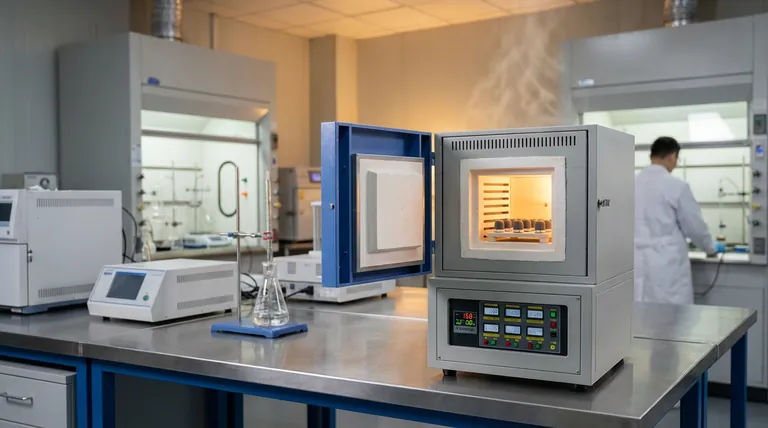
The Physical Transformation
To understand why this step cannot be skipped, one must look at the physical changes occurring within the sensor structure during the heating cycle.
Eliminating Residual Solvents
The Ni-doped LaFeO3 is initially applied as a paste. This paste contains solvents to create the necessary viscosity for coating.
The aging station drives off these residual solvents. Removing these volatiles prevents them from outgassing later, which would otherwise interfere with the sensor's baseline readings and accuracy.
Enhancing Structural Adhesion
The sensitive layer must adhere effectively to the underlying ceramic tube substrate.
Heat treatment at 150°C significantly enhances this adhesion. This ensures the sensing layer does not crack, peel, or delaminate during the rapid heating and cooling cycles the sensor will experience during actual operation.
The Chemical Stabilization
Beyond the physical structure, the aging station addresses the chemical state of the sensing material.
Achieving Chemical Equilibrium
Freshly coated materials often exist in a chemically active or unstable state.
The 24-hour thermal exposure allows the material surface to reach a state of chemical equilibrium. This settles the surface energy and structure into a consistent state before the sensor is ever deployed.
Improving Repeatability
If a sensor is not chemically equilibrated, its readings will drift as the material slowly stabilizes on its own during use.
By pre-stabilizing the sensor in the oven, you significantly improve long-term stability. This ensures the sensor offers high repeatability, giving the same reading for the same gas concentration over time.
Understanding the Trade-offs
While the aging process is essential for quality, it introduces specific constraints to the manufacturing workflow.
Production Bottlenecks
The most obvious trade-off is manufacturing throughput. Adding a 24-hour holding period to the production line creates a significant bottleneck, preventing "just-in-time" delivery of the components.
Energy and Resource Costs
Running constant temperature ovens at 150°C requires continuous energy input. This increases the unit cost of each sensor compared to technologies that might require shorter or lower-temperature curing processes.
Making the Right Choice for Your Goal
When planning your sensor fabrication process, you must view the aging station as an investment in quality rather than a simple drying step.
- If your primary focus is mechanical durability: Ensure the full 24-hour cycle is completed to maximize the bond strength between the sensitive layer and the ceramic tube.
- If your primary focus is measurement precision: Prioritize the strict temperature control of the oven to ensure the material reaches true chemical equilibrium for consistent repeatability.
The aging station is the fundamental bridge between a raw chemical paste and a precision measurement instrument.
Summary Table:
| Process Aspect | Purpose & Impact | Resulting Benefit |
|---|---|---|
| Thermal Treatment | 24h at 150°C in constant temperature oven | Removal of manufacturing byproducts |
| Solvent Removal | Eliminates residual volatiles from paste | Prevents outgassing and baseline drift |
| Adhesion Enhancement | Bonds sensing layer to ceramic substrate | Prevents cracking, peeling, or delamination |
| Chemical Equilibrium | Stabilizes surface energy and structure | Long-term repeatability and zero drift |
Elevate Your Sensor Manufacturing with KINTEK Precision
Don't let production bottlenecks compromise your sensor accuracy. KINTEK provides high-performance constant temperature ovens and muffle furnaces designed for rigorous 24-hour thermal aging cycles.
Backed by expert R&D and manufacturing, KINTEK offers Muffle, Tube, Rotary, Vacuum, and CVD systems—all customizable to meet the specific 150°C stabilization requirements of your Ni-doped LaFeO3 sensors. Ensure superior adhesion and chemical equilibrium for your lab or industrial production today.
Contact KINTEK for a Custom Solution
References
- Fanli Meng, Zhenyu Yuan. Study of the Gas Sensing Performance of Ni-Doped Perovskite-Structured LaFeO3 Nanospheres. DOI: 10.3390/chemosensors12040065
This article is also based on technical information from Kintek Furnace Knowledge Base .
Related Products
- 1700℃ High Temperature Muffle Oven Furnace for Laboratory
- 1800℃ High Temperature Muffle Oven Furnace for Laboratory
- 1200℃ Muffle Oven Furnace for Laboratory
- 1400℃ Muffle Oven Furnace for Laboratory
- 1200℃ Split Tube Furnace Laboratory Quartz Tube Furnace with Quartz Tube
People Also Ask
- What is the primary function of a high-temperature laboratory muffle furnace in chemical synthesis? Achieve Precision.
- How does a high-temperature laboratory muffle furnace affect material properties? Transform Anodic Oxide Films Fast
- What role does a muffle furnace play in BCZY712 electrolyte powder production? Achieve Perfect Phase Purity
- How does the two-stage sintering process contribute to the synthesis of MeCuFeO3 perovskite? Optimize crystal purity.
- What role does a muffle furnace play in sintering photocathodes? Enhance Electrode Conductivity & Catalytic Activity






