
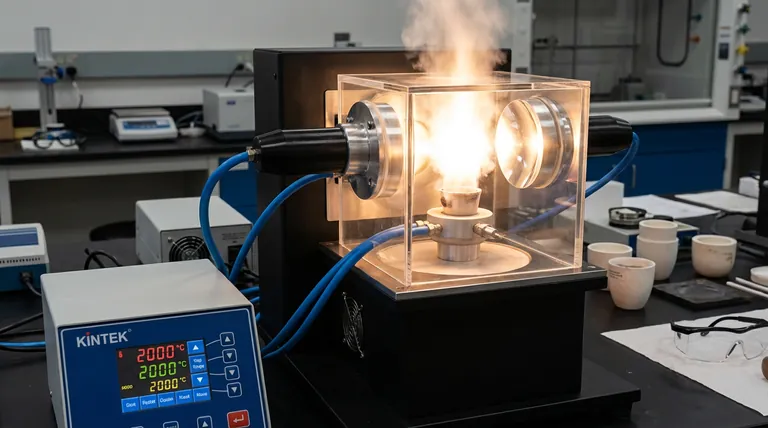
An arc-imaging furnace functions as a specialized high-energy thermal source primarily used for the rapid discovery of specific material phases. In the context of NaMgPO4:Eu phosphors, its role is to subject reactants to immediate, extreme thermal shock, raising temperatures to 2000 °C almost instantaneously to facilitate unique synthesis conditions.
The arc-imaging furnace is a tool for material discovery rather than high-purity production. By combining ultra-high temperatures with rapid cooling, it successfully isolates the olivine phase of NaMgPO4, though this aggressive process inherently results in samples containing multiple impurities.
The Mechanics of High-Energy Synthesis
Reaching Extreme Temperatures
The primary advantage of the arc-imaging furnace is its ability to generate extremely high instantaneous energy.
Unlike conventional furnaces that ramp up heat slowly, this apparatus allows the reactants to reach ultra-high temperatures of roughly 2000 °C in a very short timeframe.
The Melt-Quench Process
The synthesis process is not solely defined by the heating phase but also by how that heat is removed.
Following the rapid heating, the material undergoes a water-cooling rapid quenching process. This sudden drop in temperature is essential for "freezing" specific crystal structures that might destabilize during slow cooling.
Enabling Phase Discovery
Isolating the Olivine Phase
The extreme conditions created by the arc-imaging furnace are critical for the discovery of the olivine phase of NaMgPO4.
Standard synthesis methods may not provide the necessary thermodynamic conditions to form this specific crystal structure.
Handling Silicate-Deficiency
This high-energy method is particularly robust when dealing with non-standard compositions.
Specifically, it allows for the synthesis of the olivine phase even when the material is in a silicate-deficient state, expanding the range of potential phosphor compositions researchers can explore.
Understanding the Trade-offs
The Challenge of Impurity Phases
While the arc-imaging furnace is excellent for discovering new phases, it lacks the precision required for high-purity synthesis.
Samples produced via this method typically contain multiple impurity phases. The aggressive nature of the heating and quenching prevents the equilibrium required to form a single, pure phase, making this tool better suited for initial exploration than final product manufacturing.
Making the Right Choice for Your Research
If you are evaluating synthesis methods for NaMgPO4:Eu phosphors, consider your specific end goal:
- If your primary focus is phase discovery: Use the arc-imaging furnace to access high-temperature phases like the olivine structure that are difficult to achieve with standard heating.
- If your primary focus is compositional purity: Be aware that this method will likely require post-processing or alternative synthesis routes to eliminate the secondary impurity phases generated during rapid quenching.
Use the arc-imaging furnace to unlock the material's existence, but anticipate the need for refinement to achieve a pure phosphor.
Summary Table:
| Feature | Arc-Imaging Furnace Role | Impact on NaMgPO4:Eu |
|---|---|---|
| Temperature | Instantaneous reach to ~2000 °C | Facilitates unique high-energy synthesis conditions |
| Cooling | Water-cooled rapid quenching | "Freezes" the specific olivine crystal structure |
| Phase Isolation | High-energy thermal shock | Enables discovery of silicate-deficient phases |
| Purity Level | Low (Multiple impurity phases) | Best suited for exploration rather than mass production |
Elevate Your Material Discovery with KINTEK
Transition from initial phase discovery to high-purity production with precision equipment tailored for advanced materials research. Backed by expert R&D and manufacturing, KINTEK offers a comprehensive range of Muffle, Tube, Rotary, Vacuum, and CVD systems, as well as other lab high-temp furnaces—all fully customizable to meet your unique phosphor synthesis requirements.
Ready to achieve the perfect balance of temperature control and material purity? Contact our technical experts today to find the ideal thermal solution for your laboratory.
References
- Jianwei Qiao, Lei Wang. Compositional engineering of phase-stable and highly efficient deep-red emitting phosphor for advanced plant lighting systems. DOI: 10.1038/s41377-024-01679-9
This article is also based on technical information from Kintek Furnace Knowledge Base .
Related Products
- High Pressure Laboratory Vacuum Tube Furnace
- Multi Zone Laboratory Quartz Tube Furnace Tubular Furnace
- High Temperature Muffle Oven Furnace for Laboratory Debinding and Pre Sintering
- 1200℃ Controlled Inert Nitrogen Atmosphere Furnace
- Small Vacuum Heat Treat and Tungsten Wire Sintering Furnace
People Also Ask
- What role does a high vacuum tube furnace play in Co-Al sintering? Master High-Purity Porous Material Synthesis
- What are the different types of tube furnaces available? Find the Perfect Fit for Your Lab's Needs
- What are the main advantages of vacuum tube furnaces in the market? Achieve Purity and Precision in Material Processing
- What is the role of a vacuum tube furnace during the final thermal treatment stage of Fe3O4@CSAC catalysts?
- What conditions do tube furnaces provide for Au-Seeded TiO2 nanowires? Master Precision Thermal Synthesis



















