
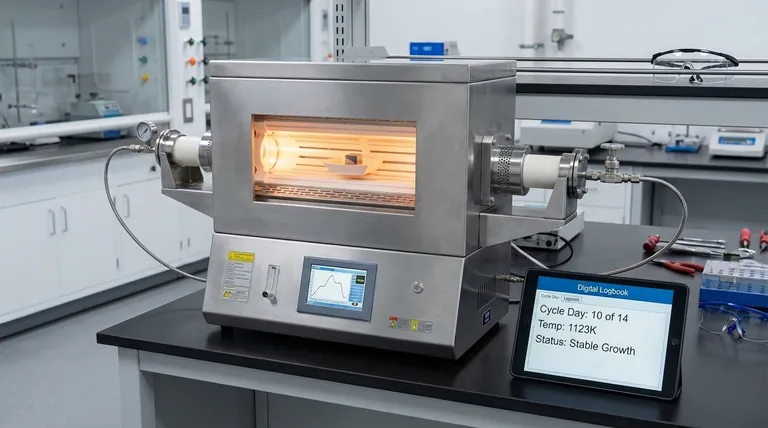
Temperature control precision is the defining variable regarding the structural integrity of cubic boron arsenide (c-BAs) crystals during their extended growth cycles. Because the formation of c-BAs relies on a gradual process of diffusion and deposition, any deviation in furnace temperature disrupts the equilibrium, leading directly to dislocations and compositional inhomogeneity within the crystal lattice.
The successful growth of c-BAs is less about reaching a peak temperature and more about maintaining unwavering stability over time. Precision prevents the lattice defects that occur when the delicate balance between diffusion and deposition is disturbed.
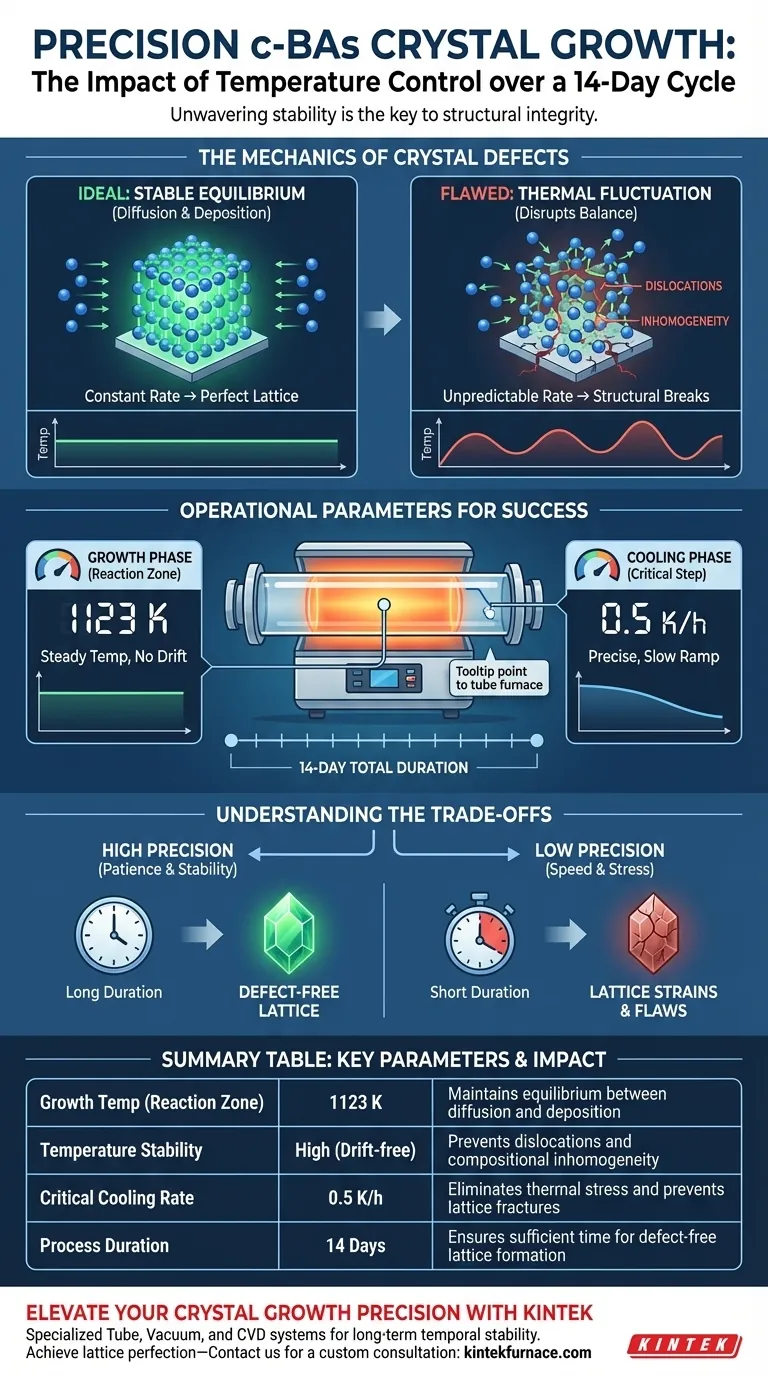
The Mechanics of Crystal Defects
The Role of Diffusion and Deposition
The growth of cubic boron arsenide is not instantaneous; it is a cumulative process driven by diffusion and deposition.
For the crystal lattice to form correctly, these physical processes must occur at a constant, predictable rate.
Consequences of Thermal Fluctuation
If the temperature fluctuates, the rate of deposition changes unpredictably.
This instability prevents the atoms from settling into their ideal positions, resulting in dislocations (structural breaks) or compositional inhomogeneity (uneven distribution of elements).
Operational Parameters for Success
Maintaining the Reaction Zone
To ensure uniformity, the furnace must maintain a constant reaction zone temperature throughout the growth phase.
Primary success has been observed at a steady temperature of 1123 K. Holding this temperature without drift is essential for the long-term stability of the crystal structure.
The Importance of Cooling Rates
The growth cycle concludes with a critical cooling phase that determines the final lattice perfection.
A precise, slow cooling rate of 0.5 K/h is required. This gradual reduction allows the crystal structure to settle without inducing thermal stress or fractures.
Understanding the Trade-offs
Time vs. Structural Integrity
Achieving a defect-free lattice requires patience; the 0.5 K/h cooling rate significantly extends the total process time.
Attempting to accelerate this cycle to save time will almost invariably result in a lower-quality crystal with significant lattice strains.
Equipment Stability vs. Duration
Maintaining precision over a two-week cycle places immense stress on standard heating elements and controllers.
Standard furnaces may drift over long periods; therefore, equipment capable of long-term temporal stability is a non-negotiable requirement for this specific material.
Optimizing Your Growth Strategy
To ensure high-quality c-BAs growth, align your equipment capabilities with these specific thermal requirements:
- If your primary focus is Lattice Perfection: Prioritize a controller capable of executing the 0.5 K/h cooling ramp without stepping or overshooting.
- If your primary focus is Compositional Uniformity: Ensure your furnace can hold the reaction zone at exactly 1123 K for the full duration of the diffusion phase without fluctuation.
Precision in temperature control is not merely a feature of the furnace; it is the architect of the crystal's quality.
Summary Table:
| Parameter | Ideal Value | Impact on c-BAs Growth |
|---|---|---|
| Growth Temp (Reaction Zone) | 1123 K | Maintains equilibrium between diffusion and deposition |
| Temperature Stability | High (Drift-free) | Prevents dislocations and compositional inhomogeneity |
| Critical Cooling Rate | 0.5 K/h | Eliminates thermal stress and prevents lattice fractures |
| Process Duration | 14 Days (2 Weeks) | Ensures sufficient time for defect-free lattice formation |
Elevate Your Crystal Growth Precision with KINTEK
Success in synthesizing cubic boron arsenide demands unwavering thermal stability that standard lab equipment simply cannot provide. Backed by expert R&D and manufacturing, KINTEK offers specialized Tube, Vacuum, and CVD systems designed for long-term temporal stability and ultra-precise ramp control.
Whether you need a horizontal tube furnace capable of maintaining 1123 K for weeks or a controller that masters 0.5 K/h cooling rates without stepping, our customizable high-temperature solutions are engineered for your most sensitive research.
Achieve lattice perfection—Contact KINTEK today for a custom consultation!
Visual Guide
References
- Jae‐Hoon Kim, Joon Sang Kang. Isotope‐Enriched Cubic Boron Arsenide with Ultrahigh Thermal Conductivity. DOI: 10.1002/advs.202502544
This article is also based on technical information from Kintek Furnace Knowledge Base .
Related Products
- Vertical Laboratory Quartz Tube Furnace Tubular Furnace
- Vacuum Sealed Continuous Working Rotary Tube Furnace Rotating Tube Furnace
- Split Multi Heating Zone Rotary Tube Furnace Rotating Tube Furnace
- High Pressure Laboratory Vacuum Tube Furnace
- Multi Zone Laboratory Quartz Tube Furnace Tubular Furnace
People Also Ask
- What are the key differences between single-zone and multi-zone vertical tube furnaces? Choose the Right Furnace for Your Lab
- How do heat treatment processes influence the configuration of a vertical tube furnace? Optimize for Quenching, Annealing, and More
- Why is a vertical tube furnace preferred for quenching tests? Achieve Rapid, Repeatable Cooling for Accurate Results
- What physical conditions does a vertical tube furnace provide for desulfurization experiments? Precision Heat Control
- How does a vertical single-temperature zone tube furnace facilitate the growth of high-quality PdSe2 single crystals?



















