
A flowing 5% H2/Ar gas mixture functions as a dual-purpose "reductive protective atmosphere" essential for high-quality synthesis. During the thermal reduction process, the hydrogen component actively converts metal ions into zero-valent atoms to enable alloying, while the argon serves as an inert shield that excludes oxygen and flushes away impurities.
The synergy of this mixture ensures that metal precursors are fully reduced to their metallic state without suffering from oxidation, guaranteeing the structural integrity and phase purity of the final intermetallic compound.
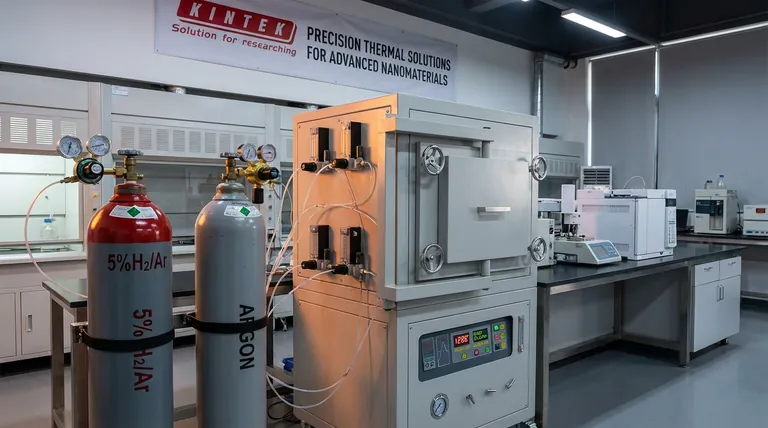
The Role of Hydrogen: Chemical Transformation
Reducing Metal Ions
The primary function of the hydrogen (H2) component is to act as the active reducing agent.
It targets the metal ions loaded onto the carbon support, chemically converting them from a positive oxidation state into zero-valent metal atoms.
Facilitating Alloying
This reduction to a zero-valent state is the prerequisite for the formation of intermetallic compounds.
By stripping the metal ions of their charge, hydrogen enables the atoms to interact freely and facilitate the alloying process necessary to form the desired nanoparticle structure.
The Role of Argon: Physical Protection and Purification
Acting as an Inert Carrier
Argon serves as the bulk carrier gas for the system.
Because it is chemically inert, it provides a stable environment that transports the hydrogen to the reaction site without participating in the reaction itself.
Excluding Oxygen
At high temperatures, nanoparticles are highly susceptible to rapid degradation via oxidation.
The flowing argon acts as a barrier that excludes oxygen from the furnace system, preventing the catalyst from oxidizing during the vulnerable annealing phase.
Removing Reaction Byproducts
The "flowing" nature of the gas mixture is critical for maintaining a clean reaction environment.
Argon sweeps away reaction byproducts generated during the reduction process, ensuring that the final intermetallic compound phase remains pure and uncontaminated.
Understanding the Operational Balance
Why One Component Is Not Enough
Using either gas in isolation would result in process failure.
If used alone, Argon provides protection but lacks the chemical ability to reduce the metal ions, leaving the precursor unreacted.
Conversely, without the Argon carrier to displace air and flush byproducts, the system would struggle to maintain the strict phase purity required for intermetallic compounds.
The Critical "Reductive Protective" Environment
The specific combination creates a "reductive protective atmosphere."
This environment allows the aggressive chemistry of reduction to occur simultaneously with the protective measures required to preserve the material's integrity.
Making the Right Choice for Your Goal
To optimize your thermal reduction process, keep these functional priorities in mind:
- If your primary focus is complete metallization: Ensure the hydrogen flow is sufficient to fully reduce all loaded metal ions to a zero-valent state.
- If your primary focus is phase purity: Rely on the flowing argon component to rigorously exclude oxygen and continuously remove reaction byproducts.
Success in thermal reduction relies on maintaining this precise balance between active reduction and inert protection.
Summary Table:
| Component | Primary Function | Role in Thermal Reduction |
|---|---|---|
| Hydrogen (H2) | Active Reducer | Converts metal ions to zero-valent atoms; enables alloying. |
| Argon (Ar) | Inert Carrier | Excludes oxygen and prevents oxidation at high temperatures. |
| Flow Action | Purification | Sweeps away reaction byproducts to ensure phase purity. |
| Synergy | Balanced Environment | Provides the 'reductive protective' atmosphere for pure synthesis. |
Precision Heat Treatment for Advanced Nanomaterials
Achieving the perfect 'reductive protective' atmosphere requires hardware that delivers absolute control. KINTEK provides industry-leading Muffle, Tube, Rotary, Vacuum, and CVD systems designed to handle complex gas mixtures like 5% H2/Ar with unmatched stability.
Backed by expert R&D and manufacturing, our lab high-temp furnaces are fully customizable to meet your unique nanoparticle synthesis and alloying needs. Ensure phase purity and structural integrity in every batch with our precision thermal solutions.
Ready to optimize your synthesis process? Contact KINTEK today for a custom consultation!
References
- Peng Yin, Hai‐Wei Liang. Machine-learning-accelerated design of high-performance platinum intermetallic nanoparticle fuel cell catalysts. DOI: 10.1038/s41467-023-44674-1
This article is also based on technical information from Kintek Furnace Knowledge Base .
Related Products
- Laboratory Quartz Tube Furnace RTP Heating Tubular Furnace
- 1400℃ Muffle Oven Furnace for Laboratory
- Custom Made Versatile CVD Tube Furnace Chemical Vapor Deposition CVD Equipment Machine
- Spark Plasma Sintering SPS Furnace
- Multi Heating Zones CVD Tube Furnace Machine for Chemical Vapor Deposition Equipment
People Also Ask
- What physical conditions does a laboratory Tube Furnace provide for SOEC? Precision Heat for Solid Oxide Characterization
- What are the main features and functions of a laboratory tube furnace? Unlock Precise High-Temp Control for Your Lab
- Why is control of heating rate and gas flow in a lab tube furnace critical for EM wave absorption materials?
- What conditions do tube furnaces provide for Au-Seeded TiO2 nanowires? Master Precision Thermal Synthesis
- What role does a laboratory tube furnace play in geological and mineralogical research? Unlock Earth's Secrets with Precision



















