
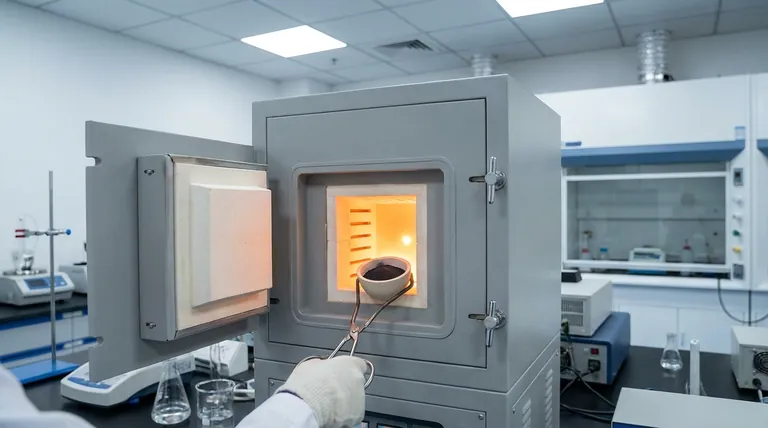
High-temperature furnace systems provide the precise thermal control necessary to fundamentally alter the atomic structure of manganese dioxide (delta-MnO2). By strictly regulating annealing conditions, these systems facilitate the creation of specific oxygen vacancies within the material. These vacancies are the critical mechanism for enhancing the material's electrical conductivity and reaction kinetics, which directly translates to improved battery performance.
Precise thermal processing is not merely a heating step; it is a tool for atomic-level engineering. By introducing oxygen vacancies through controlled annealing, you transform delta-MnO2 from a standard compound into a high-performance cathode capable of the conductivity and stability required for modern aqueous zinc-ion batteries.
The Role of Precision Thermal Processing
The development of advanced battery materials requires moving beyond simple synthesis to structural manipulation. High-temperature furnaces are the primary instrument for achieving this modification reliably.
Manipulating Atomic Structure
The core function of the furnace is to provide an environment where the atomic arrangement of delta-MnO2 can be fine-tuned. This is not a passive drying process, but an active restructuring of the crystal lattice.
Creating Oxygen Vacancies
Through accurate control of the annealing atmosphere and temperature, the system induces the removal of specific oxygen atoms. This creates "oxygen vacancies," or deliberate defects, within the material's structure. These vacancies are not errors; they are the essential features that unlock superior electrochemical properties.
Enhancing Electrochemical Performance
The introduction of oxygen vacancies solves several inherent limitations of raw manganese dioxide.
Boosting Electrical Conductivity
Pristine manganese dioxide often suffers from poor electrical conductivity, which limits electron flow. The oxygen vacancies created during thermal processing act as charge carriers. This effectively "dopes" the material, significantly lowering its resistance and allowing for efficient energy transfer.
Improving Reaction Kinetics
For a battery to charge and discharge quickly, ions must move freely. The structural modifications achieved in the furnace improve the reaction kinetics of the material. This ensures that zinc ions can interact with the cathode rapidly, enhancing the battery's rate performance.
Ensuring Long-Term Stability
Beyond immediate speed and power, the structural integrity of the cathode is vital. The specific annealing conditions foster a robust structure capable of withstanding repeated chemical cycles. This leads to excellent long-term cycling stability, preventing rapid degradation of the battery's capacity over time.
Understanding the Trade-offs
While high-temperature processing is critical, it presents specific challenges that must be managed to avoid compromising the material.
The Risk of Thermal Instability
While heat creates vacancies, excessive or uncontrolled heat can destroy the desired delta-MnO2 phase. If the annealing conditions drift outside the optimal window, the layered structure may collapse or convert into a less electrochemically active form.
Uniformity vs. Scalability
Achieving a uniform distribution of oxygen vacancies requires consistent temperature gradients throughout the furnace. In larger batches, maintaining this precision becomes difficult. A lack of uniformity can lead to "hot spots" in the material, resulting in inconsistent battery performance.
Making the Right Choice for Your Goal
The application of thermal processing should be tailored to the specific performance metrics you prioritize for your energy storage device.
- If your primary focus is High Capacity: Calibrate your annealing process to maximize the concentration of oxygen vacancies without compromising the structural integrity of the crystal lattice.
- If your primary focus is Rate Performance: Prioritize thermal uniformity to ensure consistent conductivity throughout the material, minimizing internal resistance.
- If your primary focus is Long-Term Stability: Optimize for a balanced annealing duration that reinforces the crystal structure against the stress of repeated ion insertion and extraction.
Ultimately, the high-temperature furnace serves as the essential bridge between raw chemical potential and a commercially viable, high-performance energy storage solution.
Summary Table:
| Feature Modified | Impact of Thermal Processing | Benefit for Zinc-Ion Batteries |
|---|---|---|
| Atomic Structure | Creation of oxygen vacancies/defects | Higher electrical conductivity |
| Reaction Kinetics | Enhanced ion diffusion paths | Faster charge/discharge rates |
| Phase Integrity | Controlled crystal lattice restructuring | Improved long-term cycling stability |
| Resistance | Effective material 'doping' | Reduced internal energy loss |
Elevate Your Battery Research with KINTEK Precision
Unlock the full potential of your energy storage materials with KINTEK's advanced thermal solutions. Backed by expert R&D and world-class manufacturing, KINTEK provides high-precision Muffle, Tube, Rotary, Vacuum, and CVD systems designed to meet the rigorous demands of atomic-level engineering.
Whether you are optimizing oxygen-vacancy-rich delta-MnO2 or developing next-generation cathodes, our customizable lab high-temperature furnaces ensure the uniform heating and atmosphere control essential for superior electrochemical performance.
Ready to transform your material synthesis? Contact KINTEK today to discuss your unique research needs!
References
- Shilong Li, Xiang Wu. Oxygen Vacancy-Rich δ-MnO2 Cathode Materials for Highly Stable Zinc-Ion Batteries. DOI: 10.3390/batteries10080294
This article is also based on technical information from Kintek Furnace Knowledge Base .
Related Products
- 1400℃ High Temperature Laboratory Tube Furnace with Alumina Tube
- 1800℃ High Temperature Muffle Oven Furnace for Laboratory
- 1700℃ High Temperature Laboratory Tube Furnace with Alumina Tube
- 1700℃ High Temperature Muffle Oven Furnace for Laboratory
- 1700℃ Controlled Inert Nitrogen Atmosphere Furnace
People Also Ask
- How do high-temperature laboratory tube furnaces ensure environmental stability? Precision Thermal Reduction Tips
- How are high-temperature laboratory tube furnaces applied in long-term vacuum homogenization heat treatments for intermetallic samples?
- How are high-temp tube furnaces used to measure diffusion coefficients per Fick's law? Master Precision Annealing
- How are high-temperature tube furnaces applied in testing ceramic-supported alloy membranes? Insights
- How does a laboratory high-temperature tube furnace contribute to the conversion of electrospun fibers? Expert Insights



















