The primary purpose of a spiral grain selector is to act as a geometric filter during the casting of single-crystal components. It isolates one specific grain—typically with a [001] crystal orientation—from a mass of competing grains, ensuring the final part solidifies as a uniform single crystal rather than a polycrystalline structure.
By utilizing geometric screening principles, the spiral grain selector acts as a precision gatekeeper, transforming chaotic, polycrystalline solidification into ordered, single-crystal growth.
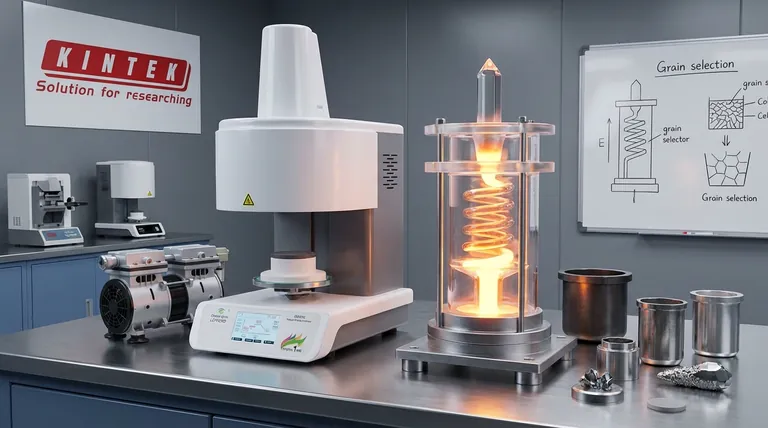
The Mechanics of Grain Selection
Starting with Directional Solidification
The process begins at the base of the mold, where molten metal starts to cool. During this initial stage, known as directional solidification, multiple grains nucleate and begin to grow upwards simultaneously.
The Geometric Screen
As these grains grow, they enter the spiral grain selector. This component is a precision-engineered flow channel designed with a complex spiral geometry.
The spiral forces the growing grains to navigate sharp turns and restricted paths.
Filtering by Orientation
Most of the initial grains cannot navigate the spiral; they grow into the channel walls and are terminated.
This process utilizes geometric screening principles. The physical shape of the channel filters out grains based on their growth direction relative to the spiral's curvature.
Achieving the [001] Orientation
The ultimate goal of this filtration is to allow only one grain to survive the ascent.
Typically, the grain that successfully navigates the spiral is one aligned with the [001] crystal orientation. Once this single grain exits the spiral, it acts as a seed, allowing the rest of the component to grow as a continuous extension of that single crystal.
Critical Considerations and Trade-offs
Precision is Non-Negotiable
The effectiveness of the selector relies entirely on the accuracy of its geometry. If the spiral is too wide or the angles are incorrect, it may fail to filter out all competing grains.
The Risk of Defects
A failure in the selector leads to a "stray grain" defect. If more than one grain passes through the spiral, the final casting will contain grain boundaries. This defeats the purpose of the process and compromises the material integrity of the component.
Implications for Manufacturing Strategy
If your primary focus is Mold Design:
- Prioritize the geometric precision of the spiral channel to ensure it imposes sufficient restriction to terminate competitive grains.
If your primary focus is Quality Assurance:
- Monitor the transition zone at the exit of the spiral to verify that only a single grain with the [001] orientation has entered the main growth zone.
The spiral grain selector is the pivotal hardware that bridges the gap between chaotic nucleation and perfect single-crystal structure.
Summary Table:
| Feature | Description |
|---|---|
| Primary Function | Geometric filter that isolates a single crystal grain from polycrystalline melt. |
| Target Orientation | Typically selects for the [001] crystal orientation for optimal material properties. |
| Mechanism | Uses complex spiral geometry to force competing grains to terminate against channel walls. |
| Critical Success Factor | Precise geometry of the flow channel to prevent "stray grain" defects and grain boundaries. |
| End Result | Uniform single-crystal structure with superior thermal and mechanical integrity. |
Elevate Your Manufacturing Precision with KINTEK
Achieving the perfect single-crystal structure requires more than just a spiral selector; it demands consistent, high-precision thermal environments. KINTEK provides the advanced laboratory solutions needed to master complex material solidification.
Backed by expert R&D and world-class manufacturing, we offer customizable Muffle, Tube, Rotary, Vacuum, and CVD systems designed to meet the rigorous demands of advanced metallurgy and material science. Whether you are refining mold designs or optimizing quality assurance, KINTEK’s high-temperature furnaces deliver the uniformity your process depends on.
Ready to enhance your lab's efficiency and casting quality? Contact our experts today to discuss your unique needs.
References
- Study of the Non-uniform Distribution of Primary Dendrite Arm Spacing (PDAS) Across the Width of a Single-Crystal Nickel-Based Superalloy Casting. DOI: 10.1007/s40962-025-01717-1
This article is also based on technical information from Kintek Furnace Knowledge Base .
Related Products
- Multi Heating Zones CVD Tube Furnace Machine for Chemical Vapor Deposition Equipment
- Stainless Steel Quick Release Vacuum Chain Three Section Clamp
- High Performance Vacuum Bellows for Efficient Connection and Stable Vacuum in Systems
- Multi Zone Laboratory Quartz Tube Furnace Tubular Furnace
- Ultra High Vacuum CF Observation Window Flange with High Borosilicate Glass Sight Glass
People Also Ask
- What is the function of a multi-zone tube furnace in CVD synthesis? Master 2D In2Se3 Nanosheet Precision
- What temperature-related capabilities make multi zone tube furnaces valuable for research? Unlock Precision Thermal Control
- Why are multi zone tube furnaces particularly useful for nanomaterial research? Unlock Precise Thermal Control for Advanced Synthesis
- What environmental protection applications utilize multi zone tube furnaces? Unlock Precision in Waste Treatment and Green Tech
- What role do multi zone tube furnaces play in new energy research? Unlock Precise Thermal Control for Innovation