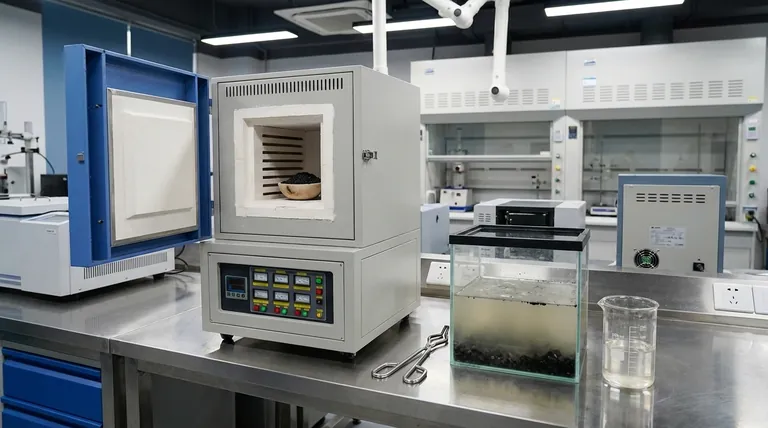
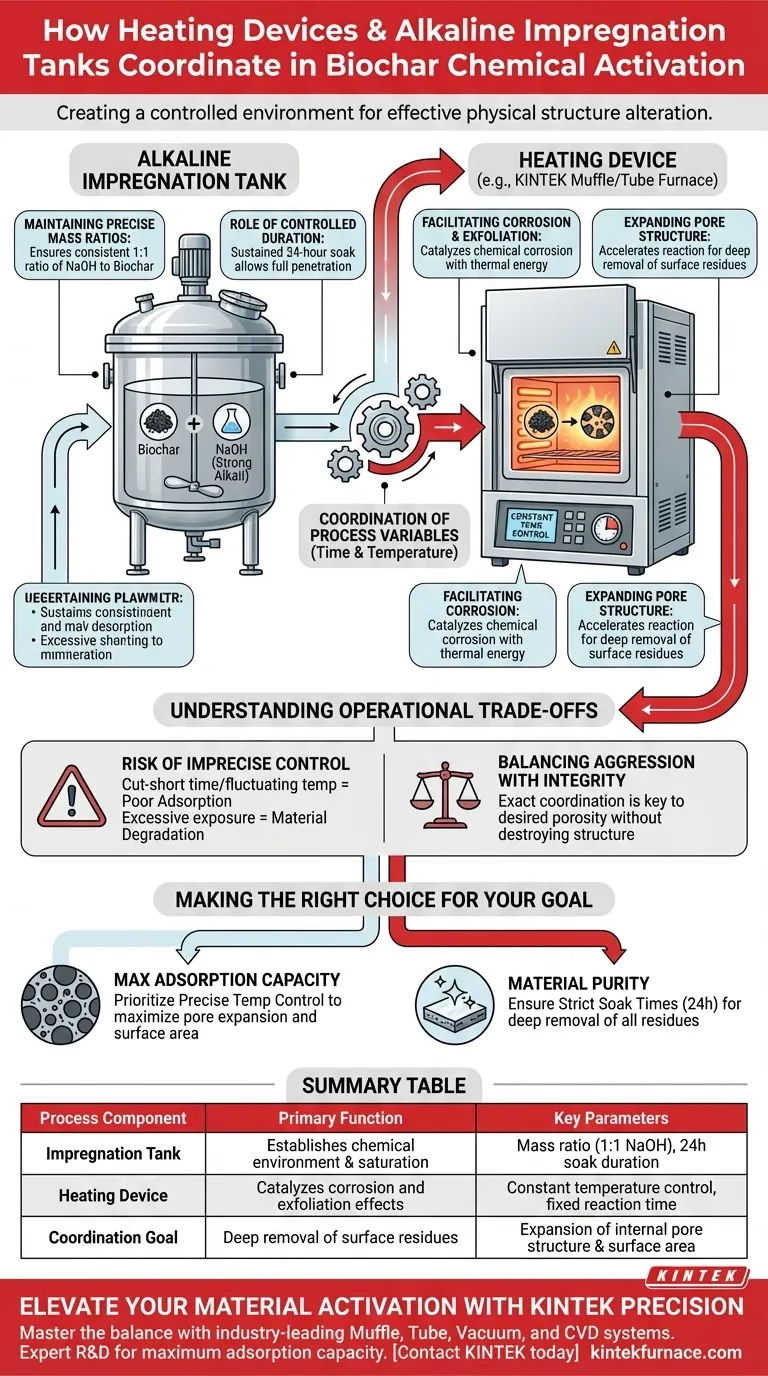
The coordination between heating devices and alkaline impregnation tanks centers on creating a controlled environment where chemical agents can effectively alter the physical structure of biochar. While the impregnation tanks maintain precise mass ratios of strong alkalis (such as NaOH) to biochar, the heating devices regulate the temperature over fixed durations to ensure thorough activation.
The success of this process relies on the strict control of reaction variables to trigger chemical corrosion and exfoliation. By managing time and temperature, these devices facilitate the deep removal of surface residues and the expansion of the pore structure, directly determining the material's final adsorption performance.
The Mechanics of Chemical Activation
Maintaining Precise Mass Ratios
The primary function of the impregnation tank is to establish and hold a specific chemical environment.
It ensures a consistent mass ratio between the activating agent and the raw material, such as a 1:1 ratio of NaOH to biochar. This balance is critical to ensure there is enough alkali to coat the material without wasting resources.
The Role of Controlled Duration
Chemical activation is not instantaneous; it requires a sustained soak to be effective.
The tanks are designed to hold the mixture for a set duration, often lasting 24 hours. This allows the strong alkalis to fully penetrate the biochar matrix before the heating phase drives the reaction further.
Driving Structure Change Through Heat
Facilitating Corrosion and Exfoliation
Once the mixture is prepared, the heating device acts as the catalyst for the physical transformation of the material.
By raising and maintaining the temperature, the device activates the chemical corrosion and exfoliation effects of the strong alkalis. This thermal energy allows the NaOH to aggressively attack surface impurities that would otherwise block the biochar's potential.
Expanding the Pore Structure
The ultimate goal of this coordination is the modification of the biochar's internal architecture.
Heat accelerates the reaction, leading to the deep removal of surface residues. This process clears the way for a significant expansion of the biochar pore structure, which is the primary factor in improving adsorption performance.
Understanding the Operational Trade-offs
The Risk of Imprecise Control
Because this process relies on "deep removal" and "exfoliation," precision is paramount.
If the reaction time is cut short or the temperature fluctuates, surface residues may remain, resulting in biochar with poor adsorption capabilities. Conversely, excessive exposure could degrade the material beyond utility.
Balancing Aggression with Integrity
The process utilizes strong alkalis, which are inherently destructive agents.
The coordination between the tank and heating device must be exact to achieve the desired porosity without destroying the structural integrity of the biochar itself.
Making the Right Choice for Your Goal
To maximize the utility of your biochar, you must tune the coordination of these devices to your specific performance metrics.
- If your primary focus is maximum adsorption capacity: Prioritize precise temperature control to maximize the expansion of the pore structure and surface area.
- If your primary focus is material purity: Ensure strictly maintained soak times (e.g., 24 hours) to guarantee the deep removal of all surface residues.
Mastering the variable interplay between heat and chemical saturation is the only way to transform raw biochar into a high-performance adsorbent.
Summary Table:
| Process Component | Primary Function | Key Parameters |
|---|---|---|
| Impregnation Tank | Establishes chemical environment & saturation | Mass ratio (e.g., 1:1 NaOH), 24h soak duration |
| Heating Device | Catalyzes corrosion and exfoliation effects | Constant temperature control, fixed reaction time |
| Coordination Goal | Deep removal of surface residues | Expansion of internal pore structure & surface area |
Elevate Your Material Activation with KINTEK Precision
To achieve superior biochar performance, you need equipment that masters the delicate balance of heat and chemical saturation. KINTEK provides industry-leading Muffle, Tube, Vacuum, and CVD systems, backed by expert R&D to ensure your activation process reaches maximum adsorption capacity.
Whether you require precise temperature regulation for pore expansion or customizable lab high-temp furnaces for unique chemical workflows, KINTEK is your trusted partner in manufacturing excellence.
Ready to optimize your lab's efficiency? Contact KINTEK today to discuss our customizable furnace solutions.
Visual Guide
References
- Barbara Pieczykolan. Investigation of Adsorption Kinetics and Isotherms of Synthetic Dyes on Biochar Derived from Post-Coagulation Sludge. DOI: 10.3390/ijms26167912
This article is also based on technical information from Kintek Furnace Knowledge Base .
Related Products
- Multi Heating Zones CVD Tube Furnace Machine for Chemical Vapor Deposition Equipment
- Silicon Carbide SiC Thermal Heating Elements for Electric Furnace
People Also Ask
- What is the function of a multi-zone tube furnace in CVD synthesis? Master 2D In2Se3 Nanosheet Precision
- Why are multi zone tube furnaces particularly useful for nanomaterial research? Unlock Precise Thermal Control for Advanced Synthesis
- What environmental protection applications utilize multi zone tube furnaces? Unlock Precision in Waste Treatment and Green Tech
- What temperature-related capabilities make multi zone tube furnaces valuable for research? Unlock Precision Thermal Control
- What role do multi zone tube furnaces play in new energy research? Unlock Precise Thermal Control for Innovation