
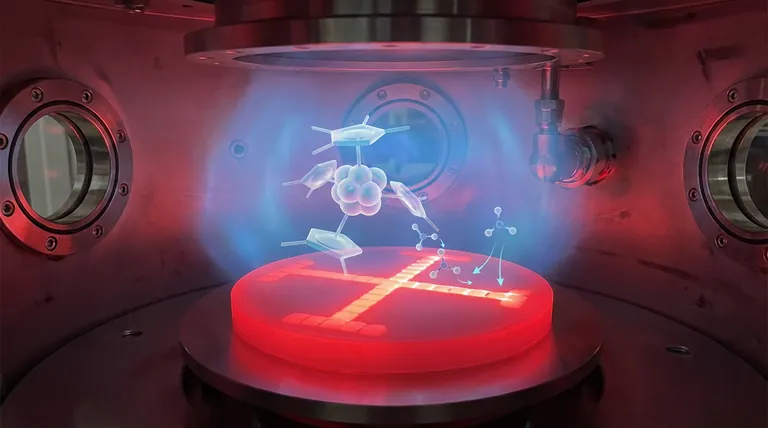
ZrCp(NMe2)3 functions as a highly specific, site-selective blocking agent within the Area-Selective Atomic Layer Deposition (AS-ALD) process. Acting as a secondary inhibitor, this heteroleptic precursor utilizes bulky cyclopentadienyl (Cp) ligands to physically shield crystalline facets on Zirconia surfaces, preventing the deposition of subsequent materials.
Core Insight: The utility of ZrCp(NMe2)3 lies in its ability to differentiate between surface morphologies on a chemically homogeneous material. By leveraging steric hindrance to passivate flat crystalline regions, it forces subsequent growth (specifically aluminum precursors) to occur only in desired areas, such as grain boundaries.
The Mechanism of Inhibition
To understand the efficacy of ZrCp(NMe2)3, one must look at how its molecular structure interacts with the substrate topology.
The Role of Heteroleptic Ligands
ZrCp(NMe2)3 is a heteroleptic precursor, meaning it contains different types of ligands.
The critical component here is the cyclopentadienyl (Cp) ligand. Unlike smaller ligands, the Cp group provides significant bulk, creating a physical barrier on the surface where the molecule adsorbs.
Steric Hindrance as a Shield
The primary mechanism of inhibition is steric hindrance.
When ZrCp(NMe2)3 adsorbs onto the surface, the bulky Cp ligands extend outward. This creates a crowded environment that physically blocks incoming aluminum precursors from reaching the reactive surface sites during subsequent ALD cycles.
Chemical Deactivation
Beyond physical blocking, the precursor modifies the chemical activity of the surface.
The Cp ligands possess lower chemical activity compared to the underlying substrate. Once adsorbed, they effectively "cap" the reactive sites, rendering them inert to the specific chemistry used in the following deposition step.
Achieving Selectivity on Homogeneous Surfaces
The unique value of this inhibitor is its ability to perform Area-Selective ALD on a surface that is chemically uniform (Zirconia) but morphologically diverse.
Targeting Crystalline Facets
ZrCp(NMe2)3 displays a distinct preference for adsorption on non-grain boundary regions, specifically the flat crystalline facets of the Zirconia (ZrO2) surface.
It does not readily adsorb into the grain boundaries. This selective adsorption creates a mask that covers the bulk of the crystalline grains while leaving the boundaries exposed.
Blocking Aluminum Nucleation
The ultimate function of this masking is to inhibit the growth of aluminum precursors.
Because the crystalline facets are shielded by the Cp ligands, the aluminum precursor cannot nucleate or grow there. Consequently, aluminum deposition is forced to occur exclusively in the unblocked grain boundary regions.
Understanding the Trade-offs
While effective, the use of ZrCp(NMe2)3 as a secondary inhibitor introduces specific constraints that must be managed.
Strict Morphological Dependence
The selectivity of this inhibitor is driven by surface morphology (facets vs. boundaries), not just surface chemistry.
If the Zirconia surface lacks well-defined crystalline facets or distinct grain boundaries, the selectivity of the inhibitor may degrade, leading to unwanted deposition on the grains or incomplete coverage.
Specificity to Aluminum Precursors
The reference highlights the blocking of aluminum precursors.
The steric protection provided by the Cp ligands is calibrated to specific molecular sizes and reactivities. It may not be equally effective against smaller or more aggressive precursors from different material families.
Making the Right Choice for Your Goal
To effectively utilize ZrCp(NMe2)3 in your AS-ALD process, align your objectives with its specific capabilities.
- If your primary focus is Grain Boundary Decoration: Rely on ZrCp(NMe2)3 to effectively passivate the bulk crystalline grains, forcing deposition solely into the grain boundaries.
- If your primary focus is Preventing Nucleation on Facets: Ensure your Zirconia surface has high crystallinity, as the inhibitor targets these specific non-grain boundary regions for adsorption.
Success with ZrCp(NMe2)3 depends on leveraging its bulky ligands to turn minor morphological differences into major barriers against chemical growth.
Summary Table:
| Feature | Description |
|---|---|
| Chemical Role | Heteroleptic Secondary Inhibitor |
| Active Mechanism | Steric Hindrance & Chemical Deactivation |
| Selective Target | Crystalline facets of Zirconia (ZrO2) |
| Key Ligand | Bulky Cyclopentadienyl (Cp) group |
| Primary Function | Blocks aluminum nucleation on grains to force growth in boundaries |
Elevate Your Material Research with KINTEK
Precise surface engineering requires high-performance equipment that can handle sophisticated chemical processes. Backed by expert R&D and manufacturing, KINTEK offers a comprehensive range of lab solutions including Muffle, Tube, Rotary, Vacuum, and CVD systems, all of which are customizable to meet your unique AS-ALD and high-temperature research needs.
Ready to achieve superior selectivity in your deposition processes? Contact us today to consult with our technical specialists and find the perfect system for your laboratory.
References
- Moo‐Yong Rhee, Il‐Kwon Oh. Area‐Selective Atomic Layer Deposition on Homogeneous Substrate for Next‐Generation Electronic Devices. DOI: 10.1002/advs.202414483
This article is also based on technical information from Kintek Furnace Knowledge Base .
Related Products
- Dental Porcelain Zirconia Sintering Ceramic Vacuum Press Furnace
- Magnesium Extraction and Purification Condensing Tube Furnace
- Chairside Dental Porcelain Zirconia Sintering Furnace with Transformer for Ceramic Restorations
- Multi Zone Laboratory Quartz Tube Furnace Tubular Furnace
- 1200℃ Controlled Inert Nitrogen Atmosphere Furnace
People Also Ask
- What factors determine the quality of sintered zirconia restorations? Master Material, Equipment, and Technique
- How do conventional vs rapid sintering in dental furnaces affect zirconia? Optimize Efficiency Without Sacrificing Strength
- What is the purpose of dental sintering furnaces? Transform Zirconia into Durable, High-Quality Dental Restorations
- What precautions should be taken when sintering zirconia in the Fast Slow Dental Sintering Furnace? Master Key Steps for Perfect Results
- What temperature range is used for sintering zirconia ceramics? Achieve Optimal Strength and Translucency






