
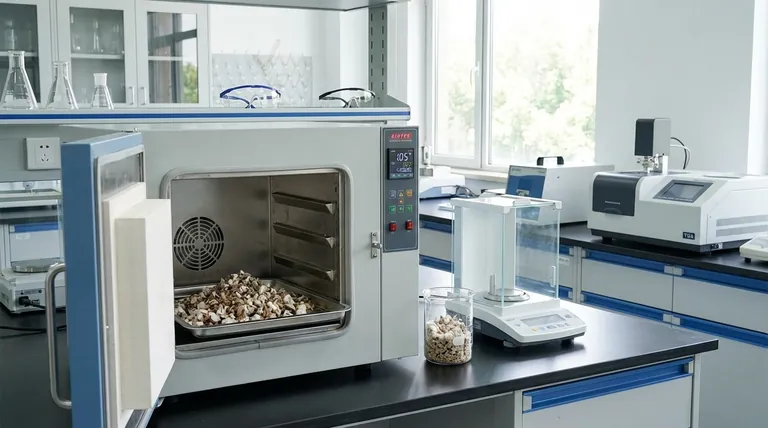
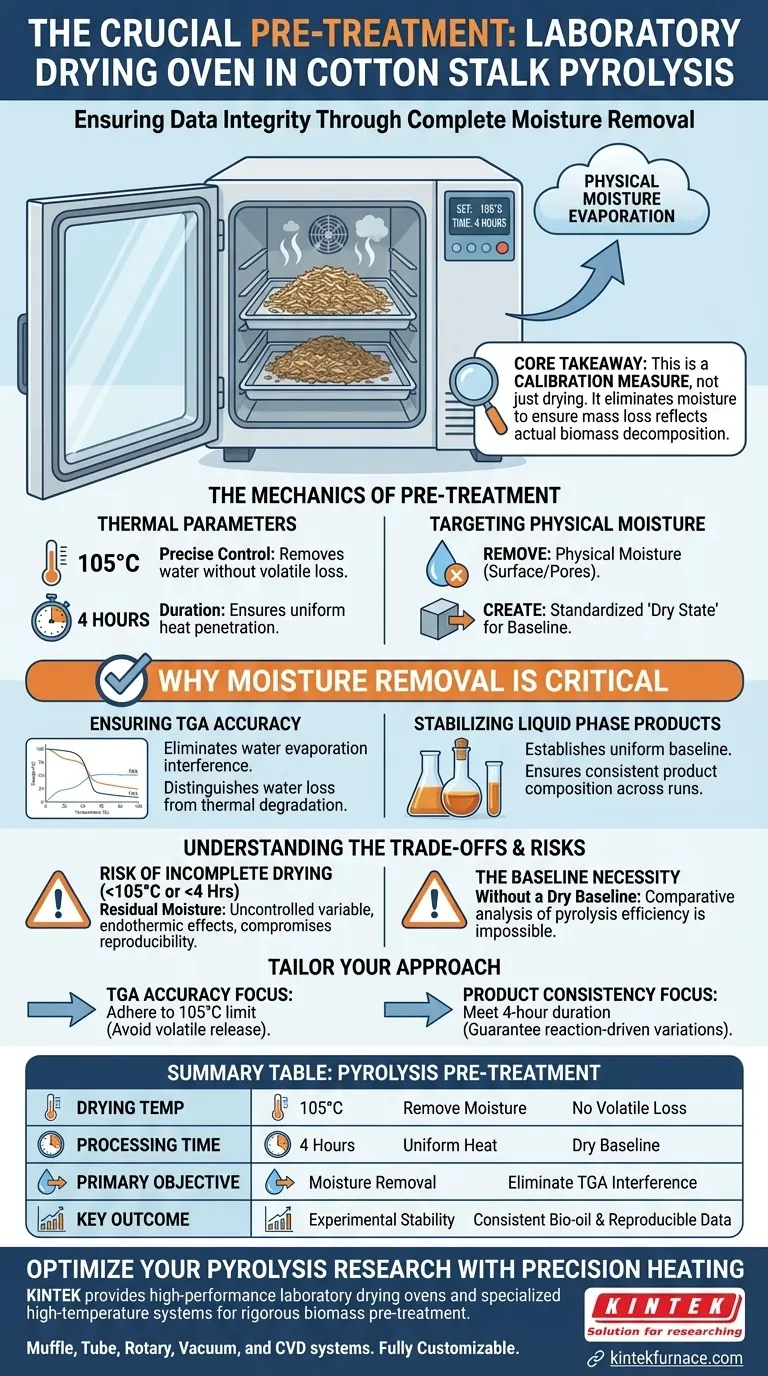
The primary function of a laboratory drying oven in this context is to completely remove physical moisture from crushed cotton stalk materials to ensure data integrity. By heating the biomass at 105°C for a duration of 4 hours, the process establishes a uniform experimental baseline before pyrolysis begins.
Core Takeaway This pre-treatment step is not merely about drying; it is a calibration measure. By eliminating moisture, you ensure that subsequent weight loss measurements reflect actual biomass decomposition rather than simple water evaporation.
The Mechanics of Pre-Treatment
Defining the Thermal Parameters
To achieve effective pre-treatment for cotton stalks, precise control is required. The laboratory drying oven must be set to 105°C.
The duration of this thermal exposure is equally critical. The material must be processed for 4 hours to ensure the heat penetrates the crushed biomass thoroughly.
Targeting Physical Moisture
The objective is the complete removal of physical moisture. This refers to water loosely bound to the surface or within the pores of the crushed stalks.
Unlike chemical water or volatiles released at higher temperatures, physical moisture is a variable that must be zeroed out. Removing it creates a standardized "dry state" for the raw material.
Why Moisture Removal is Critical
Ensuring TGA Accuracy
The most immediate impact of moisture is on Thermogravimetric Analysis (TGA). TGA measures precise changes in mass as temperature increases.
If moisture remains, its evaporation will register as weight loss. This interferes with the accuracy of the analysis, making it difficult to distinguish between water loss and the actual thermal degradation of the cotton stalk.
Stabilizing Liquid Phase Products
Pyrolysis produces bio-oil and other liquid phase components. The presence of variable amounts of water in the feedstock leads to inconsistent product compositions.
Pre-treatment establishes a uniform baseline. This ensures that the components of the liquid phase products remain consistent across different experimental runs.
Understanding the Trade-offs
The Risk of Incomplete Drying
If the 4-hour duration is shortened or the temperature drops below 105°C, residual moisture will persist. This introduces an uncontrolled variable into your experiment.
In high-temperature environments, residual moisture can cause endothermic effects (absorbing heat). This fluctuates the combustion temperature stability and compromises the reproducibility of your data.
The Baseline Necessity
Skipping or rushing this step renders comparative analysis impossible. Without a dry baseline, you cannot accurately compare the pyrolysis efficiency of different cotton stalk samples.
Making the Right Choice for Your Goal
To maximize the reliability of your pyrolysis experiments, tailor your approach based on your specific analytical needs:
- If your primary focus is TGA Accuracy: Strictly adhere to the 105°C limit to remove water without triggering premature release of volatiles or damaging the biomass structure.
- If your primary focus is Product Consistency: Ensure the 4-hour duration is fully met to guarantee that liquid phase product variations are due to reaction parameters, not feedstock moisture.
A rigorous drying protocol is the invisible foundation of reproducible pyrolysis data.
Summary Table:
| Parameter | Specification | Purpose in Pyrolysis |
|---|---|---|
| Drying Temperature | 105°C | Removal of physical moisture without volatile loss |
| Processing Time | 4 Hours | Ensures uniform heat penetration and dry baseline |
| Primary Objective | Moisture Removal | Eliminates mass loss interference in TGA |
| Key Outcome | Experimental Stability | Consistent bio-oil composition and reproducible data |
Optimize Your Pyrolysis Research with Precision Heating
Don't let residual moisture compromise your data integrity. KINTEK provides high-performance laboratory drying ovens and specialized high-temperature systems designed for the rigorous demands of biomass pre-treatment and thermal analysis.
Backed by expert R&D and manufacturing, KINTEK offers Muffle, Tube, Rotary, Vacuum, and CVD systems, all fully customizable to meet your unique laboratory needs. Whether you are focusing on TGA accuracy or liquid-phase product consistency, our equipment delivers the thermal stability your research deserves.
Ready to elevate your experimental results? Contact KINTEK today to find the perfect customized heating solution for your lab!
Visual Guide
References
- Hussien Elshareef, Yuguang Zhou. Investigation of Bio-Oil and Biochar Derived from Cotton Stalk Pyrolysis: Effect of Different Reaction Conditions. DOI: 10.3390/resources14050075
This article is also based on technical information from Kintek Furnace Knowledge Base .
Related Products
- Laboratory Muffle Oven Furnace with Bottom Lifting
- 1200℃ Muffle Oven Furnace for Laboratory
- High Temperature Muffle Oven Furnace for Laboratory Debinding and Pre Sintering
- 1400℃ Muffle Oven Furnace for Laboratory
- 1800℃ High Temperature Muffle Oven Furnace for Laboratory
People Also Ask
- Why is a high-temperature laboratory muffle furnace essential for the alkali fusion process in zeolite synthesis?
- What function does a muffle furnace perform in Ba0.75Ca0.25TiO3 calcination? Ensure Phase Purity & Synthesis
- Why is a high-temperature muffle furnace required for FeOx-MOx/TiO2? Engineering High-Performance Nanocomposites
- What is the importance of the calcination process? Master High-Purity Calcium Phosphate Nanopowder Production
- What are the primary functions of a high-temperature laboratory muffle furnace in the preparation of biosorbent materials?






