
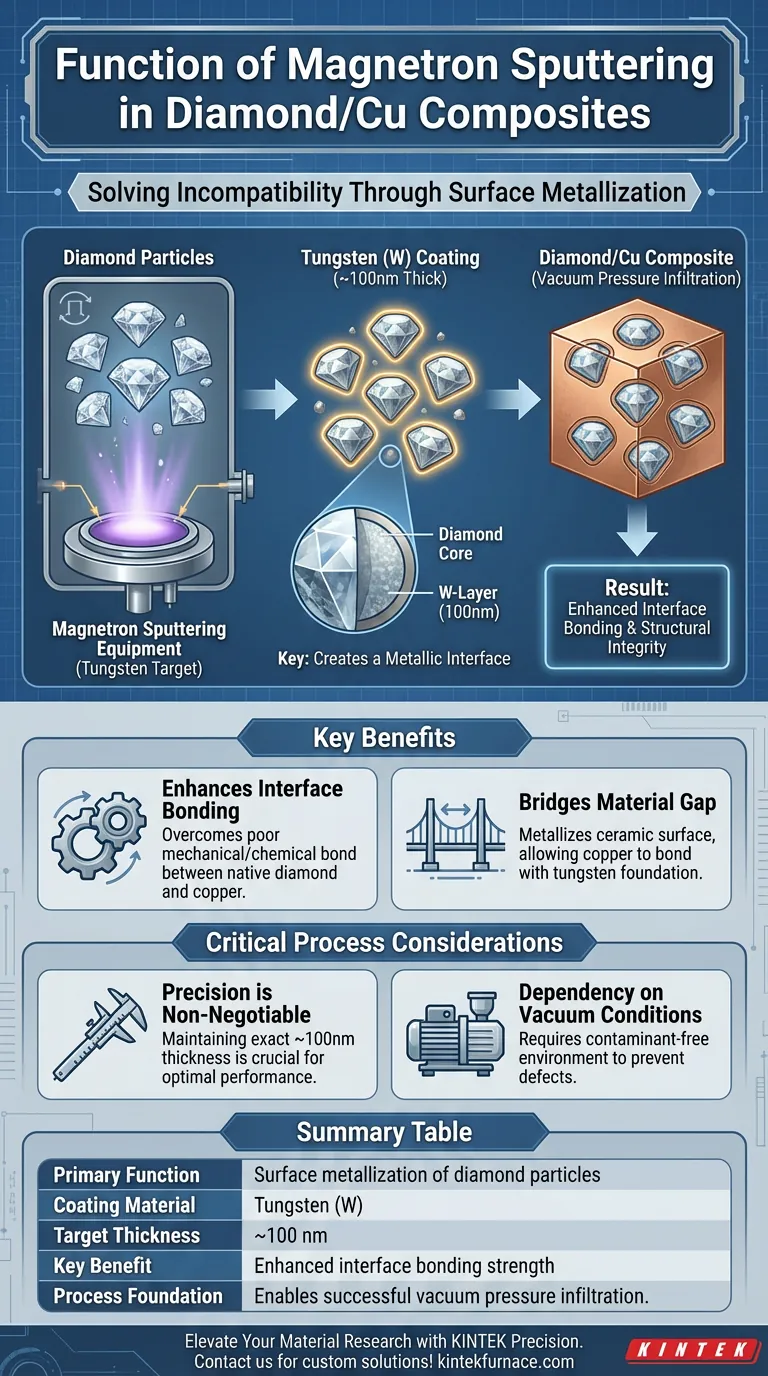
Magnetron sputtering equipment functions as the primary tool for surface metallization in the fabrication of Diamond/Cu composites. Its specific role is to deposit a tungsten (W) thin film, approximately 100nm thick, directly onto the diamond particles. This coating acts as a crucial bridge, altering the surface chemistry of the diamond to prepare it for integration with a metal matrix.
Core Takeaway The equipment solves the fundamental incompatibility between diamond and copper by creating a metallic tungsten interface. This ~100nm layer significantly enhances bonding strength and provides the necessary foundation for successful vacuum pressure infiltration.
The Mechanics of Surface Metallization
Deposition of the Tungsten Layer
The magnetron sputtering process is used to coat non-metallic diamond particles with a metallic layer. Specifically, it deposits tungsten (W) onto the diamond surface.
Achieving Nanoscale Precision
The equipment allows for high-precision thickness control. The target thickness for this application is approximately 100nm. This specific thickness provides adequate coverage without adding excessive bulk to the composite reinforcement.
The Impact on Composite Integrity
Enhancing Interface Bonding
The primary outcome of using magnetron sputtering is a dramatic improvement in interface bonding strength. Native diamond surfaces often struggle to bond mechanically or chemically with copper matrices.
Bridging the Material Gap
By coating the diamond with tungsten, the equipment effectively "metallizes" the ceramic surface. This allows the copper matrix to interact with a tungsten surface rather than a carbon surface, facilitating a stronger connection.
Enabling Vacuum Pressure Infiltration
The metallization process is not an end in itself but a preparation step. The tungsten coating serves as a critical foundation for the subsequent manufacturing stage: vacuum pressure infiltration. Without this surface modification, the infiltration process would likely result in poor wetting and weak structural integrity.
Critical Process Considerations
Precision is Non-Negotiable
The reference highlights a specific thickness of 100nm. This implies that deviations—coatings that are too thin or too thick—may compromise the interface. The magnetron sputtering equipment must be calibrated to maintain this exact tolerance to ensure the bonding benefits are realized.
Dependency on Vacuum Conditions
As this is a sputtering process, the quality of the tungsten film relies heavily on the vacuum environment. Any contamination during this stage could disrupt the metallization, leading to defects in the final Diamond/Cu composite.
Optimizing Your Composite Preparation
The use of magnetron sputtering is a strategic step to overcome the natural incompatibility of your raw materials.
- If your primary focus is mechanical strength: Ensure the equipment is calibrated to deliver a uniform 100nm tungsten layer to maximize interface bonding.
- If your primary focus is process reliability: View the sputtering phase as a prerequisite for infiltration; a poor coating here will lead to failure in the subsequent vacuum pressure step.
Reliable surface metallization is the key to unlocking the full potential of Diamond/Cu composites.
Summary Table:
| Feature | Specification/Role |
|---|---|
| Primary Function | Surface metallization of diamond particles |
| Coating Material | Tungsten (W) |
| Target Thickness | ~100 nm |
| Key Benefit | Enhanced interface bonding strength |
| Process Foundation | Enables successful vacuum pressure infiltration |
Elevate Your Material Research with KINTEK Precision
Unlock the full potential of your Diamond/Cu composites with KINTEK’s industry-leading technology. Backed by expert R&D and manufacturing, KINTEK offers high-performance Magnetron Sputtering systems, Muffle, Tube, Rotary, Vacuum, and CVD systems, all customizable to your unique research or production needs.
Whether you require nanoscale thickness control or specialized high-temperature lab furnaces, our engineering team is ready to deliver the reliability your project demands. Contact us today to discuss your custom solution and see how we can optimize your material integration process!
Visual Guide
References
- Ying Zhou, Degan Xiong. An Investigation on the Spark Plasma Sintering Diffusion Bonding of Diamond/Cu Composites with a Cr Interlayer. DOI: 10.3390/ma17246026
This article is also based on technical information from Kintek Furnace Knowledge Base .
Related Products
- 915MHz MPCVD Diamond Machine Microwave Plasma Chemical Vapor Deposition System Reactor
- Multi Heating Zones CVD Tube Furnace Machine for Chemical Vapor Deposition Equipment
- Slide PECVD Tube Furnace with Liquid Gasifier PECVD Machine
- Cylindrical Resonator MPCVD Machine System for Lab Diamond Growth
- Custom Made Versatile CVD Tube Furnace Chemical Vapor Deposition CVD Equipment Machine
People Also Ask
- What is the MPCVD method and why is it considered effective for diamond deposition? Superior Purity & High Growth Rates
- What factors influence the quality of diamond deposition in the MPCVD method? Master the Critical Parameters for High-Quality Diamond Growth
- What are some key features and benefits of the microwave plasma chemical vapor deposition system? Achieve Unmatched Material Synthesis
- What is the purpose of a microwave plasma chemical vapor deposition system? Grow High-Purity Diamonds and Advanced Materials
- What is the basic principle of operation for the microwave plasma chemical vapor deposition system? Unlock High-Purity Material Growth



















