
In magnesium vapor condensation experiments, graphite paper serves as a specialized, high-performance substrate designed to capture and preserve the metallic magnesium as it solidifies from a gaseous state. Its primary role is to provide a chemically inert and thermally stable surface where hot magnesium vapor can nucleate, grow, and be collected for subsequent analysis.
The use of graphite paper goes beyond simple collection; it acts as a diagnostic tool. It allows researchers to map how the physical structure of the condensed magnesium changes along a temperature gradient, providing critical insights into the condensation process itself.
The Core Function: A Stable Collection Surface
To understand why graphite paper is used, we must look at the extreme conditions of the experiment. The process involves highly reactive magnesium vapor at very high temperatures, which demands a unique set of properties from any material it contacts.
High-Temperature Resistance
Magnesium vapor exists at elevated temperatures. The collection substrate must be able to withstand this heat without melting, degrading, or outgassing, which could contaminate the experiment. Graphite paper excels in this high-temperature environment.
Chemical Inertness
Magnesium is a highly reactive metal, especially in its vapor form. The graphite paper provides a chemically stable and non-reactive surface. This inertness is critical to ensure that the collected condensate is pure metallic magnesium, free from contamination that would result from a reaction with the substrate.
Providing Nucleation Sites
Vapor does not condense into a solid spontaneously in mid-air; it requires a surface to begin the process. The graphite paper provides these crucial nucleation sites, allowing the first magnesium atoms to adhere and begin forming a solid structure. Subsequent vapor then condenses onto this growing layer.
Beyond Collection: A Tool for Spatial Analysis
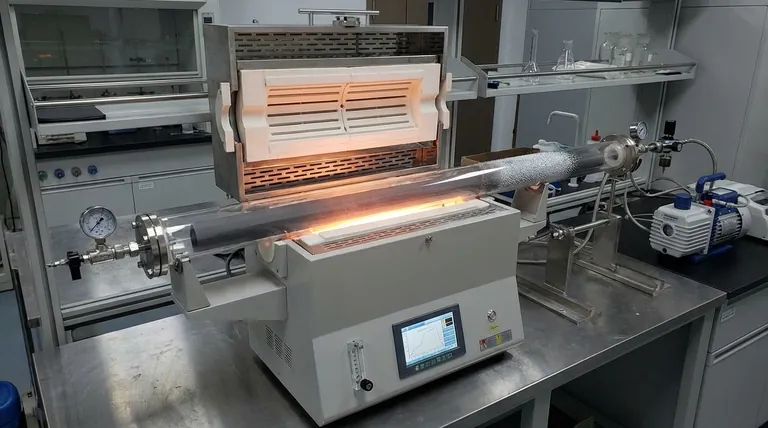
The true value of using a long strip of graphite paper in a horizontal tube furnace is its ability to provide spatial information. The furnace is designed with a temperature gradient, being hottest in the center and cooler toward the ends.
Mapping the Temperature Gradient
The graphite paper is placed along the length of the tube, spanning from the hotter zones to the cooler condensation zones. This setup creates a physical record of the condensation process at different temperatures.
Correlating Temperature with Product Morphology
By analyzing the condensates at various positions along the paper, researchers can directly correlate the condensation temperature with the product morphology—the physical shape, size, and structure of the resulting magnesium crystals. This reveals how different cooling rates affect the final product.
Studying Condensation Dynamics
This spatial analysis allows for a detailed study of the entire condensation process. Researchers can determine where condensation begins, where it is most efficient, and how the magnesium vapor diffuses from the hot zone to the cool zone.
Key Considerations and Limitations
While effective, this method is not without its specific requirements and constraints. Its successful application depends on controlling several key factors.
Substrate Purity
The purity of the graphite paper itself is a critical variable. Any impurities on or within the paper could potentially leach out at high temperatures and contaminate the magnesium condensate, compromising the experimental results.
Handling and Preservation
The condensed magnesium product can be delicate and loosely attached to the graphite surface. Careful handling is required post-experiment to preserve the sample's structure for analysis, especially for techniques like scanning electron microscopy (SEM).
Analytical vs. Production Scale
This method is an exceptional tool for laboratory-scale analysis and fundamental research. However, it is designed for study and characterization, not for the bulk production of magnesium metal.
Applying This to Your Research Goal
The use of graphite paper as a substrate directly enables specific experimental outcomes. Your objective will determine which of its properties is most critical.
- If your primary focus is producing high-purity material: The chemical inertness of graphite paper is its most vital feature, preventing contamination of the final product.
- If your primary focus is studying condensation physics: The ability to map product morphology along a continuous temperature gradient is the key advantage.
- If your primary focus is process optimization: Analyzing the distribution and density of the condensate along the paper reveals the efficiency and characteristics of your furnace's condensation zone.
Ultimately, the graphite paper substrate transforms a simple collection task into a powerful diagnostic method for understanding high-temperature phase transitions.
Summary Table:
| Role of Graphite Paper | Key Benefit | Application in Experiment |
|---|---|---|
| Chemically Inert Surface | Prevents contamination of magnesium condensate | Ensures high-purity material for analysis |
| Thermally Stable Substrate | Withstands high temperatures without degradation | Provides a reliable surface for vapor condensation |
| Provider of Nucleation Sites | Initiates the condensation process | Allows magnesium atoms to adhere and form solid structures |
| Spatial Analysis Tool | Maps condensation along a temperature gradient | Correlates temperature with product morphology and dynamics |
Ready to achieve precise and reliable results in your high-temperature experiments?
Backed by expert R&D and manufacturing, KINTEK offers Muffle, Tube, Rotary, Vacuum, CVD systems, and other lab high-temp furnaces, all customizable for unique needs like magnesium vapor condensation studies. Our equipment provides the stable, controllable environment essential for your research.
Contact our experts today to discuss how a KINTEK furnace can be tailored to optimize your specific condensation process and analytical goals.
Visual Guide

Related Products
People Also Ask
- Why are vacuum heat treating furnaces essential for aerospace? Ensure Superior Material Integrity for High-Stakes Applications
- What is the primary application of vacuum heat treating furnaces in aerospace? Enhance Component Performance with Precision
- What is the process of vacuum heat treating? Achieve Superior Metallurgical Properties
- How does vacuum heat treating work in terms of temperature and time control? Master Precise Material Transformations
- How does a vacuum heat treating furnace improve the condition of metal alloys? Achieve Superior Metal Performance
