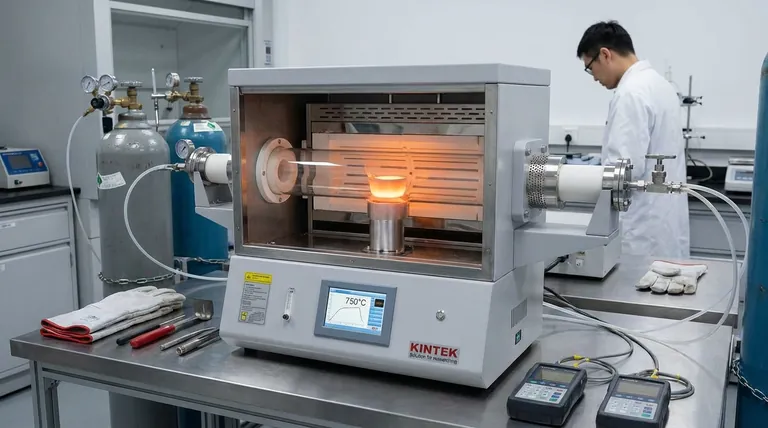
The industrial electric furnace serves as the primary thermal processing hub for Al-Cu 224 alloy production.
In the preparation of Al-Cu 224, the furnace provides a precisely controlled environment to heat the aluminum matrix and essential additives—including copper, manganese, magnesium, iron, and TiB master alloys—to a target temperature of 750 °C. This specific thermal regulation ensures the full melting and homogenization of all components, resulting in alloy ingots with stable chemical compositions and a significant reduction in structural inclusions.
The primary function of the electric furnace in Al-Cu 224 preparation is to provide a uniform, high-temperature environment that guarantees the full dissolution of alloying elements while preventing chemical instability or structural defects.
Achieving Chemical Homogenization and Purity
Precise Thermal Regulation at 750 °C
Maintaining a steady 750 °C is critical for transitioning the aluminum matrix and its additives into a uniform liquid phase. This temperature is high enough to ensure that elements with higher melting points, such as copper and iron, are fully integrated into the melt.
Eliminating Inclusions and Impurities
A controlled electric environment minimizes the turbulence and atmospheric contamination often associated with combustion-based furnaces. This results in a "clean" melt, which is fundamental for obtaining ingots that are free from non-metallic inclusions that could compromise the alloy's final integrity.
Integration of Master Alloys
The furnace environment facilitates the dissolution of TiB (Titanium-Boron) master alloys and other grain refiners. This thorough mixing at the liquid stage ensures that the grain-refining agents are distributed evenly, which is vital for the alloy’s performance during solidification.
Impact on Downstream Microstructure
Foundation for Secondary Processing
By producing an ingot with a stable chemical composition, the electric furnace creates a reliable substrate for subsequent purification or research. Uniformity at the melting stage ensures that later processes, such as solution treatment, yield predictable results across the entire batch.
Facilitating Phase Transformation
While the melting occurs at 750 °C, the initial homogenization is what allows secondary program-controlled furnaces to be effective. These later stages involve heating between 495 °C and 528 °C to dissolve coarse second phases into the matrix, forming a supersaturated solid solution.
Enabling Precipitation Hardening
The success of artificial aging at 160 °C is directly dependent on the initial melt quality. A well-homogenized melt leads to the uniform precipitation of nanoscale strengthening phases, such as theta' and theta'', which are responsible for the alloy's high mechanical hardness.
Understanding the Trade-offs and Limitations
Risk of Temperature Overshoot
If the furnace exceeds the 750 °C target significantly, it can lead to increased oxidation of the melt surface and the potential loss of volatile alloying elements. Precise program control is necessary to avoid "hot spots" that cause localized grain growth or element segregation.
Atmospheric Sensitivity
Standard industrial electric furnaces may not protect against the oxidation of highly active elements if they lack a vacuum or inert gas system. For alloys containing very reactive components, a non-consumable vacuum arc furnace might be required to prevent oxygen contamination.
Segregation During Cooling
Even a perfectly homogenized melt can suffer from gravitational segregation if the cooling process is not managed alongside the melting cycle. Heavier elements like copper can settle if the furnace does not facilitate adequate stirring or if the transition to casting is too slow.
Guidelines for Optimizing Al-Cu 224 Preparation
To achieve the best results with Al-Cu 224, the furnace selection and operating parameters must be matched to the specific metallurgical goals of the project.
- If your primary focus is high compositional uniformity: Utilize a furnace capable of mechanical or electromagnetic stirring to ensure that heavy elements like copper do not settle at the bottom of the melt.
- If your primary focus is enhancing mechanical hardness: Ensure the initial melt is free of inclusions to allow for the effective precipitation of nanoscale strengthening phases during subsequent aging cycles.
- If your primary focus is preventing element oxidation: Consider using a furnace with a controlled atmosphere or vacuum capability, especially if adding highly reactive master alloys.
Mastering the thermal environment during the melting phase is the essential foundation for producing high-performance, defect-free aluminum alloys.
Summary Table:
| Feature | Function in Al-Cu 224 Preparation |
|---|---|
| Temperature Control | Maintains precise 750 °C for full dissolution of Cu, Fe, and Mn |
| Melt Purity | Reduces atmospheric contamination and non-metallic inclusions |
| Homogenization | Ensures even distribution of TiB master alloys and grain refiners |
| Phase Support | Prepares stable chemical substrate for secondary aging and hardening |
Elevate Your Alloy Production with KINTEK Precision
High-performance Al-Cu 224 alloys demand the highest standards of thermal accuracy. KINTEK provides industry-leading Muffle, Vacuum, and Tube furnaces engineered to deliver the precise 750°C environment required for perfect chemical homogenization. Backed by expert R&D and world-class manufacturing, our systems are fully customizable to meet your unique metallurgical research and production needs.
Ready to eliminate structural defects and achieve superior mechanical hardness?
References
- Esmaeil Pourkhorshid, X.-Grant Chen. Laser-Based Additive Manufacturing Processability and Mechanical Properties of Al-Cu 224 Alloys with TiB Grain Refiner Additions. DOI: 10.3390/ma18030516
This article is also based on technical information from Kintek Furnace Knowledge Base .
Related Products
People Also Ask
- What are the typical application temperatures for molybdenum disilicide (MoSi2) heating elements? Master High-Temp Performance
- What is the primary use of molybdenum disilicide? Ideal for High-Temp Heating Elements
- What are the characteristics of molybdenum disilicide heating elements? Unlock High-Temp Performance
- What are the properties of molybdenum disilicide (MoSi2) that make it suitable for high-temperature applications? Discover Its High-Temp Resilience
- What are the applications of molybdenum disilicide heating elements? Achieve Extreme Heat Stability for Industrial Processes