
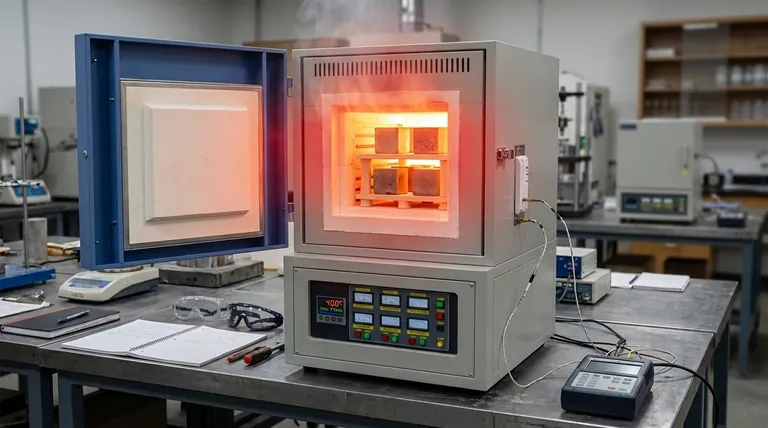
Industrial-grade laboratory furnaces simulate fire environments by rigorously replicating standardized thermal heating curves, most notably the ISO834 standard. Through precise electronic control, these furnaces apply a consistent heating rate—typically 9°C per minute—to concrete specimens until specific target temperatures like 200°C or 400°C are achieved.
By adhering to strict heating profiles and maintaining constant temperatures, these furnaces provide a stable, reproducible environment. This control is critical for isolating thermal effects and accurately mapping the strength degradation of Ultra-High Performance Fiber Reinforced Concrete (UHPFRC).
The Mechanics of Fire Simulation
Adherence to Standardized Profiles
To simulate a "realistic" fire, a furnace cannot simply generate random heat. It must follow a specific trajectory known as a heating profile.
The most common benchmark used is the ISO834 curve. This standard dictates exactly how temperature should rise over time, ensuring that the test conditions mimic the thermal load of a structural fire.
Precision Heating Rates
The effectiveness of the simulation relies on the rate of temperature increase.
Furnaces are programmed to apply heat at a steady rate, such as 9°C per minute. This controlled ramp-up allows researchers to observe how the UHPFRC reacts to rapidly increasing heat without introducing variables caused by fluctuating power sources.
Reaching Critical Target Temperatures
The simulation is designed to test the material at specific thermal milestones.
Common target temperatures include 200°C and 400°C. By isolating these temperatures, engineers can assess how the concrete's internal structure changes at different stages of a fire event.
Ensuring Data Integrity
The Importance of the "Soaking" Phase
Once the target temperature is reached, the furnace does not shut off immediately.
It shifts to maintain a constant temperature. This phase is essential to ensure thermal equilibrium, meaning the core of the concrete cube reaches the same temperature as its surface.
Evaluating Strength Degradation
The ultimate goal of this simulation is to measure strength degradation patterns.
By subjecting cube specimens to these controlled environments, researchers can quantify exactly how much structural integrity is lost at specific temperatures. This data is vital for predicting how a building will stand up during an actual emergency.
Understanding the Limitations
Idealized Conditions vs. Reality
While these furnaces simulate the heat of a fire, they create an idealized environment.
A laboratory furnace applies heat uniformly. In a real-world scenario, fire dynamics can be chaotic, with uneven heating or cooling phases that a standard ISO834 curve might not fully capture.
Specimen constraints
The process relies on testing concrete cube specimens.
This provides excellent data on the material properties of the UHPFRC itself. However, it does not necessarily simulate how a full-scale complex structure (with joints and loads) would behave under the same thermal stress.
Making the Right Choice for Your Goal
When designing a testing protocol for UHPFRC, clarity on your specific data requirements is essential.
- If your primary focus is regulatory compliance: Ensure your furnace is programmed to strictly follow the ISO834 heating curve to meet international standards.
- If your primary focus is material research: Prioritize the precision of the heating rate (e.g., 9°C/min) and the stability of the constant temperature phase to accurately map degradation.
Reliable safety data comes from the ability to turn the chaos of fire into a controlled, measurable variable.
Summary Table:
| Feature | Specification/Standard | Purpose in Fire Simulation |
|---|---|---|
| Heating Profile | ISO834 Standard Curve | Mimics structural fire thermal load trajectories |
| Heating Rate | 9°C per minute | Ensures consistent, reproducible thermal ramping |
| Target Points | 200°C and 400°C | Evaluates material changes at critical milestones |
| Thermal Phase | Soaking (Constant Temp) | Achieves equilibrium between specimen core and surface |
| Data Output | Strength Degradation | Quantifies loss of structural integrity for safety mapping |
Elevate Your Material Research with KINTEK Precision
Reliable fire safety data requires the transition from chaotic heat to controlled, measurable variables. Backed by expert R&D and manufacturing, KINTEK offers high-performance Muffle, Tube, Rotary, Vacuum, and CVD systems—all fully customizable to meet your unique testing protocols. Whether you are conducting material research or ensuring regulatory compliance for Ultra-High Performance Fiber Reinforced Concrete (UHPFRC), our laboratory furnaces deliver the precision heating rates and stability your data demands.
Ready to optimize your thermal testing? Contact us today to discuss your specific laboratory needs with our technical team.
Visual Guide

References
- Jiayu Huang, Jin Zhang. Effect of Graphene Nanotube on the Ultra High-Performance Fiber-Reinforced Concrete (UHPFRC) Under High Elevated Temperature. DOI: 10.17576/jkukm-2025-37(3)-22
This article is also based on technical information from Kintek Furnace Knowledge Base .
Related Products
- 1400℃ High Temperature Laboratory Tube Furnace with Alumina Tube
- 1700℃ High Temperature Laboratory Tube Furnace with Alumina Tube
- 1200℃ Muffle Oven Furnace for Laboratory
- High Temperature Muffle Oven Furnace for Laboratory Debinding and Pre Sintering
- 1700℃ High Temperature Muffle Oven Furnace for Laboratory
People Also Ask
- How do high-temperature laboratory tube furnaces ensure environmental stability? Precision Thermal Reduction Tips
- How are high-temperature laboratory tube furnaces applied in long-term vacuum homogenization heat treatments for intermetallic samples?
- How are high-temperature tube furnaces applied in testing ceramic-supported alloy membranes? Insights
- How does a laboratory high-temperature tube furnace contribute to the conversion of electrospun fibers? Expert Insights
- What is the function of a furnace in CuAlMn alloy treatment? Achieve Perfect Microstructural Homogenization



















