Knowledge Resources How does Vacuum Degassing (VD) influence spinel inclusions in heavy rail steel? Controlling Refractory Erosion
Author avatar

Tech Team · Kintek Furnace

Updated 2 weeks ago

How does Vacuum Degassing (VD) influence spinel inclusions in heavy rail steel? Controlling Refractory Erosion


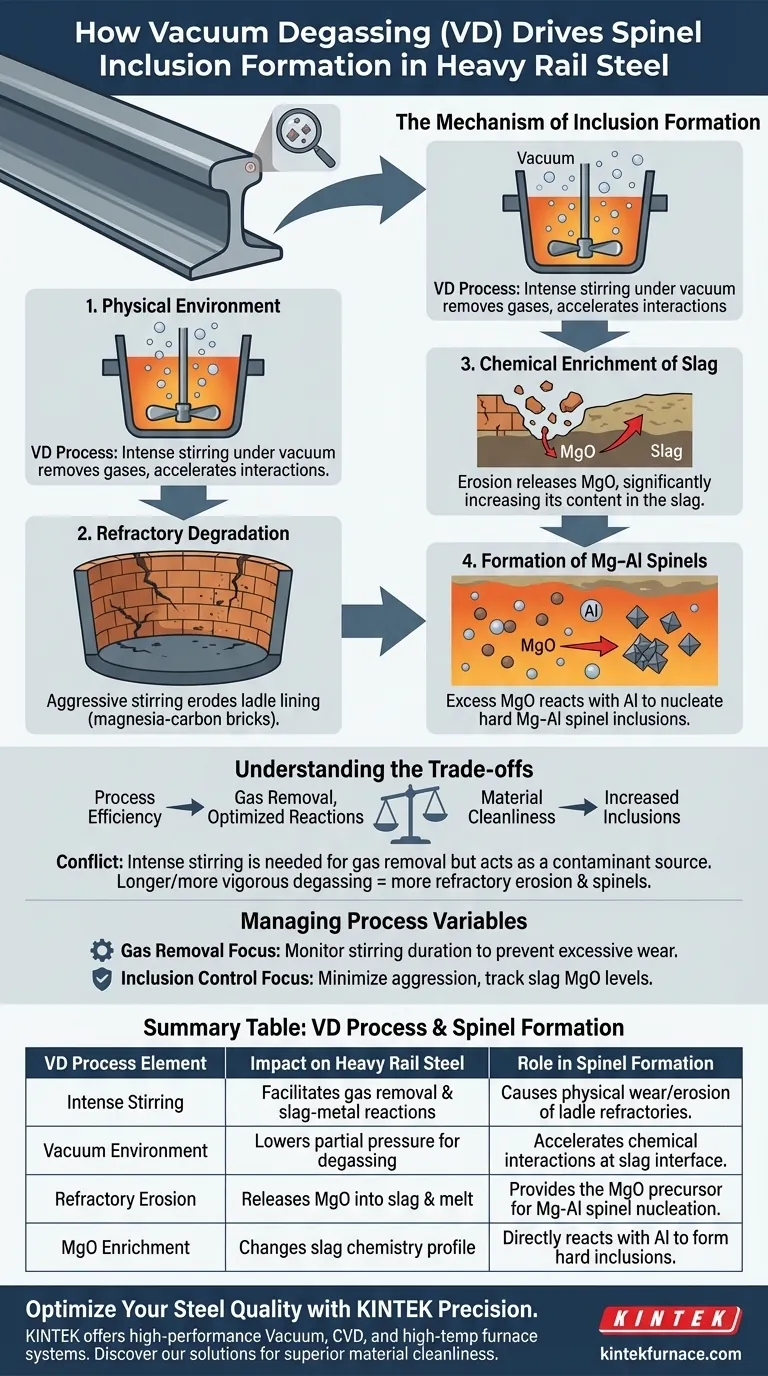
Vacuum Degassing (VD) drives the formation of spinel inclusions primarily through the erosion of ladle refractories. The process utilizes intense stirring within a low-pressure environment to remove gases and facilitate slag-metal reactions. However, this vigorous physical agitation wears down the ladle lining, introducing magnesium into the slag and creating the chemical conditions necessary for magnesium-aluminum (Mg–Al) spinel inclusions to form.

While Vacuum Degassing is critical for gas removal, the prolonged stirring under vacuum accelerates the degradation of ladle bricks. This erosion enriches the slag with Magnesium Oxide (MgO), which serves as the direct chemical precursor for hard, detrimental spinel inclusions.

The Mechanism of Inclusion Formation

The Role of Physical Environment

The VD process relies on a vacuum environment combined with prolonged and intense stirring.

This agitation is necessary to ensure the steel melt interacts sufficiently with the slag and to facilitate the removal of unwanted gases.

Refractory Degradation

The aggressive nature of this stirring places immense stress on the ladle refractories.

These linings are typically constructed from magnesia-carbon or high-alumina bricks, which succumb to the physical wear of the process.

Chemical Enrichment of Slag

As the refractories erode, they release their constituent materials into the steelmaking environment.

Specifically, this erosion causes a significant increase in the MgO content within the slag.

Formation of Mg–Al Spinels

The presence of excess MgO in the slag is the tipping point for inclusion formation.

This magnesium reacts with aluminum in the melt, providing the chemical basis for Mg–Al spinel inclusions to nucleate and grow within the heavy rail steel.

Understanding the Trade-offs

Process Efficiency vs. Material Cleanliness

There is an inherent conflict between the operational goals of the VD process and the cleanliness of the final product.

To effectively remove gases and optimize slag-metal reactions, intense stirring is required.

The Cost of Agitation

However, the very energy used to purify the steel of gases acts as a contaminant source regarding inclusions.

Pushing for longer or more vigorous degassing cycles directly correlates with increased refractory erosion and a higher population of spinel inclusions.

Managing Process Variables for Steel Quality

To optimize heavy rail steel production, you must balance the necessity of degassing against the risks of refractory erosion.

  • If your primary focus is gas removal: Maintain the necessary stirring intensity but strictly monitor the duration to prevent excessive refractory wear.
  • If your primary focus is inclusion control: Minimize the aggression of the stir and closely track MgO levels in the slag to detect early signs of lining degradation.

Understanding that the ladle lining is an active chemical participant in the VD process is key to controlling spinel formation.

Summary Table:

VD Process Element Impact on Heavy Rail Steel Role in Spinel Formation
Intense Stirring Facilitates gas removal and slag-metal reactions Causes physical wear/erosion of ladle refractories
Vacuum Environment Lowers partial pressure for degassing Accelerates chemical interactions at the slag interface
Refractory Erosion Releases MgO into the slag and melt Provides the MgO precursor for Mg-Al spinel nucleation
MgO Enrichment Changes slag chemistry profile Directly reacts with aluminum to form hard inclusions

Optimize Your Steel Quality with KINTEK Precision

Don't let refractory erosion compromise the integrity of your heavy rail steel. At KINTEK, we understand the delicate balance between efficient vacuum degassing and inclusion control. Backed by expert R&D and manufacturing, we offer high-performance Vacuum, CVD, and laboratory high-temp furnace systems designed to meet the rigorous demands of modern metallurgy.

Whether you need customizable solutions for advanced material research or industrial-grade furnaces for precise thermal processing, our team is ready to help you achieve superior material cleanliness. Contact us today to discover how KINTEK's specialized equipment can enhance your lab's efficiency and production standards.

Visual Guide
How does Vacuum Degassing (VD) influence spinel inclusions in heavy rail steel? Controlling Refractory Erosion Visual Guide

References

  1. Jun Zhu, Jichun Yang. Study on the Causes and Control Measures of Mg–Al Spinel Inclusions in U75V Heavy Rail Steel. DOI: 10.3390/app14051718

This article is also based on technical information from Kintek Furnace Knowledge Base .

Related Products

People Also Ask

Related Products

Vacuum Heat Treat Sintering and Brazing Furnace

Vacuum Heat Treat Sintering and Brazing Furnace

KINTEK Vacuum Brazing Furnaces deliver precision, clean joints with superior temperature control. Customizable for diverse metals, ideal for aerospace, medical, and thermal applications. Get a quote!

2200 ℃ Tungsten Vacuum Heat Treat and Sintering Furnace

2200 ℃ Tungsten Vacuum Heat Treat and Sintering Furnace

2200°C Tungsten Vacuum Furnace for high-temperature materials processing. Precise control, superior vacuum, customizable solutions. Ideal for research & industrial applications.

304 316 Stainless Steel High Vacuum Ball Stop Valve for Vacuum Systems

304 316 Stainless Steel High Vacuum Ball Stop Valve for Vacuum Systems

KINTEK's 304/316 stainless steel vacuum ball valves and stop valves ensure high-performance sealing for industrial and scientific applications. Explore durable, corrosion-resistant solutions.

Vacuum Heat Treat Furnace with Ceramic Fiber Liner

Vacuum Heat Treat Furnace with Ceramic Fiber Liner

KINTEK's Vacuum Furnace with Ceramic Fiber Lining offers precise high-temperature processing up to 1700°C, ensuring uniform heat distribution and energy efficiency. Ideal for labs and production.

Small Vacuum Heat Treat and Tungsten Wire Sintering Furnace

Small Vacuum Heat Treat and Tungsten Wire Sintering Furnace

Compact vacuum tungsten wire sintering furnace for labs. Precise, mobile design with superior vacuum integrity. Ideal for advanced material research. Contact us!

Stainless Steel Quick Release Vacuum Chain Three Section Clamp

Stainless Steel Quick Release Vacuum Chain Three Section Clamp

Stainless steel quick release vacuum clamps ensure leak-free connections for high vacuum systems. Durable, corrosion-resistant, and easy to install.

Vacuum Heat Treat Sintering Furnace with Pressure for Vacuum Sintering

Vacuum Heat Treat Sintering Furnace with Pressure for Vacuum Sintering

KINTEK's Vacuum Pressure Sintering Furnace offers 2100℃ precision for ceramics, metals, and composites. Customizable, high-performance, and contamination-free. Get a quote now!

CF KF Flange Vacuum Electrode Feedthrough Lead Sealing Assembly for Vacuum Systems

CF KF Flange Vacuum Electrode Feedthrough Lead Sealing Assembly for Vacuum Systems

Reliable CF/KF flange vacuum electrode feedthrough for high-performance vacuum systems. Ensures superior sealing, conductivity & durability. Customizable options available.

High Pressure Laboratory Vacuum Tube Furnace Quartz Tubular Furnace

High Pressure Laboratory Vacuum Tube Furnace Quartz Tubular Furnace

KINTEK High Pressure Tube Furnace: Precision heating up to 1100°C with 15Mpa pressure control. Ideal for sintering, crystal growth, and lab research. Customizable solutions available.

1700℃ Controlled Inert Nitrogen Atmosphere Furnace

1700℃ Controlled Inert Nitrogen Atmosphere Furnace

KT-17A Controlled Atmosphere Furnace: Precise 1700°C heating with vacuum & gas control. Ideal for sintering, research & material processing. Explore now!

Molybdenum Vacuum Heat Treat Furnace

Molybdenum Vacuum Heat Treat Furnace

High-performance molybdenum vacuum furnace for precise 1400°C heat treatment. Ideal for sintering, brazing, and crystal growth. Durable, efficient, and customizable.

Vacuum Hot Press Furnace Machine Heated Vacuum Press Tube Furnace

Vacuum Hot Press Furnace Machine Heated Vacuum Press Tube Furnace

Discover KINTEK's advanced Vacuum Tube Hot Press Furnace for precise high-temperature sintering, hot pressing, and material bonding. Customizable solutions for labs.

Magnesium Extraction and Purification Condensing Tube Furnace

Magnesium Extraction and Purification Condensing Tube Furnace

Magnesium purification tube furnace for high-purity metal production. Achieve ≤10Pa vacuum, dual-zone heating. Ideal for aerospace, electronics, and lab research.

2200 ℃ Graphite Vacuum Heat Treat Furnace

2200 ℃ Graphite Vacuum Heat Treat Furnace

2200℃ Graphite Vacuum Furnace for high-temperature sintering. Precise PID control, 6*10⁻³Pa vacuum, durable graphite heating. Ideal for research & production.

Vacuum Hot Press Furnace Machine for Lamination and Heating

Vacuum Hot Press Furnace Machine for Lamination and Heating

KINTEK Vacuum Lamination Press: Precision bonding for wafer, thin-film & LCP applications. 500°C max temp, 20-ton pressure, CE certified. Custom solutions available.

Vacuum Heat Treat Sintering Furnace Molybdenum Wire Vacuum Sintering Furnace

Vacuum Heat Treat Sintering Furnace Molybdenum Wire Vacuum Sintering Furnace

KINTEK's Vacuum Molybdenum Wire Sintering Furnace excels in high-temperature, high-vacuum processes for sintering, annealing, and material research. Achieve precise 1700°C heating with uniform results. Custom solutions available.

Ultra High Vacuum Observation Window KF Flange 304 Stainless Steel High Borosilicate Glass Sight Glass

Ultra High Vacuum Observation Window KF Flange 304 Stainless Steel High Borosilicate Glass Sight Glass

KF Ultra-High Vacuum Observation Window with borosilicate glass for clear viewing in demanding vacuum environments. Durable 304 stainless steel flange ensures reliable sealing.

Vacuum Sealed Continuous Working Rotary Tube Furnace Rotating Tube Furnace

Vacuum Sealed Continuous Working Rotary Tube Furnace Rotating Tube Furnace

Precision rotary tube furnace for continuous vacuum processing. Ideal for calcination, sintering, and heat treatment. Customizable up to 1600℃.

Split Chamber CVD Tube Furnace with Vacuum Station CVD Machine

Split Chamber CVD Tube Furnace with Vacuum Station CVD Machine

Split Chamber CVD Tube Furnace with Vacuum Station - High precision 1200°C lab furnace for advanced materials research. Customizable solutions available.

Laboratory Vacuum Tilt Rotary Tube Furnace Rotating Tube Furnace

Laboratory Vacuum Tilt Rotary Tube Furnace Rotating Tube Furnace

KINTEK Laboratory Rotary Furnace: Precision heating for calcination, drying, sintering. Customizable solutions with vacuum & controlled atmosphere. Enhance research now!


Leave Your Message