
High-precision temperature control acts as the critical regulator of the thermodynamic equilibrium during the aging step of MCM-41 synthesis. By strictly maintaining temperatures, typically between 15 and 70 °C, this equipment governs the dissolution and precipitation balance of the silica network.
By stabilizing the thermodynamic environment, high-precision equipment enables the exact fine-tuning of pore volume and diameter, ensuring the material meets the strict physical requirements of its intended application.
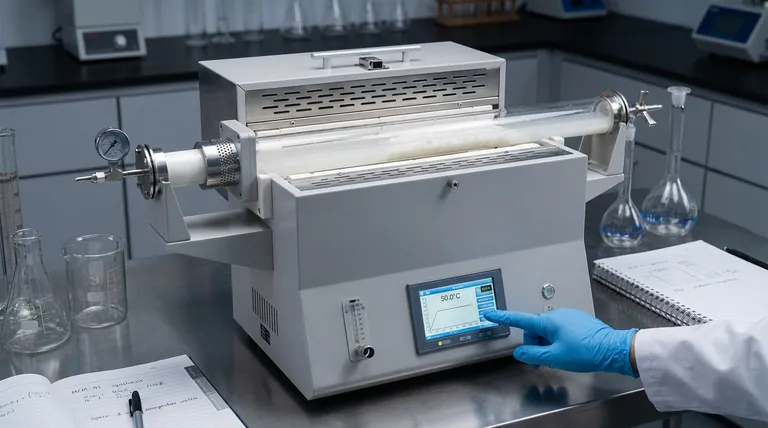
Managing the Thermodynamic Balance
Controlling Dissolution and Precipitation
The aging step is defined by a dynamic chemical balance where the silica network continuously dissolves and reprecipitates. High-precision equipment is essential to regulate the rate of this exchange.
Without exact thermal management, this cycle becomes unpredictable. The equipment ensures that the structural reorganization of the silica happens at a controlled, steady pace.
The Impact of Temperature Fluctuations
The synthesis process operates within a sensitive window, generally 15 to 70 °C. Even minor fluctuations within this range can disrupt the thermodynamic stability of the solution.
Precise equipment eliminates these deviations. This stability is necessary to prevent structural defects that occur when the temperature drifts away from the target setpoint.
Defining Physical Properties
Fine-Tuning Pore Diameter
The ultimate role of this temperature control is to dictate the final geometry of the material. By locking in a specific temperature, researchers can fine-tune the pore diameter of the MCM-41.
This allows for the creation of materials tailored to specific molecular sizes. The equipment effectively turns temperature into a design tool for the material's framework.
Optimizing Pore Volume
Beyond diameter, the equipment influences the specific pore volume. Consistent heat ensures that the silica framework develops the optimal void space required for high-performance use.
If the temperature varies, the resulting pore volume may be inconsistent across the batch. This renders the material less effective for applications requiring high surface area.
Understanding the Risks of Imprecision
Inconsistent Material Quality
The primary trade-off in MCM-41 synthesis is between equipment precision and material uniformity. Relying on standard, low-precision heating methods often leads to batch-to-batch inconsistency.
Heterogeneous Structures
Lack of precision can result in uneven heating or "thermal drift." This causes the silica network to develop heterogeneously, producing a final product with varied pore sizes rather than a uniform structure.
Applying Precision to Your Synthesis
To achieve the best results in MCM-41 production, align your equipment choice with your specific goals:
- If your primary focus is reproducible manufacturing: Ensure your equipment can maintain the target temperature within tight tolerances to guarantee identical batches.
- If your primary focus is application-specific design: Use the temperature controls to actively manipulate the dissolution balance, adjusting the setpoint to target distinct pore diameters.
Precise thermal control transforms the aging step from a passive wait time into an active, structural design phase.
Summary Table:
| Feature | Role in MCM-41 Aging Step | Impact on Final Material |
|---|---|---|
| Thermodynamic Regulation | Balances silica dissolution & precipitation | Ensures structural uniformity and stability |
| Temperature Stability | Maintains setpoint between 15°C and 70°C | Prevents structural defects and heterogeneity |
| Pore Diameter Control | Fine-tunes the geometric framework | Enables application-specific molecular tailoring |
| Volume Optimization | Controls void space development | Maximizes surface area for high performance |
Elevate Your Materials Synthesis with KINTEK
Precision is the difference between a failed batch and a high-performance material. Backed by expert R&D and manufacturing, KINTEK offers a comprehensive range of Muffle, Tube, Rotary, Vacuum, and CVD systems, along with other lab high-temperature furnaces—all fully customizable to meet your unique MCM-41 synthesis requirements.
Don't let thermal drift compromise your pore architecture. Our advanced heating solutions provide the strict thermodynamic control necessary for consistent, reproducible results. Contact us today to discuss how our customizable laboratory furnaces can optimize your synthesis process and drive your research forward.
References
- Michael Karl, Simone Pokrant. Porous MCM‐41 Silica Materials as Scaffolds for Silicon‐based Lithium‐ion Battery Anodes. DOI: 10.1002/celc.202300707
This article is also based on technical information from Kintek Furnace Knowledge Base .
Related Products
People Also Ask
- What thermal phenomena occur during polymer binder burnout in ceramic green bodies? Lab Furnace Guide
- Why is controlled heat treatment in a muffle furnace necessary for calcined clay? Achieve Optimal Pozzolanic Activity
- What role does a high-temperature muffle furnace play in STFO synthesis? Achieve Pure Perovskite Results
- How does a high-temperature muffle furnace facilitate the formation of LaNbxAl1−xO3+δ perovskite structures? Key Roles
- What role does a high-temperature muffle furnace play in the multi-stage synthesis of Li0.5MnFe1.5O4? Key to Pure Spinel
