
The vacuum drying oven plays a critical preservation role in the synthesis of Co-HCC by maintaining the structural integrity of Metal-Organic Framework (MOF) precursors. It creates a low-pressure environment that allows for the removal of solvents, such as methanol or DMF, at significantly reduced temperatures. This process is essential for preventing the collapse of the MOF’s delicate crystalline framework, which can occur due to surface tension or thermal stress during standard atmospheric drying.
Core Takeaway By lowering the boiling point of residual solvents, vacuum drying enables deep dehydration without the destructive effects of high heat. This preserves the MOF's ordered pore structure and prevents capillary collapse, ensuring the precursor remains chemically and morphologically intact for subsequent processing.
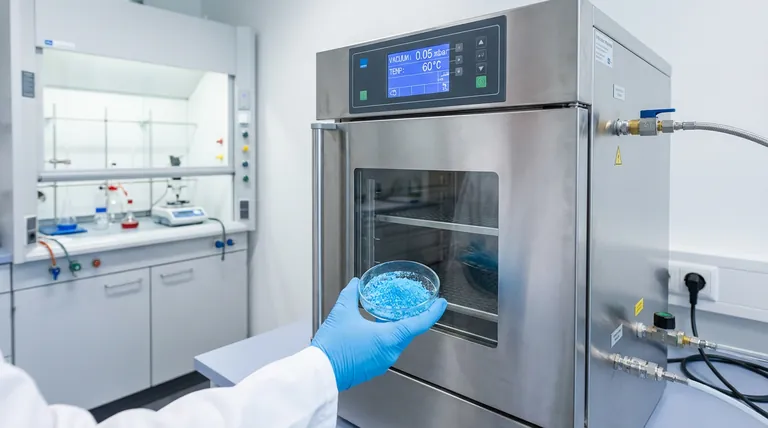
Preserving Structural Integrity via Low-Temperature Drying
The primary challenge in processing MOF precursors is removing liquid solvents without destroying the solid material holding them.
Lowering the Solvent Boiling Point
The vacuum environment significantly reduces the pressure inside the chamber. This physical change lowers the boiling point of solvents trapped within the MOF structure.
Consequently, solvents like dimethylformamide (DMF) or methanol can evaporate efficiently at much lower temperatures than would be required at atmospheric pressure.
Preventing Thermal Degradation
MOFs are often thermally sensitive. High temperatures required for standard drying can cause the organic linkers within the framework to degrade or the structure to sinter.
Vacuum drying mitigates this risk by allowing the material to dry thoroughly while remaining in a cooler, thermally safe range.
Mitigating Mechanical Stress on the Framework
Beyond temperature control, the physical mechanics of evaporation play a vital role in determining the quality of the final precursor.
Avoiding Capillary Collapse
When solvents evaporate from nanopores under atmospheric pressure, they exert significant surface tension on the pore walls.
This force is often strong enough to crush the pore structure, leading to a phenomenon known as "pore collapse." Vacuum drying reduces these forces, protecting the specific morphology and porosity of the MOF.
Ensuring Deep Pore Clearance
MOFs are defined by their microporous nature. A standard oven may dry the surface, but leave solvent trapped deep within the internal cavities.
The vacuum environment promotes the diffusion of these trapped molecules out of the micropores, ensuring the material is chemically pure and fully dried from the inside out.
Secondary Benefits for Processing
While the primary reference focuses on the MOF structure, supplementary contexts regarding porous precursors highlight additional benefits relevant to synthesis.
Prevention of Oxidation
At elevated temperatures, many precursors are susceptible to reacting with oxygen in the air, leading to degradation.
Because the vacuum oven operates in an oxygen-depleted environment, it effectively prevents oxidative degradation of the organic components within the MOF precursor.
Facilitating Physical Processing
Vacuum drying tends to produce a precursor with a looser internal structure compared to air-dried materials.
This physical state facilitates easier grinding or pulverization in subsequent stages, ensuring a uniform powder for the final carbonization or pyrolysis steps.
Understanding the Trade-offs
While vacuum drying is superior for maintaining quality, it introduces specific operational considerations.
Process Speed vs. Integrity
Vacuum drying is often a slower process compared to high-temperature forced-air drying. You are trading speed for structural preservation. Rushing this step by increasing the temperature—even under vacuum—can negate the benefits and risk sintering the nanoparticles.
Equipment Maintenance
The solvents removed (such as DMF) are chemically aggressive. Unlike water vapor, these organic solvents can damage vacuum pump seals and oil if not properly trapped or vented.
Making the Right Choice for Your Goal
To maximize the effectiveness of your Co-HCC synthesis, align your drying strategy with your specific material requirements.
- If your primary focus is Pore Architecture: Prioritize a lower temperature setting and longer vacuum duration to minimize surface tension and prevent framework collapse.
- If your primary focus is Chemical Purity: Ensure the vacuum level is sufficient to lower the boiling point of your specific solvent (e.g., DMF) well below the MOF's thermal decomposition threshold to avoid residual contamination.
The quality of your final Co-HCC catalyst is directly determined by the gentleness and thoroughness of the drying phase applied to the MOF precursor.
Summary Table:
| Feature | Benefit for MOF/Co-HCC Synthesis |
|---|---|
| Low-Pressure Environment | Lowers solvent boiling points, enabling low-temp evaporation. |
| Structural Preservation | Prevents capillary collapse and maintains delicate pore architecture. |
| Oxygen-Depleted Chamber | Eliminates oxidative degradation of organic linkers. |
| Deep Pore Clearance | Ensures removal of trapped solvents (DMF/Methanol) from internal cavities. |
| Thermal Protection | Avoids sintering and thermal stress on sensitive framework precursors. |
Elevate Your MOF Research with Precision Vacuum Technology
Maintaining the structural integrity of sensitive precursors is critical for successful Co-HCC synthesis. KINTEK provides advanced, customizable Vacuum Drying Ovens and high-temperature systems specifically designed for the delicate needs of lab research and material science.
Backed by expert R&D and manufacturing, our equipment ensures uniform heating and precise pressure control to prevent pore collapse and chemical degradation. Whether you need standard or bespoke solutions for CVD, Vacuum, or Muffle systems, our team is ready to support your unique process requirements.
Ready to optimize your drying process and achieve superior material purity?
Contact KINTEK Today to Consult with an Expert
References
- Tian Mai, Ming‐Guo Ma. Hollow Metal–Organic Framework/MXene/Nanocellulose Composite Films for Giga/Terahertz Electromagnetic Shielding and Photothermal Conversion. DOI: 10.1007/s40820-024-01386-5
This article is also based on technical information from Kintek Furnace Knowledge Base .
Related Products
- Vacuum Heat Treat Sintering and Brazing Furnace
- Vacuum Heat Treat Sintering Furnace Molybdenum Wire Vacuum Sintering Furnace
- Dental Porcelain Zirconia Sintering Ceramic Vacuum Press Furnace
- Molybdenum Vacuum Heat Treat Furnace
- Vacuum Hot Press Furnace Machine Heated Vacuum Press
People Also Ask
- What are the benefits of using vacuum heat treating furnaces for metal alloys? Achieve Superior Metal Properties and Performance
- What is one of the most important uses of vacuum heat treating furnaces in aerospace? Achieve Superior Strength in Aircraft Alloys
- How does vacuum heat treating affect the grain structure of metal alloys? Achieve Precise Microstructure Control
- What is the temperature of a vacuum furnace brazing? Optimize Your Joint Strength and Cleanliness
- What are the steps involved in a typical vacuum brazing treatment? Master the Process for Strong, Clean Joints












