
The quality of aluminum matrix green compacts is fundamentally defined by their density and the integrity of their internal interfaces. A single-action hydraulic press ensures this quality by applying up to 300 MPa of directional axial pressure to composite powders within a rigid mold. This intense pressure forces the aluminum particles to undergo plastic deformation, effectively eliminating internal voids and establishing the intimate particle-to-particle contact necessary for successful sintering.
A single-action hydraulic press utilizes high-pressure forced molding to convert axial mechanical force into localized plastic deformation. This process minimizes porosity and creates the tight contact interfaces required for high-strength diffusion bonding in the final composite.
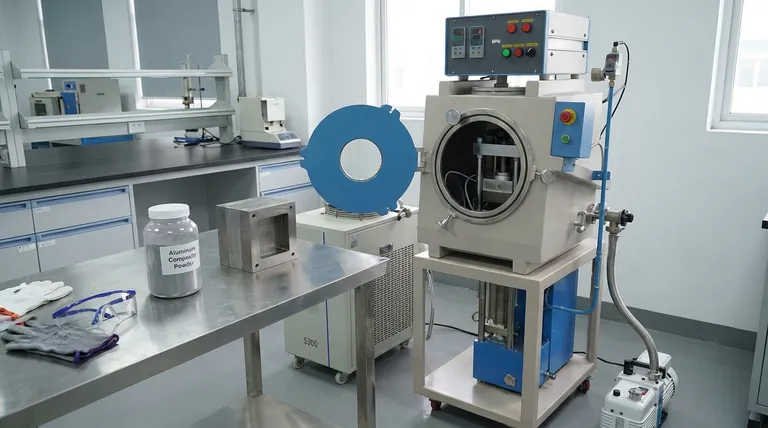
The Mechanics of Cold Forming
High-Pressure Densification at 300 MPa
The press applies directional axial pressure reaching levels as high as 300 MPa. This specific pressure threshold is critical for overcoming the natural resistance of the composite powder particles to packing.
As the pressure increases, the powder particles are forced into a smaller volume, significantly increasing the density of the green compact. This high initial density is the primary predictor of the final component's structural strength.
Plastic Deformation and Void Reduction
Aluminum is a ductile metal, and under the force of the press, the particles undergo plastic deformation. This means the particles physically change shape to fill the "empty" spaces, or voids, between them.
By reducing initial porosity at this stage, the press ensures there are fewer defects in the material. This creates a solid, cohesive mass that is stable enough to be handled before it is permanently hardened.
Achieving Interfacial Quality
Creating Foundations for Diffusion Bonding
The quality of a composite depends on how well the particles bond during the later sintering stage. The hydraulic press creates tight particle contact interfaces by rubbing and pressing surfaces together under extreme load.
Without this mechanical "interlocking" and intimate contact, diffusion bonding cannot occur effectively. The press essentially prepares the microscopic surfaces for the atoms to migrate and bond during the heating phase.
The Role of the Rigid Mold
The use of a rigid mold is essential to ensure that the pressure remains directional and the dimensions remain precise. The mold contains the powder, allowing the hydraulic ram to exert its full force without the material escaping or deforming inconsistently.
This containment ensures that the resulting green compact has a uniform shape and consistent external dimensions. This geometric accuracy is a hallmark of high-quality cold forming.
Understanding the Trade-offs
The Challenge of Density Gradients
In a single-action press, the pressure is applied from only one direction (typically the top). This often leads to density gradients, where the top of the compact is denser than the bottom due to internal friction.
Friction and Wall Effects
Friction between the powder particles and the mold walls can dissipate some of the applied energy. This can result in uneven compaction, particularly in "tall" or high-aspect-ratio parts, potentially leading to structural weaknesses.
Geometry Limitations
Single-action pressing is best suited for relatively simple, flat geometries. Complex parts with varying thicknesses may experience uneven pressure distribution, which can cause the green compact to crack or warp during the sintering process.
Making the Right Choice for Your Goal
To ensure the highest quality results when using a single-action hydraulic press for aluminum matrix composites, consider the following strategic priorities:
- If your primary focus is maximizing structural strength: Ensure your press is calibrated to reach the 300 MPa threshold to trigger maximum plastic deformation and void elimination.
- If your primary focus is uniform density: Keep the aspect ratio of the part low (thinner parts) to minimize the impact of directional pressure gradients.
- If your primary focus is successful sintering: Prioritize the cleanliness of the powder to ensure that the tight contact interfaces created by the press are not contaminated by oxides or oils.
The successful cold forming of aluminum matrix composites relies on the precise application of high axial pressure to transform loose powder into a dense, handleable, and bond-ready green compact.
Summary Table:
| Feature | Impact on Green Compact Quality |
|---|---|
| 300 MPa Axial Pressure | Drives high-density packing and structural integrity |
| Plastic Deformation | Eliminates internal voids and reduces initial porosity |
| Rigid Mold Casting | Ensures precise geometric dimensions and directional force |
| Interfacial Contact | Creates the mechanical foundation for effective diffusion bonding |
| Single-Action Load | Best for simple, flat geometries with low aspect ratios |
Elevate Your Material Fabrication Precision
Achieve superior densification and structural integrity in your composite manufacturing with KINTEK’s advanced hydraulic systems. Backed by expert R&D and world-class manufacturing, KINTEK offers a comprehensive range of laboratory equipment including high-precision Muffle, Tube, Rotary, Vacuum, and CVD systems. Whether you are refining aluminum matrix composites or developing new material alloys, our lab high-temp furnaces and presses are fully customizable to meet your unique research and production needs.
Ready to optimize your cold forming and sintering workflow? Contact KINTEK today to discuss your custom solution!
References
- A Wasik, M. Madej. Sustainability in the Manufacturing of Eco-Friendly Aluminum Matrix Composite Materials. DOI: 10.3390/su16020903
This article is also based on technical information from Kintek Furnace Knowledge Base .
Related Products
- Vacuum Hot Press Furnace Machine Heated Vacuum Press
- Vacuum Hot Press Furnace Machine for Lamination and Heating
- 600T Vacuum Induction Hot Press Vacuum Heat Treat and Sintering Furnace
- Vacuum Hot Press Furnace Machine Heated Vacuum Press Tube Furnace
People Also Ask
- What are the primary components of a vacuum hot press furnace? Master the Core Systems for Precise Material Processing
- What are the benefits of the vacuum environment system in a vacuum hot press furnace? Unlock High-Density Sintering
- What safety features are incorporated in vacuum hot press furnaces? Ensure Operator and Equipment Protection
- What types of heating elements are used in vacuum hot press furnaces? Optimize for High-Temp Performance
- What are the core advantages of using a vacuum hot press furnace? Achieve Near-Forged Density for Ti-6Al-4V Alloys



