
The primary function of an industrial resistance furnace in this configuration is to provide a highly stable, precisely controlled thermal environment for melting magnesium alloys. By regulating heating power around a low-carbon steel crucible, the system ensures that magnesium, aluminum, and intermediate alloys are fully melted and uniformly mixed at temperatures typically around 700 °C.
Core Takeaway The resistance furnace does not merely melt metal; it creates a consistent thermal baseline that guarantees the chemical uniformity and fluidity of the liquid alloy. This stability is the physical foundation required for successful high-pressure die casting (HPDC).
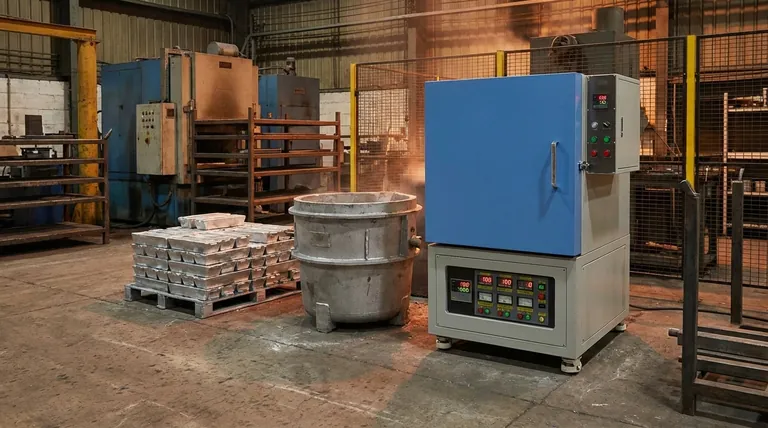
The Mechanics of Thermal Control
Precision Heating Power
Unlike combustion-based heating, a resistance furnace offers exact control over heating power. This allows the system to maintain the target temperature—often around 700°C for magnesium alloys—with minimal fluctuation.
The Role of the Steel Crucible
The low-carbon steel crucible serves as the conductive vessel within this thermal environment. It works in conjunction with the furnace to hold the melt, facilitating efficient heat transfer to the raw materials inside.
Long-Term Insulation
Supplementary data indicates that these furnaces are capable of maintaining insulation for extended periods, such as two hours. This dwell time is critical for ensuring that pure metal blocks and master alloys are not just heated, but fully integrated into the melt.
Achieving Material Homogeneity
Uniform Mixing of Elements
The ultimate goal of this setup is to ensure that magnesium, aluminum, and intermediate alloys are fully melted and mixed. The stable heat source prevents "cold spots" that could lead to incomplete melting.
Consistent Chemical Composition
By maintaining a stable environment, the furnace achieves preliminary homogenization of the alloy. This ensures that the chemical composition is consistent throughout the entire batch, which is vital for the structural integrity of the final cast part.
Optimizing Fluidity
For high-pressure die casting, the metal must flow rapidly and smoothly into the mold. The resistance furnace ensures the liquid alloy reaches and maintains the high fluidity required for this process.
Understanding the Trade-offs
Process Time vs. Throughput
Achieving true homogeneity requires time. The necessity of maintaining insulation for periods like two hours means that this process prioritizes alloy quality over rapid throughput speed.
Energy Demands
Maintaining temperatures between 700°C and 750°C for extended periods requires significant energy input. While resistance furnaces are precise, the requirement for long-term thermal stability effectively increases the energy cost per batch.
Making the Right Choice for Your Goal
When evaluating your melting strategy for HPDC, consider your specific production requirements.
- If your primary focus is casting quality: Prioritize the resistance furnace's ability to maintain a steady 700°C, as this guarantees the chemical consistency and fluidity necessary for complex die casts.
- If your primary focus is process control: Leverage the furnace's precise power regulation to eliminate temperature spikes that could alter the alloy's microstructure.
Ultimately, the resistance furnace transforms raw ingredients into a dependable, homogenized liquid material, minimizing defects in the final die-cast product.
Summary Table:
| Feature | Function in HPDC Magnesium Melting |
|---|---|
| Heating Mechanism | Precise resistance heating for stable power regulation |
| Target Temperature | Typically maintains a consistent 700°C - 750°C range |
| Crucible Type | Low-carbon steel for efficient heat transfer and durability |
| Key Outcome | Full melting, uniform mixing, and high alloy fluidity |
| Process Focus | Prioritizes chemical homogeneity and casting quality over speed |
Elevate Your Die Casting Quality with KINTEK
Don’t compromise on the structural integrity of your magnesium components. KINTEK’s advanced heating solutions are engineered to deliver the thermal stability and precision your HPDC process demands. Backed by expert R&D and world-class manufacturing, we offer a comprehensive range of Muffle, Tube, Rotary, Vacuum, and CVD systems, alongside lab high-temperature furnaces that are fully customizable to your specific metallurgical needs.
Our equipment ensures your alloys are perfectly homogenized and ready for high-fluidity casting. Contact KINTEK today to discuss how our customized thermal systems can optimize your production efficiency and minimize casting defects.
References
- Guan Sheng, Yong Zhu. Microstructure and Mechanical Properties of High-Pressure Die-Casting Mg–Al–RE Alloys with Minor Ca Addition. DOI: 10.3390/ma18020231
This article is also based on technical information from Kintek Furnace Knowledge Base .
Related Products
- 1200℃ Controlled Inert Nitrogen Atmosphere Furnace
- High Pressure Laboratory Vacuum Tube Furnace
- Small Vacuum Heat Treat and Tungsten Wire Sintering Furnace
- Mesh Belt Controlled Atmosphere Furnace Inert Nitrogen Atmosphere Furnace
- 1700℃ Controlled Inert Nitrogen Atmosphere Furnace
People Also Ask
- What controlled-atmosphere furnace conditions are required for sintering powder metallurgy copper alloy compacts? Ideal Setup
- What are the key benefits of precise temperature control in a controlled atmosphere furnace? Unlock Superior Quality and Efficiency
- What types of gases are used in controlled atmosphere furnaces? Optimize Material Protection and Transformation
- How do surface oxide layers on ceramic powders like silicon nitride affect sintering? Master Atmosphere Control
- What are the advantages of a controlled atmosphere furnace over tube furnaces? Superior Process Control for Sensitive Materials



















