
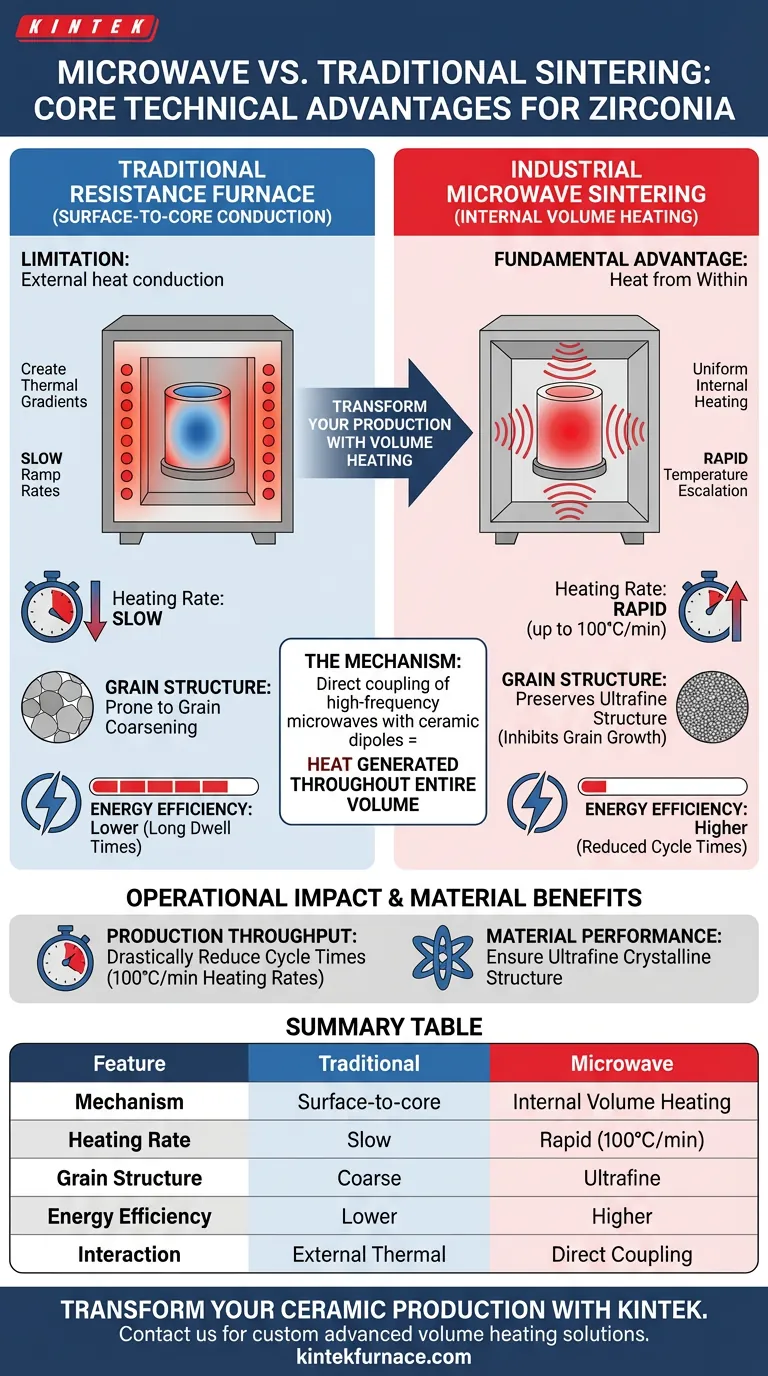
The fundamental technical advantage of an industrial microwave sintering system is its ability to generate heat from within the material itself via "volume heating," rather than relying on external thermal conduction. By utilizing high-frequency microwaves to couple directly with ceramic dipoles, this technology achieves uniform internal heating, enabling rapid temperature escalation and significantly reduced processing times compared to traditional resistance furnaces.
Core Takeaway: Traditional furnaces heat from the outside in, creating thermal gradients and requiring slow ramp rates. Industrial microwave sintering flips this paradigm by creating a volume heating effect, allowing for heating rates up to 100°C per minute while preserving an ultrafine crystalline structure.
The Mechanism: Volume Heating vs. Thermal Conduction
To understand the efficiency of microwave sintering, one must first understand the limitations of the traditional approach.
The Limitation of Traditional Heating
Traditional resistance furnaces operate on a surface-to-core principle. Heat generates at the elements, transfers to the ceramic surface, and then must slowly conduct inward to the center of the part.
The Power of Volume Heating
Microwave systems utilize high-frequency microwaves to couple directly with the ceramic dipoles inside the zirconia.
This interaction generates heat uniformly throughout the entire volume of the material simultaneously. This mechanism eliminates the reliance on thermal conduction from the surface, which is the primary bottleneck in traditional sintering.
Operational Efficiency and Speed
The shift to volume heating creates immediate, measurable improvements in process metrics.
Achieving Rapid Heating Rates
Because heat is generated internally, the thermal lag associated with conduction is eliminated. This allows for aggressive heating rates of up to 100°C per minute.
Lower Energy Consumption
The sintering cycle is significantly shortened due to these rapid heating rates. Consequently, the total energy required to process a batch of zirconia is notably reduced compared to the long dwell times of resistance furnaces.
Impact on Material Structure
Beyond speed, the thermodynamics of microwave sintering have a profound effect on the physical quality of the zirconia.
Preserving Ultrafine Grain Structure
In traditional sintering, prolonged exposure to high heat creates a window for grains to enlarge, which can weaken the mechanical properties of the ceramic.
The Thermodynamic Advantage
The rapid thermodynamics of the microwave system effectively inhibit grain growth. By minimizing the time the material spends at critical grain-coarsening temperatures, the system produces zirconia ceramics with an ultrafine crystalline structure.
Understanding the Trade-offs
While microwave sintering offers superior speed and structure, it is distinct from other rapid techniques and requires specific material conditions.
Material Dependency
The entire process relies on the material's ability to physically interact with the energy source. Success is dictated by the coupling of high-frequency microwaves with ceramic dipoles.
If a material does not possess the correct dielectric properties to facilitate this coupling, the volume heating effect cannot occur.
Making the Right Choice for Your Goal
When deciding between a traditional resistance furnace and an industrial microwave sintering system, consider your specific production drivers.
- If your primary focus is Production Throughput: Leverage the volume heating effect to achieve heating rates of 100°C/minute, drastically reducing your total cycle time.
- If your primary focus is Material Performance: Utilize the rapid thermodynamic profile to inhibit grain growth, ensuring your final product retains an ultrafine crystalline structure.
By moving from surface conduction to internal volume heating, you achieve a simultaneous increase in processing speed and material quality.
Summary Table:
| Feature | Traditional Resistance Furnace | Industrial Microwave Sintering |
|---|---|---|
| Heating Mechanism | Surface-to-core conduction | Internal volume heating |
| Heating Rate | Slow (limited by thermal lag) | Rapid (up to 100°C/minute) |
| Grain Structure | Prone to grain coarsening | Preserves ultrafine structure |
| Energy Efficiency | Lower (long dwell times) | Higher (reduced cycle times) |
| Material Interaction | External thermal transfer | Direct coupling with dipoles |
Transform Your Ceramic Production with KINTEK
Are you looking to drastically reduce your sintering cycles while achieving superior material properties? KINTEK provides industry-leading thermal solutions backed by expert R&D and precision manufacturing.
Whether you require specialized Microwave Sintering, Vacuum, CVD, or Muffle systems, our high-temp lab furnaces are fully customizable to meet your unique processing needs. Don't let traditional heating bottlenecks limit your throughput—partner with KINTEK to integrate advanced volume heating into your workflow.
Ready to optimize your lab's performance? Contact us today to discuss your custom furnace solution!
Visual Guide
References
- Dilsuz A. Abdaljabar, Ahmed Abdulrasool Ahmed Alkhafaji. Using Taguchi Technique to Study the Effect of Adding Copper Nano on Shape Recovery for Smart Alloy (CU-AL-NI). DOI: 10.31026/j.eng.2025.05.03
This article is also based on technical information from Kintek Furnace Knowledge Base .
Related Products
- Chairside Dental Porcelain Zirconia Sintering Furnace with Transformer for Ceramic Restorations
- Dental Porcelain Zirconia Sintering Ceramic Vacuum Press Furnace
- Vacuum Dental Porcelain Sintering Furnace for Dental Laboratories
- High Temperature Muffle Oven Furnace for Laboratory Debinding and Pre Sintering
- Spark Plasma Sintering SPS Furnace
People Also Ask
- What factors determine the quality of sintered zirconia restorations? Master Material, Equipment, and Technique
- How do conventional vs rapid sintering in dental furnaces affect zirconia? Optimize Efficiency Without Sacrificing Strength
- What industries use zirconia sintering furnaces? Beyond Dental and Jewelry Applications
- What are the key components of a zirconia sintering furnace? Unlock Precision for Superior Dental Restorations
- Why is a zirconia sintering furnace considered essential for dental laboratories and clinics? Unlock Precision and Durability






