
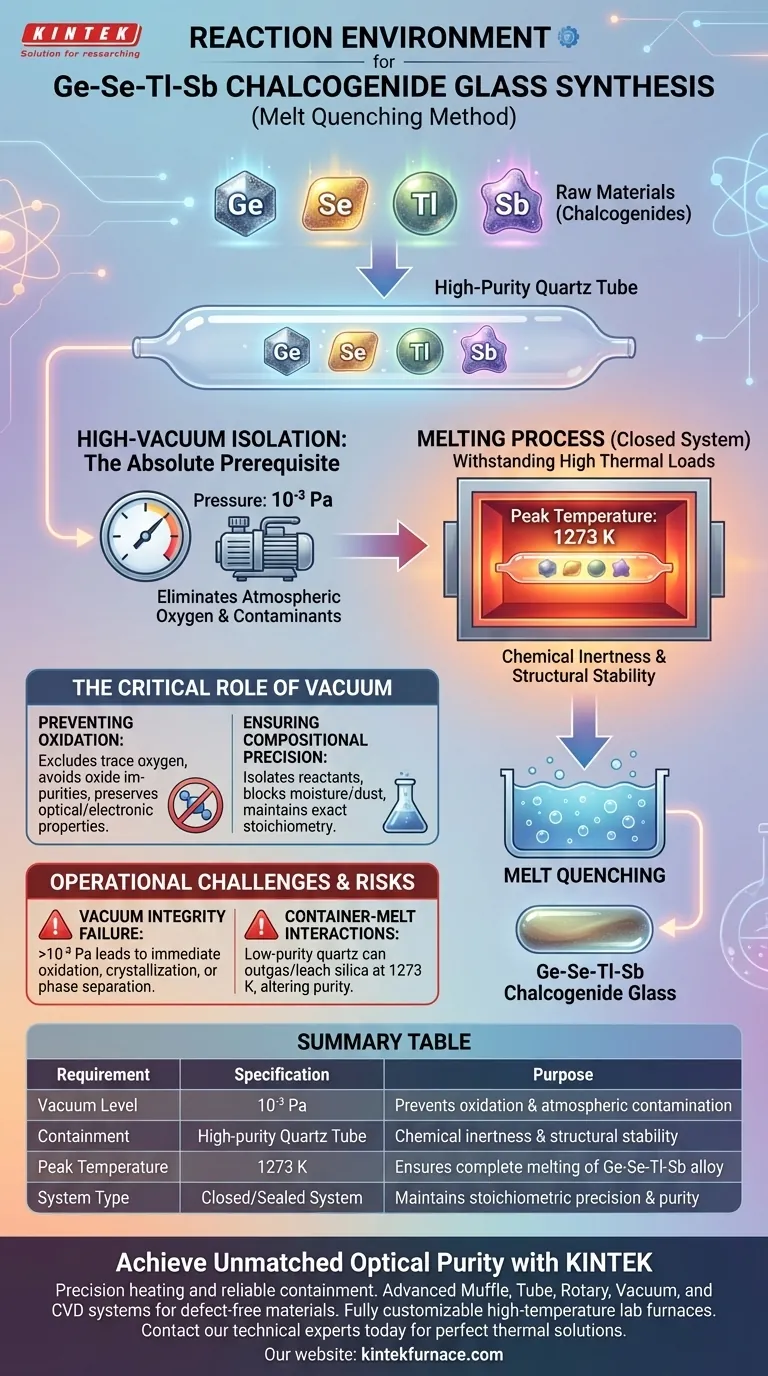
High-vacuum isolation is the absolute prerequisite for synthesizing Ge-Se-Tl-Sb chalcogenide glasses via melt quenching. Specifically, the reaction requires sealing raw materials within high-purity quartz tubes that have been evacuated to a pressure of 10⁻³ Pa. This sealed, oxygen-free environment is maintained throughout the melting process, which reaches temperatures as high as 1273 K.
The synthesis of high-purity chalcogenide glass relies on a closed system under high vacuum (10⁻³ Pa) to completely eliminate atmospheric oxygen and contaminants, preventing oxidation and ensuring precise alloy composition during high-temperature melting.
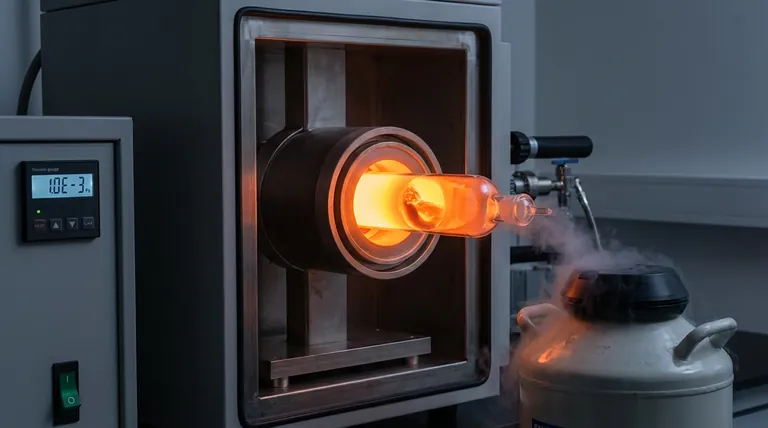
The Critical Role of the Vacuum Environment
Preventing Oxidation
The primary function of the 10⁻³ Pa vacuum is the exclusion of oxygen.
Chalcogenide elements (Ge, Se, Tl, Sb) are highly susceptible to oxidation at elevated temperatures. Even trace amounts of atmospheric oxygen can react with the melt, creating oxide impurities that degrade the optical and electronic properties of the final glass.
Ensuring Compositional Precision
Beyond oxidation, the sealed environment protects the stoichiometry of the alloy.
By isolating the reactants in a closed quartz system, you prevent the introduction of atmospheric moisture and dust. This ensures that the final glass composition strictly matches the intended Ge-Se-Tl-Sb ratio without external contamination.
Withstanding High Thermal Loads
The reaction environment must maintain its integrity under extreme heat.
The synthesis process involves heating the materials to 1273 K. High-purity quartz is selected as the containment material because it remains chemically inert and structurally stable at these temperatures, unlike standard glass or lesser ceramics.
Operational Challenges and Risks
Vacuum Integrity Failure
The success of the synthesis is binary; if the vacuum is compromised, the material is ruined.
If the pressure rises above 10⁻³ Pa due to a micro-leak or improper sealing, oxidation will occur immediately. This often results in crystallization or phase separation rather than the formation of a homogeneous glass.
Container-Melt Interactions
While quartz is robust, it is not invincible.
At 1273 K, the reactive melt is in direct contact with the tube walls. It is vital to use high-purity quartz to prevent the tube itself from outgassing or leaching silica into the chalcogenide melt, which would alter the refractive index and purity of the glass.
Ensuring Synthesis Success
To achieve optimal results with Ge-Se-Tl-Sb glasses, you must prioritize the quality of your containment and evacuation systems.
- If your primary focus is optical purity: Ensure your vacuum system can reliably sustain 10⁻³ Pa or lower to eliminate absorption bands caused by oxides.
- If your primary focus is mechanical stability: Verify that the quartz ampoules are rated for temperatures exceeding 1273 K to prevent rupture during the melt quenching phase.
Strict adherence to high-vacuum protocols is the only way to guarantee a homogeneous, defect-free chalcogenide glass.
Summary Table:
| Requirement | Specification | Purpose |
|---|---|---|
| Vacuum Level | 10⁻³ Pa | Prevents oxidation and atmospheric contamination |
| Containment | High-purity Quartz Tube | Chemical inertness and structural stability |
| Peak Temperature | 1273 K | Ensures complete melting of Ge-Se-Tl-Sb alloy |
| System Type | Closed/Sealed System | Maintains stoichiometric precision and purity |
Achieve Unmatched Optical Purity with KINTEK
High-vacuum synthesis of chalcogenide glasses demands precision heating and reliable containment. KINTEK provides the advanced technology needed to ensure your materials remain defect-free. Backed by expert R&D and manufacturing, we offer high-performance Muffle, Tube, Rotary, Vacuum, and CVD systems, as well as specialized high-temperature lab furnaces—all fully customizable to meet your unique synthesis requirements.
Ready to elevate your material research? Contact our technical experts today to find the perfect thermal solution for your laboratory.
Visual Guide
References
- A. M. Ismail, E.G. El-Metwally. Insight on the optoelectronic properties of novel quaternary Ge–Se–Tl–Sb non-crystalline glassy alloy films for optical fiber sensing devices. DOI: 10.1140/epjp/s13360-024-05012-6
This article is also based on technical information from Kintek Furnace Knowledge Base .
Related Products
- High Pressure Laboratory Vacuum Tube Furnace
- Magnesium Extraction and Purification Condensing Tube Furnace
- Vacuum Hot Press Furnace Machine Heated Vacuum Press Tube Furnace
- Vacuum Sealed Continuous Working Rotary Tube Furnace Rotating Tube Furnace
- 2200 ℃ Tungsten Vacuum Heat Treat and Sintering Furnace
People Also Ask
- What role does a high vacuum tube furnace play in Co-Al sintering? Master High-Purity Porous Material Synthesis
- What are the different types of tube furnaces available? Find the Perfect Fit for Your Lab's Needs
- What are the main advantages of vacuum tube furnaces in the market? Achieve Purity and Precision in Material Processing
- What is the role of a vacuum tube furnace during the final thermal treatment stage of Fe3O4@CSAC catalysts?
- Why is a laboratory tube furnace necessary for BiVO4/RGO synthesis? Achieve Precise Nano-Structure Control



















