
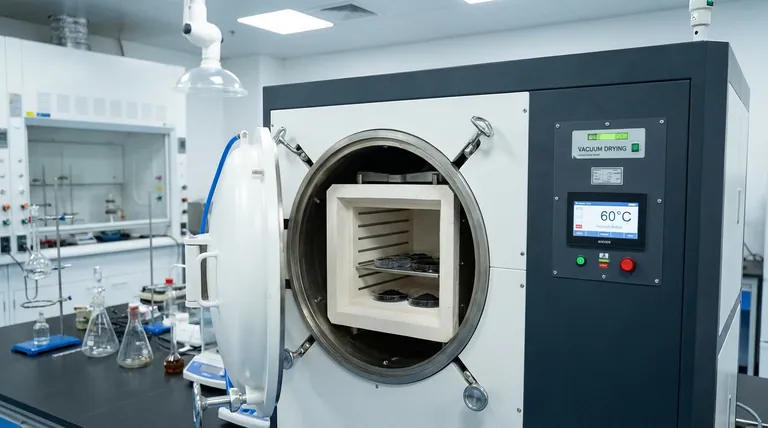
The use of a vacuum drying oven is strictly necessary to protect the chemical and structural integrity of Ti3C2 MXene@NiS or Ti3C2 MXene@Co4S3 precipitates during processing. By lowering environmental pressure, the oven allows solvents like water and ethanol to evaporate rapidly at relatively low temperatures, typically around 60°C. This specific environment is critical to prevent oxidative degradation, ensuring the catalyst retains its necessary active sites and surface morphology.
Core Insight: Vacuum drying is not just a method of solvent removal; it is a preservation strategy. It decouples evaporation from high thermal stress and oxygen exposure, preventing the irreversible degradation of sensitive MXene and metal sulfide nanostructures.
The Critical Role of Pressure Reduction
The primary function of the vacuum oven is to manipulate the boiling point of the solvents used in the synthesis of these precipitates.
Lowering Boiling Points
Under standard atmospheric pressure, removing solvents such as water or ethanol requires significant heat.
By creating a vacuum, you reduce the boiling point of these solvents. This allows them to volatilize rapidly at much lower temperatures (e.g., 60°C) than would be required in a standard convection oven.
Avoiding Thermal Degradation
Ti3C2 MXene and metal sulfides (NiS, Co4S3) are thermally sensitive materials.
Subjecting them to high heat to drive off moisture can damage their internal structure. Low-temperature vacuum drying mitigates this risk entirely.
Preserving Material Integrity
Beyond simple solvent removal, the vacuum environment addresses the specific chemical vulnerabilities of MXene-based composites.
Preventing Oxidative Degradation
The most significant threat to Ti3C2 MXene and metal sulfides is oxidation.
Standard drying ovens expose materials to heated air, which accelerates oxidation. A vacuum oven removes the air—and consequently the oxygen—from the chamber, creating an inert environment that effectively prevents the material from degrading into less active oxides.
Maximizing Active Sites
For catalytic applications, the chemical composition of the surface is paramount.
By preventing oxidation, you ensure that the specific "active sites" on the NiS or Co4S3 nanostructures remain available for reaction. High-temperature aerobic drying would likely deactivate these sites, rendering the catalyst ineffective.
Retaining Physical Morphology
The physical shape and porous structure of the precipitate define its surface area and performance.
Rapid evaporation under vacuum prevents the "hard agglomeration" or structural collapse that often occurs during slow, high-temperature drying. This ensures the material maintains a loose, porous micro-nano structure.
Common Pitfalls to Avoid
While vacuum drying is the correct method, improper execution can still lead to suboptimal results.
The Risk of Solvent "Bumping"
If the pressure is reduced too aggressively at the start, solvents may boil violently.
This can cause the material to splatter or damage the delicate framework of the precipitate. Pressure should be reduced gradually to ensure controlled evaporation.
Temperature Mismanagement
Even under vacuum, setting the temperature too high defeats the purpose of the process.
Adhere strictly to low-temperature settings (around 60°C for these specific composites). Excessive heat, even without oxygen, can still induce structural changes or phase transitions in metal sulfides.
Making the Right Choice for Your Goal
To maximize the performance of your Ti3C2 MXene composites, align your drying parameters with your specific catalytic requirements.
- If your primary focus is Maximizing Catalytic Activity: Prioritize oxygen exclusion by ensuring a high-quality vacuum seal to prevent the oxidation of surface active sites.
- If your primary focus is Structural Stability: Prioritize temperature control, keeping heat input strictly at or below 60°C to preserve the delicate physical morphology of the nanostructures.
By utilizing a vacuum drying oven, you ensure that the sophisticated catalyst you synthesized performs exactly as designed, rather than degrading before it ever reaches the test cell.
Summary Table:
| Parameter | Standard Convection Oven | Vacuum Drying Oven (KINTEK) |
|---|---|---|
| Drying Temperature | High (Potential thermal stress) | Low (~60°C) |
| Oxygen Exposure | High (Risk of oxidation) | Minimal to Zero (Inert environment) |
| Boiling Point | Standard | Reduced (Rapid low-temp evaporation) |
| Material Effect | Potential active site deactivation | Preserves active sites & morphology |
| Structural Impact | Risk of hard agglomeration | Maintains loose, porous structure |
Precision Processing for Advanced MXene Composites
Don’t let oxidation compromise your research. KINTEK’s high-performance vacuum drying ovens provide the precise pressure control and thermal stability needed to protect sensitive catalysts like Ti3C2 MXene@NiS and Ti3C2 MXene@Co4S3.
Backed by expert R&D and manufacturing, KINTEK offers a comprehensive range of Muffle, Tube, Rotary, Vacuum, and CVD systems. Whether you require standard lab equipment or a fully customizable high-temperature furnace tailored to your unique specifications, our solutions ensure your materials maintain their physical morphology and catalytic performance.
Ready to elevate your material synthesis? Contact KINTEK today for a custom quote!
References
- Mohit Kumar, Jae Su Yu. MXene composite with Ni/Co sulfide for enhanced hydrogen evolution reaction. DOI: 10.1039/d4qm00095a
This article is also based on technical information from Kintek Furnace Knowledge Base .
Related Products
- Vacuum Heat Treat Sintering and Brazing Furnace
- Vacuum Heat Treat Sintering Furnace Molybdenum Wire Vacuum Sintering Furnace
- Dental Porcelain Zirconia Sintering Ceramic Vacuum Press Furnace
- Vacuum Hot Press Furnace Machine for Lamination and Heating
- Vacuum Hot Press Furnace Machine Heated Vacuum Press
People Also Ask
- What are the benefits of using vacuum heat treating furnaces for metal alloys? Achieve Superior Metal Properties and Performance
- What is one of the most important uses of vacuum heat treating furnaces in aerospace? Achieve Superior Strength in Aircraft Alloys
- How does vacuum heat treating affect the grain structure of metal alloys? Achieve Precise Microstructure Control
- What is the temperature of a vacuum furnace brazing? Optimize Your Joint Strength and Cleanliness
- What are the steps involved in a typical vacuum brazing treatment? Master the Process for Strong, Clean Joints







