
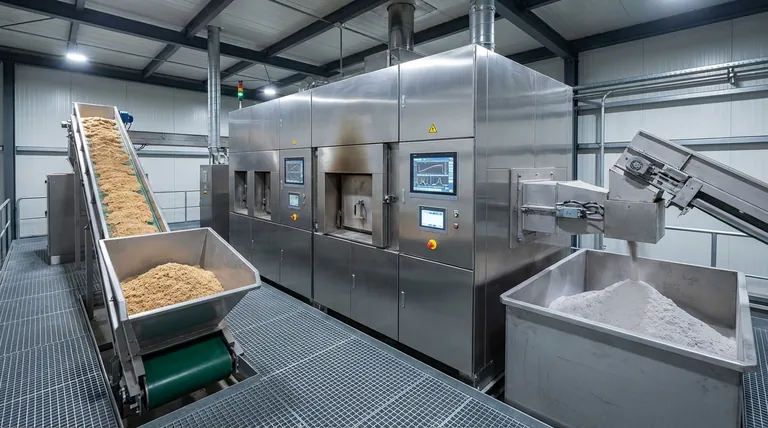
The critical role of a controlled temperature incinerator is to enforce precise thermal management during the combustion of raw rice husks. This controlled environment is the specific mechanism required to convert the silica within the husks into a chemically active, amorphous state.
By strictly regulating the heat treatment environment, the incinerator ensures the silica remains amorphous rather than becoming crystalline. This specific chemical state is the fundamental requirement for rice husk ash to function as a high-performance substitute for cement.
The Mechanism of Reactivity
Achieving Amorphous Silica
The primary function of the incinerator is to manage the transformation of silica. Raw rice husks naturally contain silica, but for industrial use, this silica must be processed into a specific form.
The incinerator provides the precise thermal environment needed to convert this raw material into amorphous silica. Without this control, the silica could transition into less desirable states that lack the necessary properties for advanced applications.
Ensuring Pozzolanic Reactivity
The value of rice husk ash lies in its pozzolanic reactivity. This refers to the material's ability to participate in chemical reactions that are vital for strengthening concrete.
The controlled temperature process ensures the resulting ash possesses this high reactivity. By maintaining specific heat parameters, the equipment guarantees that the ash is chemically active rather than inert.
Application in Concrete Production
Viability as a Cement Replacement
For rice husk ash to serve as a partial replacement for cement, it must meet strict performance standards. The controlled incineration process is the gatekeeper of this quality.
It ensures the final product is a viable additive for high-performance concrete applications. Without the chemical activity secured by the incinerator, the ash would not effectively contribute to the structural integrity of the concrete mixture.
Understanding the Risks of Improper Heating
Loss of Chemical Activity
The "controlled" aspect of the incinerator is not merely a feature; it is a necessity for preventing material failure.
If the thermal environment is not managed precisely, the silica conversion process becomes unreliable. This results in ash that lacks the required amorphous structure, rendering it chemically inactive.
Compromised End-Product Quality
When the heat treatment is unregulated, the ash fails to achieve the high pozzolanic reactivity needed for construction.
Using such substandard ash prevents it from acting as a functional cement replacement. This ultimately compromises the performance and durability of the concrete in which it is used.
Making the Right Choice for Your Goal
To maximize the utility of rice husk ash, you must align your processing method with your specific end-use requirements.
- If your primary focus is Chemical Reactivity: Ensure your incinerator is calibrated to prioritize the creation of amorphous silica, as this is the driver of pozzolanic activity.
- If your primary focus is Concrete Performance: Verify that your thermal management system consistently produces ash capable of partial cement replacement to meet high-performance standards.
Precision in thermal management is the difference between agricultural waste and a valuable industrial resource.
Summary Table:
| Key Feature | Impact on Rice Husk Ash | Industrial Benefit |
|---|---|---|
| Precise Thermal Management | Prevents silica crystallization | Ensures chemical reactivity |
| Amorphous Silica Conversion | Maintains non-crystalline state | High-performance cement replacement |
| Pozzolanic Reactivity Control | Maximizes chemical bonding | Increases concrete structural integrity |
| Regulated Environment | Prevents inert/substandard ash | Guarantees consistent material quality |
Elevate Your Material Production with KINTEK Precision
Don't let unregulated heating compromise your industrial output. KINTEK provides industry-leading thermal solutions, including Rotary, Vacuum, and CVD systems, engineered to deliver the precise environment needed for high-purity amorphous silica production.
Backed by expert R&D and manufacturing, our customizable lab and high-temperature furnaces ensure your rice husk ash meets the strictest performance standards for high-performance concrete. Ready to optimize your chemical reactivity? Contact us today to discuss your unique processing needs.
References
- Roz‐Ud‐Din Nassar, Shah Room. Strength, Durability, and Microstructural Characteristics of Binary Concrete Mixes Developed with Ultrafine Rice Husk Ash as Partial Substitution of Binder. DOI: 10.13189/cea.2025.130137
This article is also based on technical information from Kintek Furnace Knowledge Base .
Related Products
- Electric Rotary Kiln Small Rotary Furnace Biomass Pyrolysis Plant Rotating Furnace
- High Temperature Muffle Oven Furnace for Laboratory Debinding and Pre Sintering
- 1200℃ Muffle Oven Furnace for Laboratory
- Electric Rotary Kiln Small Rotary Furnace for Activated Carbon Regeneration
- Electric Rotary Kiln Continuous Working Small Rotary Furnace Kiln for Pyrolysis Plant Heating
People Also Ask
- What are the main applications of a rotary kiln electric furnace? Achieve Uniform Heat Treatment for Powders
- What are the key components of a rotary kiln electric furnace? Unlock Efficient Thermal Processing
- What is the significance of the refractory lining in a rotary kiln electric furnace? Unlock Efficiency and Longevity
- What is the benefit of adjustable speed control in rotary kilns? Optimize Efficiency and Quality
- What are the main advantages of using rotary kilns for bulk solids processing? Achieve High-Volume, Uniform Thermal Processing



















