
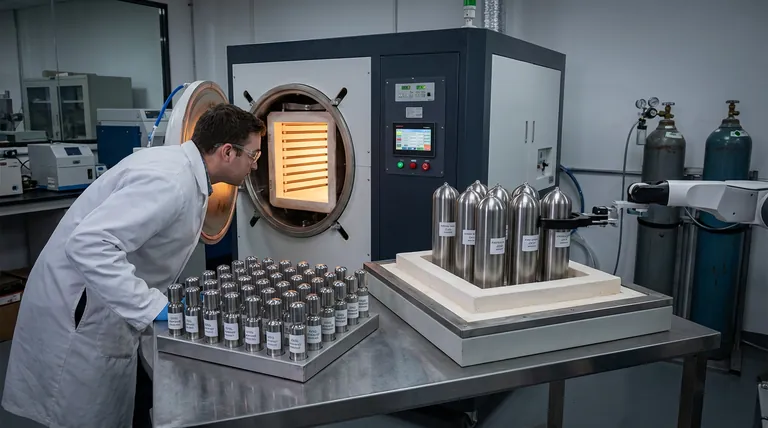
The significance of ampoule size lies in the trade-off between experimental precision and manufacturing efficiency. Large steel working ampoules are designed to maximize the effective space within a vacuum furnace for high-volume batch processing, while smaller ampoules are engineered to isolate variables, such as melt composition, enabling granular analysis of diffusion kinetics and layer formation.
The choice of ampoule size fundamentally shifts the focus of operation from scientific isolation to industrial efficiency. Small ampoules isolate variables for granular kinetic analysis, whereas large ampoules leverage furnace capacity for high-volume output.
Optimizing for Kinetic Precision
Enhancing Variable Control
When the primary goal is understanding high-temperature diffusion kinetics, small ampoules are the superior choice.
They allow researchers to exercise precise control over specific variables, particularly variations in melt composition. This isolation is difficult to achieve in larger volumes where homogeneity can be harder to maintain.
Analyzing Diffusion Mechanisms
Small ampoules create a controlled physical environment that is ideal for fundamental research.
By limiting the scale, researchers can perform an in-depth analysis of the diffusion layer formation. This helps in accurately characterizing the mechanisms at play without the compounding factors often found in larger-scale processing.
Scaling for Production Efficiency
Maximizing Furnace Geometry
For industrial applications, the priority shifts from isolating variables to maximizing throughput.
Large-scale ampoules are utilized to occupy the maximum effective working space of the vacuum furnace. This ensures that the energy consumed by the furnace yields the highest possible return in terms of treated material.
Enabling Batch Processing
The use of large ampoules is essential for the batch processing of components.
While this approach may sacrifice the hyper-local control available in smaller vessels, it provides the necessary efficiency required for manufacturing or pilot-scale production runs.
Understanding the Strategic Trade-offs
The Cost of Precision
While small ampoules offer the highest data fidelity for kinetic studies, they are inherently inefficient for production.
Using small ampoules for anything other than research or sampling results in wasted furnace capacity and increased processing time per unit.
The Risk of Scale
Conversely, relying solely on large ampoules can mask subtle kinetic behaviors.
If used during the initial research phase, large ampoules may introduce macro-level variables that obscure the precise diffusion mechanisms you are trying to isolate.
Aligning Ampoule Size with Your Objective
To select the correct equipment, you must define the current phase of your project.
- If your primary focus is Fundamental Research: Choose small ampoules to rigorously control melt composition and isolate the specific mechanisms of diffusion layer formation.
- If your primary focus is Industrial Application: Choose large ampoules to maximize the effective working space of the furnace and achieve efficient batch processing.
Ultimately, the correct specification depends on whether your immediate priority is dissecting the science of diffusion or maximizing the efficiency of the manufacturing process.
Summary Table:
| Factor | Small Ampoules | Large Ampoules |
|---|---|---|
| Primary Goal | Scientific Research & Variable Isolation | Industrial Throughput & Batch Efficiency |
| Variable Control | High (Precise control of melt composition) | Lower (Focus on volume homogeneity) |
| Analysis Focus | Granular kinetic/layer formation analysis | Maximizing effective furnace geometry |
| Best Used For | Fundamental diffusion studies | High-volume manufacturing/Pilot runs |
| Efficiency | Low (Research intensive) | High (Optimized for furnace capacity) |
Elevate Your Diffusion Research with KINTEK
Precision starts with the right environment. Backed by expert R&D and manufacturing, KINTEK offers a comprehensive range of Muffle, Tube, Rotary, Vacuum, and CVD systems, all fully customizable to fit your unique experimental or industrial needs.
Whether you are isolating variables in small ampoules for granular kinetic analysis or maximizing throughput with large-scale batch processing, our high-temperature lab furnaces provide the stability and control your materials demand.
Ready to optimize your thermal processing? Contact us today to find your custom solution!
Visual Guide

References
- Ismatov Jumaniez Faizullaevich. Mplementation Of The Process Of High Temperature Diffusion Treatment. DOI: 10.37547/ajast/volume05issue11-22
This article is also based on technical information from Kintek Furnace Knowledge Base .
Related Products
- Vacuum Hot Press Furnace Machine Heated Vacuum Press Tube Furnace
- Vacuum Hot Press Furnace Machine Heated Vacuum Press
- 600T Vacuum Induction Hot Press Vacuum Heat Treat and Sintering Furnace
- 2200 ℃ Tungsten Vacuum Heat Treat and Sintering Furnace
- Vacuum Heat Treat Sintering Furnace with Pressure for Vacuum Sintering
People Also Ask
- Why use Vacuum Hot Press (VHP) for ZnS Ceramics? Achieve Superior IR Transparency and Mechanical Strength
- What are the benefits of the vacuum environment system in a vacuum hot press furnace? Unlock High-Density Sintering
- What safety features are incorporated in vacuum hot press furnaces? Ensure Operator and Equipment Protection
- What is the significance of the vacuum environment for sintering stainless steel? Unlock High-Density Purity
- How does a vacuum hot press furnace promote densification in the manufacturing of graphite flake/copper composites? Achieve Superior Composite Materials



















