
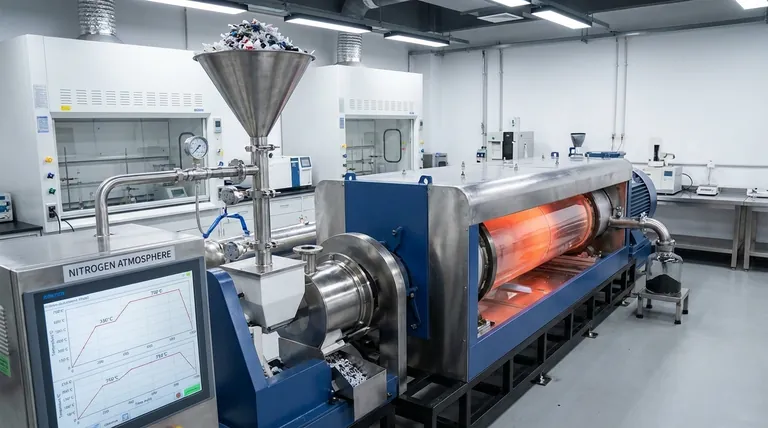
The pyrolysis furnace acts as the central reactor in the conversion of waste plastics into graphene nanosheets. It provides a precise, oxygen-free environment where high temperatures drive the dissociation of plastic polymers and the subsequent reconstruction of carbon atoms into the hexagonal lattice structure of graphene.
Core Takeaway The pyrolysis furnace functions as a molecular restructuring chamber. By maintaining an inert nitrogen atmosphere and utilizing staged heating, it facilitates the chemical cracking of long-chain hydrocarbons and the reassembly of the carbon skeleton into high-value graphene nanosheets.
Creating the Reaction Environment
The Necessity of an Inert Atmosphere
To create graphene rather than simply burning the plastic, combustion must be prevented.
The furnace maintains a strictly inert Nitrogen atmosphere (or occasionally Argon) throughout the process. This ensures that when the material is heated, it undergoes thermal decomposition without reacting with oxygen.
Uniform Heat Transfer
The physical structure of the furnace, often a horizontal tube design, utilizes a stainless steel shell and internal heating elements.
This design ensures uniform heat transfer to the reaction vessel. Consistent temperature distribution is critical to prevent hot spots that could lead to uneven quality in the resulting nanomaterials.
The Mechanism of Transformation
Driving Chemical Cracking
The primary role of the furnace is to facilitate chemical cracking.
Under high heat, the long-chain hydrocarbons that make up the plastic polymers are broken down. This process dissociates the waste material, stripping away hydrogen and other non-carbon elements to isolate the carbon precursors.
Reconstruction of the Carbon Skeleton
Once the polymer chains are broken, the furnace environment allows for the reconstruction of the carbon skeleton.
The liberated carbon atoms rearrange themselves. Instead of returning to a disordered state, the controlled thermal energy encourages them to bond into the ordered, thin-layer structures characteristic of graphene nanosheets.
Staged Heating Protocols
The conversion process is rarely a single-step heating event.
The furnace is capable of staged heating, often targeting specific plateaus such as 350°C and 750°C. These specific temperature zones allow different phases of decomposition and graphitization to occur sequentially, maximizing the yield of high-value-added carbon nanomaterials.
Understanding the Trade-offs
Temperature Precision vs. Material Quality
The effectiveness of the furnace relies heavily on its ability to maintain precise temperatures.
If the temperature is too low (e.g., failing to reach the upper ranges like 750°C-900°C), the carbonization may be incomplete, resulting in low-quality char rather than graphene. Conversely, uncontrolled fluctuations can disrupt the lattice formation.
Atmosphere Integrity
The "inert" status of the furnace environment is a critical failure point.
Any leak in the furnace seal that introduces oxygen will immediately degrade the process. instead of reconstructing the carbon skeleton, the system will oxidize the carbon, effectively turning your feedstock into useless ash and CO2.
Making the Right Choice for Your Goal
The specific configuration of your pyrolysis furnace determines the quality of your graphene output.
- If your primary focus is high-quality lattice structure: Prioritize a furnace with advanced staged heating controls to precisely manage the transition between 350°C and 750°C.
- If your primary focus is process consistency: Ensure the furnace utilizes a high-grade stainless steel shell and heating elements that guarantee uniform heat transfer across the entire tube length.
Success in graphene production depends less on the heat itself, and more on the precision with which that heat is applied and controlled.
Summary Table:
| Feature | Role in Graphene Synthesis | Impact on Output |
|---|---|---|
| Inert Atmosphere | Prevents combustion using Nitrogen/Argon | Pure carbon recovery vs. oxidation |
| Staged Heating | Manages decomposition and graphitization | Maximizes yield of thin-layer nanosheets |
| Uniform Heat Transfer | Ensures consistent molecular restructuring | Prevents hot spots and structural defects |
| Chemical Cracking | Dissociates long-chain plastic polymers | Isolates carbon atoms for reconstruction |
Unlock the Value of Waste with KINTEK
Transition from waste to high-performance carbon nanomaterials with KINTEK’s advanced thermal technology. Backed by expert R&D and manufacturing, KINTEK offers Muffle, Tube, Rotary, Vacuum, and CVD systems—all fully customizable to meet the rigorous demands of graphene synthesis and plastic pyrolysis.
Whether you require precise staged heating protocols or superior atmosphere integrity, our engineering team provides the reliable equipment needed to ensure your carbonization is complete and high-quality.
Ready to scale your lab's capabilities? Contact us today to discover how our high-temperature furnaces can optimize your material production.
References
- Sunil Dhali, Nanda Gopal Sahoo. Waste plastic derived nitrogen-doped reduced graphene oxide decorated core–shell nano-structured metal catalyst (WpNrGO-Pd–Ru) for a proton exchange membrane fuel cell. DOI: 10.1039/d3ma01006f
This article is also based on technical information from Kintek Furnace Knowledge Base .
Related Products
- Electric Rotary Kiln Small Rotary Furnace Biomass Pyrolysis Plant Rotating Furnace
- Electric Rotary Kiln Pyrolysis Furnace Plant Machine Small Rotary Kiln Calciner
- Electric Rotary Kiln Continuous Working Small Rotary Furnace Kiln for Pyrolysis Plant Heating
- Vacuum Heat Treat Sintering Furnace with Pressure for Vacuum Sintering
- High Temperature Muffle Oven Furnace for Laboratory Debinding and Pre Sintering
People Also Ask
- What are the key components of a rotary kiln electric furnace? Unlock Efficient Thermal Processing
- What are the main applications of a rotary kiln electric furnace? Achieve Uniform Heat Treatment for Powders
- What is the significance of the refractory lining in a rotary kiln electric furnace? Unlock Efficiency and Longevity
- What are the key components of a rotary kiln's construction? Discover the Essential Parts for Efficient Industrial Processing
- What role does the rotary kiln serve in coal-based DRI production? Unlock Cost-Effective Ironmaking Efficiency



















