
The primary advantage of a customized multimode microwave reaction furnace is its ability to utilize volumetric heating, where electromagnetic waves act directly on reactant molecules rather than relying on slow thermal conduction. This fundamental shift in heat transfer allows for a dramatic reduction in total processing time—often exceeding 90%—while simultaneously offering researchers superior control over the microscopic structure of the final carbon material.
Traditional heating methods are limited by how quickly heat can travel from a furnace wall to the center of a sample. By switching to microwave volumetric heating, you bypass this thermal lag, compressing days of synthesis into hours while achieving a level of structural precision that is difficult to replicate with conventional ovens.
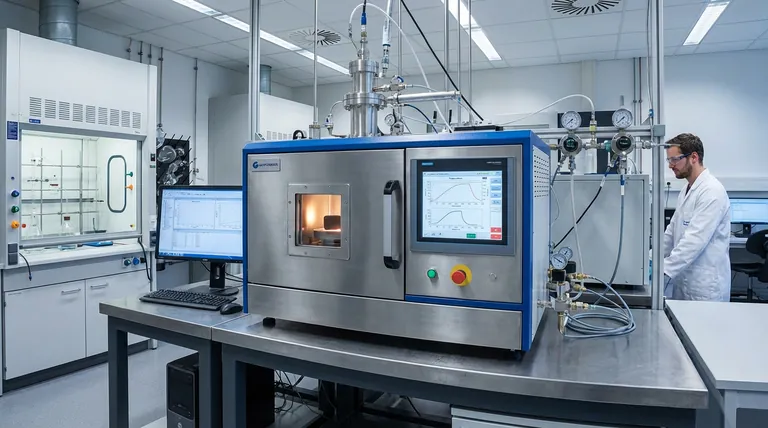
The Mechanism of Volumetric Heating
Direct Molecular Interaction
Unlike traditional furnaces that heat a sample from the outside in, a multimode microwave furnace uses electromagnetic waves.
These waves interact directly with the reactant molecules throughout the entire sample volume.
Eliminating Thermal Gradients
This process results in volumetric heating, where heat is generated internally and instantaneously.
This ensures the material is heated uniformly, avoiding the temperature gradients and "cold centers" common in conventional conduction heating.
Accelerating the Sol-Gel Workflow
Drastic Reduction in Processing Time
The most immediate operational benefit is speed.
Using microwave heating can reduce the total processing time for carbon material synthesis by more than 90 percent.
Streamlining Critical Stages
This efficiency is not limited to a single step but applies across the entire sol-gel procedure.
Key phases such as polymerization, aging, and drying are all significantly accelerated, allowing for much faster iteration and production cycles.
Achieving Structural Precision
Tuning the Pore Hierarchy
Beyond speed, microwave heating offers a qualitative advantage in material design.
It provides precise control over the hierarchical pore structure of carbon gels.
Optimizing Micropores and Mesopores
Researchers can fine-tune the furnace parameters to achieve specific distributions of micropores and mesopores.
This capability is essential for tailoring carbon materials for specific high-performance applications, such as filtration or energy storage.
Understanding the Trade-offs
Equipment Complexity
While the results are superior, a "customized" furnace implies a move away from standard, off-the-shelf laboratory ovens.
Operators must be comfortable managing electromagnetic parameters rather than just setting a simple temperature dial.
Process Calibration
Achieving the precise pore distribution described requires careful calibration.
Because the heating is so rapid, the window for error is smaller; parameters must be dialed in correctly to prevent overheating or structural collapse.
Making the Right Choice for Your Goal
To determine if this technology aligns with your synthesis requirements, consider your primary objectives:
- If your primary focus is Production Throughput: Leverage the volumetric heating capability to reduce polymerization and drying times by over 90 percent.
- If your primary focus is Material Performance: Utilize the precise control over electromagnetic waves to engineer specific distributions of micropores and mesopores.
Mastering this technology allows you to decouple synthesis speed from material quality, achieving faster production without sacrificing structural integrity.
Summary Table:
| Feature | Microwave Volumetric Heating | Traditional Conduction Heating |
|---|---|---|
| Heating Mechanism | Direct molecular interaction (Internal) | External surface-to-core conduction |
| Processing Time | Reduced by >90% (Hours vs. Days) | Standard/Slow |
| Temperature Gradient | Uniform heating; eliminates cold centers | Significant thermal lag and gradients |
| Structural Control | Precise tuning of micro/mesopores | Limited control over pore hierarchy |
| Workflow Efficiency | Accelerates polymerization, aging, & drying | Sequential, time-consuming stages |
Unlock Precision and Speed in Your Lab
Ready to transform your material synthesis with a 90% reduction in processing time? KINTEK provides the cutting-edge technology you need. Backed by expert R&D and world-class manufacturing, we offer a comprehensive range of Muffle, Tube, Rotary, Vacuum, and CVD systems—all fully customizable to meet your specific research or production requirements.
Whether you are engineering complex pore structures or scaling up carbon material production, our team is here to provide the ideal high-temperature solution. Contact us today to discuss your custom furnace needs and see how KINTEK can enhance your lab's efficiency and material performance!
References
- Belén Lobato, Ana Arenillas. Designing and Optimizing Electrode Materials for Energy Harvesting in CAPMIX Cells. DOI: 10.3390/nano14242031
This article is also based on technical information from Kintek Furnace Knowledge Base .
Related Products
- Multi Heating Zones CVD Tube Furnace Machine for Chemical Vapor Deposition Equipment
- Multi Zone Laboratory Quartz Tube Furnace Tubular Furnace
- MPCVD Machine System Reactor Bell-jar Resonator for Lab and Diamond Growth
- Split Multi Heating Zone Rotary Tube Furnace Rotating Tube Furnace
- Custom Made Versatile CVD Tube Furnace Chemical Vapor Deposition CVD Equipment Machine
People Also Ask
- What is the function of a multi-zone tube furnace in CVD synthesis? Master 2D In2Se3 Nanosheet Precision
- What environmental protection applications utilize multi zone tube furnaces? Unlock Precision in Waste Treatment and Green Tech
- What role do multi zone tube furnaces play in new energy research? Unlock Precise Thermal Control for Innovation
- Why are multi zone tube furnaces particularly useful for nanomaterial research? Unlock Precise Thermal Control for Advanced Synthesis
- What temperature-related capabilities make multi zone tube furnaces valuable for research? Unlock Precision Thermal Control



















