
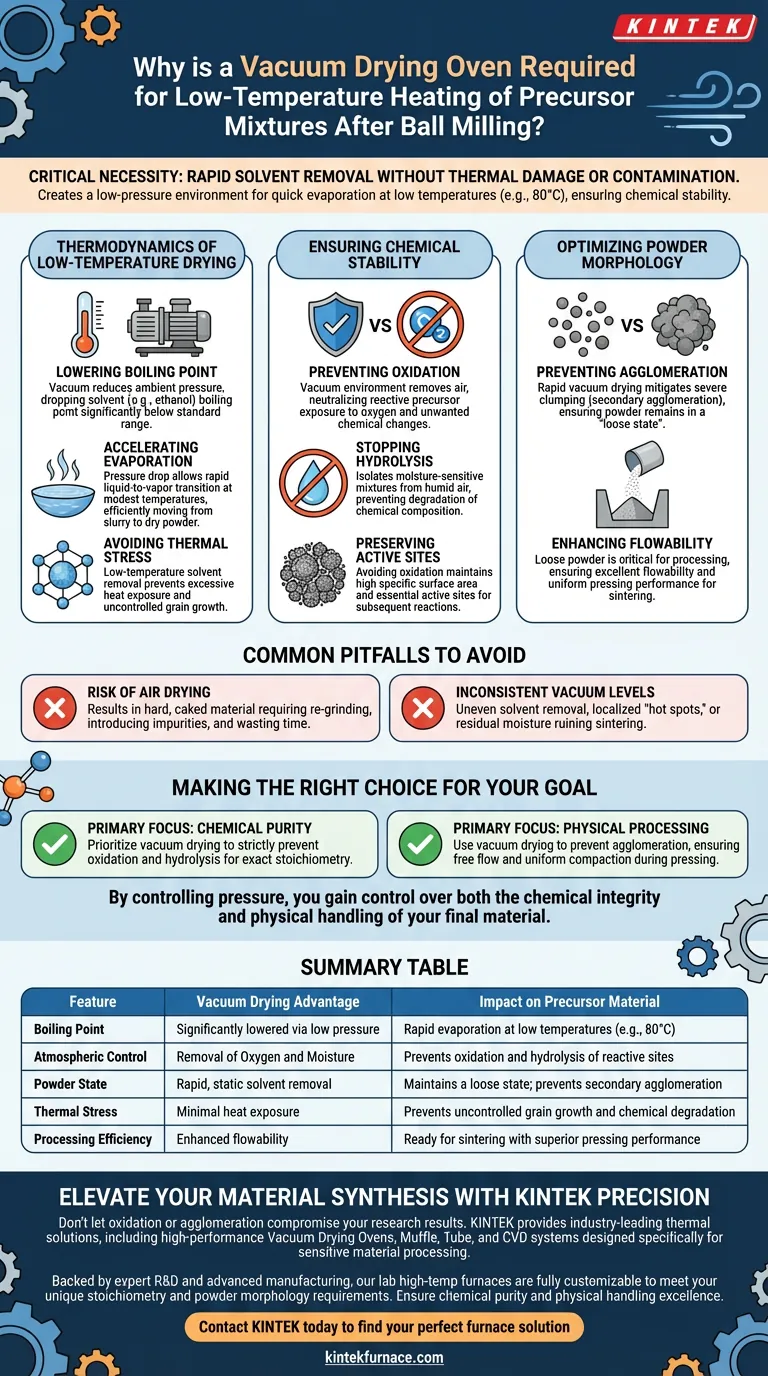
The critical necessity of a vacuum drying oven lies in its ability to rapidly remove solvents from post-milling slurries without subjecting the material to thermal damage or atmospheric contamination. By creating a low-pressure environment, the oven allows solvents like ethanol to evaporate quickly at temperatures as low as 80°C, ensuring the precursor remains chemically stable.
The vacuum environment fundamentally alters the drying dynamics by lowering the solvent's boiling point. This allows for rapid drying that prevents oxidation and agglomeration, yielding a loose, high-quality powder ready for sintering.
The Thermodynamics of Low-Temperature Drying
Lowering the Boiling Point
The primary mechanism at work is the reduction of ambient pressure. In a vacuum, the boiling point of solvents like ethanol drops significantly below their standard range.
Accelerating Evaporation
This pressure drop allows the liquid phase to evaporate rapidly, even at modest temperatures (e.g., 80°C). This speed is essential for moving from a slurry state to a dry powder efficiently.
Avoiding Thermal Stress
Because the solvent boils off at a lower temperature, the precursor material is not exposed to excessive heat. This prevents uncontrolled grain growth that often occurs during high-temperature drying processes.
Ensuring Chemical Stability
Preventing Oxidation
Standard air drying exposes reactive precursors to oxygen, leading to unwanted chemical changes. A vacuum environment removes air from the chamber, effectively neutralizing the risk of oxidation.
Stopping Hydrolysis
Many precursor mixtures are sensitive to moisture in the air. By drying in a vacuum, you isolate the material from humid air, preventing hydrolysis reactions that would degrade the chemical composition of the mixture.
Preserving Active Sites
For advanced materials like nanosheets, avoiding oxidation preserves the material's high specific surface area. This maintains the essential active sites required for subsequent compositing or reactions.
Optimizing Powder Morphology
Preventing Agglomeration
Drying in a static, non-vacuum environment often leads to severe clumping, or secondary agglomeration. Rapid vacuum drying mitigates this, ensuring the powder remains in a "loose state."
Enhancing Flowability
A loose, non-agglomerated powder is critical for the next stage of processing. It ensures excellent flowability and pressing performance, allowing the material to be easily transferred to sintering crucibles or molded into shapes.
Common Pitfalls to Avoid
The Risk of Air Drying
Attempting to bypass the vacuum stage and using a standard air oven is a common error. This typically results in a hard, caked material that requires re-grinding, introducing impurities and wasting time.
Inconsistent Vacuum Levels
If the vacuum pressure is not maintained consistently, solvent removal becomes uneven. This can lead to localized "hot spots" in the powder or residual moisture that ruins the sintering process later.
Making the Right Choice for Your Goal
To maximize the quality of your precursor powder, align your drying strategy with your specific material requirements:
- If your primary focus is Chemical Purity: Prioritize vacuum drying to strictly prevent oxidation and hydrolysis, ensuring the stoichiometry remains exact.
- If your primary focus is Physical Processing: Use vacuum drying to prevent agglomeration, ensuring the powder flows freely and compacts uniformly during pressing.
By controlling pressure, you gain control over both the chemical integrity and physical handling of your final material.
Summary Table:
| Feature | Vacuum Drying Advantage | Impact on Precursor Material |
|---|---|---|
| Boiling Point | Significantly lowered via low pressure | Rapid evaporation at low temperatures (e.g., 80°C) |
| Atmospheric Control | Removal of Oxygen and Moisture | Prevents oxidation and hydrolysis of reactive sites |
| Powder State | Rapid, static solvent removal | Maintains a loose state; prevents secondary agglomeration |
| Thermal Stress | Minimal heat exposure | Prevents uncontrolled grain growth and chemical degradation |
| Processing Efficiency | Enhanced flowability | Ready for sintering with superior pressing performance |
Elevate Your Material Synthesis with KINTEK Precision
Don't let oxidation or agglomeration compromise your research results. KINTEK provides industry-leading thermal solutions, including high-performance Vacuum Drying Ovens, Muffle, Tube, and CVD systems designed specifically for sensitive material processing.
Backed by expert R&D and advanced manufacturing, our lab high-temp furnaces are fully customizable to meet your unique stoichiometry and powder morphology requirements. Ensure chemical purity and physical handling excellence—Contact KINTEK today to find your perfect furnace solution.
Visual Guide
References
- Jiadong Chen, Wenhao Sun. Navigating phase diagram complexity to guide robotic inorganic materials synthesis. DOI: 10.1038/s44160-024-00502-y
This article is also based on technical information from Kintek Furnace Knowledge Base .
Related Products
- Vacuum Heat Treat Sintering and Brazing Furnace
- Vacuum Heat Treat Sintering Furnace Molybdenum Wire Vacuum Sintering Furnace
- Dental Porcelain Zirconia Sintering Ceramic Vacuum Press Furnace
- Vacuum Hot Press Furnace Machine for Lamination and Heating
- Vacuum Hot Press Furnace Machine Heated Vacuum Press
People Also Ask
- What is one of the most important uses of vacuum heat treating furnaces in aerospace? Achieve Superior Strength in Aircraft Alloys
- How does vacuum heat treating affect the grain structure of metal alloys? Achieve Precise Microstructure Control
- What are the benefits of using vacuum heat treating furnaces for metal alloys? Achieve Superior Metal Properties and Performance
- What is the temperature of a vacuum furnace brazing? Optimize Your Joint Strength and Cleanliness
- What are the steps involved in a typical vacuum brazing treatment? Master the Process for Strong, Clean Joints







