
Testing at 1250°C serves as a critical stress test for determining the upper limits of advanced alloy performance. This specific temperature threshold is used to simulate the extreme operational environment of gas turbine blades, allowing engineers to observe how materials behave near their absolute service limits. By replicating these conditions in a controlled setting, researchers can verify structural integrity and predict potential failures before components are deployed.
The primary value of this thermal simulation is the detection of brittle Topologically Close-Packed (TCP) phases, such as the σ phase. Identifying these phases is essential for validating the long-term reliability of alloys containing rhenium and tantalum.
Simulating Real-World Extremes
Replicating Gas Turbine Environments
The 1250°C benchmark is not an arbitrary figure; it is designed to mirror the harsh working conditions of high-performance gas turbine blades.
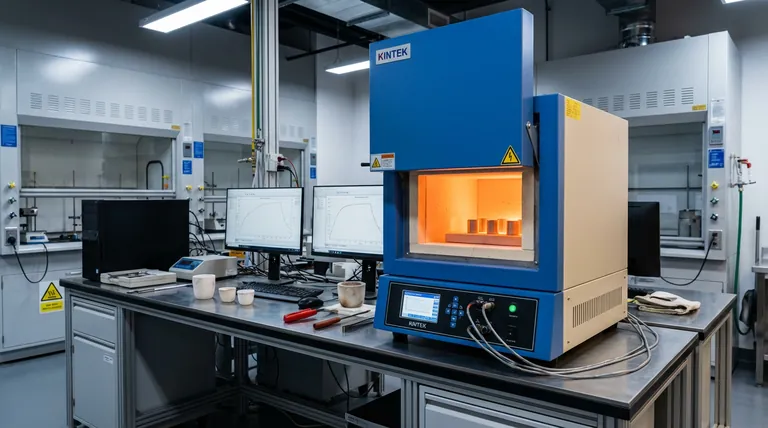
Standard heating equipment is insufficient for this task. Specialized high-temperature furnaces or calorimeters are required to maintain stability at these extremes.
Validating High-Performance Elements
This testing is particularly relevant for complex alloys containing rhenium and tantalum.
These elements are added to enhance performance, but their stability must be verified. Testing at this temperature confirms that the alloy maintains its structural integrity even when pushed to the edge of its service capabilities.
Identifying Structural Weaknesses
Detecting Brittle Phases
The most critical structural risk at these temperatures is the precipitation of Topologically Close-Packed (TCP) phases.
Among these, the σ (sigma) phase is a primary concern. If these phases form, they significantly compromise the material's mechanical properties.
Preventing Structural Failure
When TCP phases precipitate, they render the alloy brittle.
This brittleness reduces the material's ability to withstand stress without fracturing. Detecting this precipitation early ensures that only alloys capable of maintaining ductility are selected for long-term operations.
Understanding the Trade-offs
The Limit of Simulation
While heating to 1250°C provides vital data, it represents a "worst-case" scenario for many materials.
It is a pass/fail threshold for long-term reliability. An alloy that exhibits phase instability at this temperature is generally deemed unsuitable for critical turbine applications, regardless of its performance at lower temperatures.
Making the Right Choice for Your Goal
To ensure your material selection meets the demands of high-stress environments, consider the following:
- If your primary focus is component longevity: Prioritize alloys that show zero precipitation of the σ phase during 1250°C simulations.
- If your primary focus is material composition: Ensure that alloys containing rhenium and tantalum have been specifically validated against TCP phase formation at this temperature threshold.
Successful thermal simulation at this level is the definitive gatekeeper for ensuring operational safety in gas turbine technology.
Summary Table:
| Feature | Significance at 1250°C |
|---|---|
| Target Application | High-performance gas turbine blades |
| Key Elements Validated | Rhenium (Re) and Tantalum (Ta) |
| Primary Risk Detected | Brittle Topologically Close-Packed (TCP) phases |
| Structural Concern | Sigma (σ) phase precipitation causing brittleness |
| Performance Goal | Long-term structural integrity and operational safety |
Maximize Your Material Reliability with KINTEK
Precise thermal simulation is the only way to guarantee the safety of high-performance components. Backed by expert R&D and manufacturing, KINTEK offers high-performance Muffle, Tube, Rotary, Vacuum, and CVD systems designed to reach 1250°C and beyond with unmatched stability.
Whether you are studying TCP phase precipitation or validating complex alloys containing rhenium and tantalum, our customizable lab high-temperature furnaces provide the precision your research demands.
Ready to push the limits of alloy performance? Contact us today to find the perfect thermal solution for your unique laboratory needs.
Visual Guide

References
- Yu. H. Kvasnytska, K. H. Kvasnytska. Influence of Refractory Elements on Phase–Structural Stability of Heat-Resistant Corrosion-Resistant Alloys for Gas Turbine Blades. DOI: 10.15407/mfint.45.08.0975
This article is also based on technical information from Kintek Furnace Knowledge Base .
Related Products
- 1200℃ Muffle Oven Furnace for Laboratory
- 1200℃ Controlled Inert Nitrogen Atmosphere Furnace
- 1200℃ Split Tube Furnace Laboratory Quartz Tube Furnace with Quartz Tube
- High Temperature Muffle Oven Furnace for Laboratory Debinding and Pre Sintering
- 1400℃ High Temperature Laboratory Tube Furnace with Alumina Tube
People Also Ask
- How does a high-temperature laboratory muffle furnace affect material properties? Transform Anodic Oxide Films Fast
- What is the primary function of a high-temperature laboratory muffle furnace in chemical synthesis? Achieve Precision.
- How is a laboratory muffle furnace used in 3D-printed PP-CF cross-linking? Achieve Thermal Stability at 150 °C
- How is a laboratory high-temperature muffle furnace used to evaluate porous Co-Al materials? Precision Thermal Analysis
- What role does a muffle furnace play in plant bark mineral analysis? Essential for Precise Dry Ashing & Trace Extraction



















