
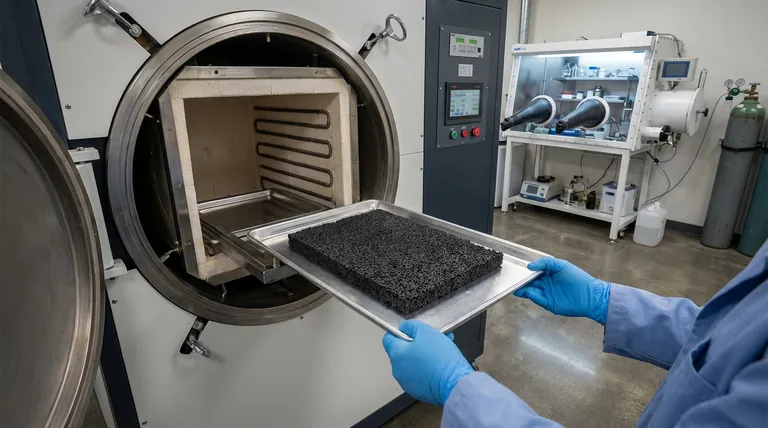
The use of a vacuum drying oven is mandatory to eliminate deep-seated moisture and solvents without thermally damaging the delicate porous structure of the cathode.
Standard thermal drying is insufficient for porous graphene (PG) because it often traps liquid in microscopic pores or requires temperatures that degrade the material. Vacuum drying lowers the boiling point of these residuals, ensuring complete removal at safe temperatures to prevent impurity-driven failure in the final battery cell.
The critical function of vacuum drying is to prevent residual water from chemically reacting with organic electrolytes. By removing moisture from deep micropores at low temperatures, you preserve the electrode's structural integrity and safeguard the battery's electrochemical performance and cycle life.
The Challenge of Deep Pore Moisture
Overcoming Capillary Action
Porous graphene composites are defined by their high surface area and intricate network of microscopic pores. Liquids like water, ethanol, or methanol often become trapped deep within these structures due to capillary forces.
The Limits of Standard Drying
In a standard convection oven, evaporating solvent from these deep pores is inefficient. Surface moisture evaporates first, potentially creating a "crust" or barrier that traps internal moisture, which leads to catastrophic failure later in the production line.
The Vacuum Solution
Vacuum drying operates by significantly lowering the ambient pressure. This physical change drops the boiling point of solvents, forcing them to flash into vapor even from the deepest pores, ensuring the material is thoroughly dried before it enters the glove box.
Preventing Chemical Failure
The Water-Electrolyte Danger
The primary reference highlights a specific, critical risk for Lithium-Oxygen (Li-O2) batteries: electrolyte contamination.
Reaction Risks
If residual water remains in the porous graphene, it will react with organic electrolytes once the battery is assembled. This reaction introduces impurities that degrade electrochemical performance.
Safeguarding Cycle Life
By ensuring absolute dryness, vacuum processing prevents these parasitic reactions. This is the only way to ensure the battery achieves its expected cycle life and stability.
Preserving Structural Integrity
Low-Temperature Processing
Graphene composites and associated nanomaterials can be thermally sensitive. Vacuum ovens allow for effective drying at significantly lower temperatures, typically between 60°C and 80°C.
Preventing Pore Collapse
High temperatures required for standard drying can cause the internal framework of porous materials to collapse or "melt" together. Low-temperature vacuum drying preserves the hierarchical morphology and specific surface area required for ion transport.
Avoiding Oxidation
At high temperatures, graphene and carbon-based composites are susceptible to oxidation if exposed to air. The vacuum environment removes oxygen, effectively preventing the material's surface structure from degrading or losing its conductive properties.
Preventing Agglomeration
Heat can cause nanoparticles to clump together (agglomerate), reducing their active surface area. Vacuum drying mitigates this risk, keeping the active sites accessible for the electrochemical reactions.
Understanding the Trade-offs
Processing Time vs. Throughput
While vacuum drying provides superior quality, it is generally a batch process that can be slower than continuous convection drying. This creates a potential bottleneck in high-volume manufacturing that must be managed.
Equipment Sensitivity
Vacuum pumps must be carefully maintained. If the system is not properly isolated or trapped, there is a risk of oil backstreaming from the pump into the chamber, which would contaminate the ultra-pure cathode material.
Thermal Transfer Limitations
In a vacuum, heat does not transfer via convection (air movement). It relies on conduction from shelf to tray. This requires careful loading of the oven to ensure the PG powder is spread evenly and makes good thermal contact with the heated shelves.
Making the Right Choice for Your Goal
When configuring your drying protocol for porous graphene cathodes, consider the following:
- If your primary focus is Electrochemical Stability: Prioritize longer drying cycles at higher vacuum levels to ensure zero residual moisture, preventing electrolyte decomposition.
- If your primary focus is Surface Area Preservation: Limit the temperature to 60°C to prevent any risk of pore collapse or agglomeration, relying on the vacuum pressure to drive evaporation.
- If your primary focus is Material Purity: Ensure your vacuum system utilizes cold traps to capture solvents and prevent pump oil contamination of the porous carbon.
Vacuum drying is not just a drying step; it is a preservation technique that ensures the chemical and physical viability of the cathode.
Summary Table:
| Challenge | Vacuum Drying Benefit | Impact on PG Cathode |
|---|---|---|
| Deep Pore Moisture | Lowers boiling point to overcome capillary forces | Complete removal of trapped solvents |
| Thermal Sensitivity | Effective drying at lower temperatures (60°C-80°C) | Prevents pore collapse and material melting |
| Chemical Stability | Eliminates residual water and oxygen | Prevents electrolyte reaction and oxidation |
| Surface Area | Reduces particle clumping (agglomeration) | Maintains high active sites for ion transport |
Maximize Your Material Integrity with KINTEK
Precision is non-negotiable when processing sensitive porous graphene composites. KINTEK provides industry-leading vacuum drying solutions and lab high-temp furnaces specifically designed to preserve hierarchical morphologies and ensure absolute chemical purity.
Backed by expert R&D and manufacturing, we offer customizable Muffle, Tube, Rotary, Vacuum, and CVD systems tailored to your unique research or production needs. Don't compromise your battery's cycle life with residual moisture—partner with KINTEK for superior thermal processing.
Contact Our Technical Experts Today
References
- Yanna Liu, Xiao Liang. Binder-Free Three-Dimensional Porous Graphene Cathodes via Self-Assembly for High-Capacity Lithium–Oxygen Batteries. DOI: 10.3390/nano14090754
This article is also based on technical information from Kintek Furnace Knowledge Base .
Related Products
- Vacuum Heat Treat Sintering and Brazing Furnace
- Vacuum Heat Treat Sintering Furnace Molybdenum Wire Vacuum Sintering Furnace
- Dental Porcelain Zirconia Sintering Ceramic Vacuum Press Furnace
- Molybdenum Vacuum Heat Treat Furnace
- Vacuum Hot Press Furnace Machine Heated Vacuum Press
People Also Ask
- What are the benefits of using vacuum heat treating furnaces for metal alloys? Achieve Superior Metal Properties and Performance
- How does vacuum heat treating affect the grain structure of metal alloys? Achieve Precise Microstructure Control
- What is one of the most important uses of vacuum heat treating furnaces in aerospace? Achieve Superior Strength in Aircraft Alloys
- What is the temperature of a vacuum furnace brazing? Optimize Your Joint Strength and Cleanliness
- What are the steps involved in a typical vacuum brazing treatment? Master the Process for Strong, Clean Joints












