
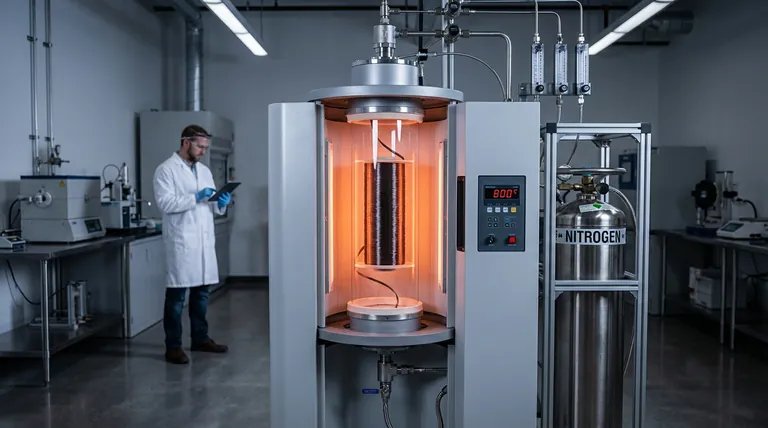
The low-temperature carbonization furnace serves as the foundational processing stage where stabilized raw fibers are converted into a carbon-rich material. Operating in an inert atmosphere with temperatures reaching 800°C, these furnaces strip away non-carbon elements to initiate the structural transformation required for multifunctional performance.
This stage is not merely about heating; it is a purification process that systematically removes oxygen, nitrogen, and hydrogen to establish the fiber's initial turbostratic graphite structure.
The Process of Elemental Elimination
Targeted Removal of Non-Carbons
The primary technical function of this equipment is chemical refinement.
It drives out volatile non-carbon elements—specifically oxygen, nitrogen, and hydrogen—from the stabilized fiber matrix.
Controlled Inert Environment
This elimination process creates a risk of oxidation if not managed correctly.
To prevent the fiber from degrading or burning, the furnace maintains a strict inert atmosphere throughout the entire heating cycle.
Establishing the Structural Foundation
Initiating Turbostratic Graphite Formation
As non-carbon elements are expelled, the remaining carbon atoms begin to reorganize.
This results in the formation of a turbostratic graphite structure. This is a layered but somewhat disordered arrangement of carbon atoms that defines the material's identity as carbon fiber.
Setting the Stage for Refinement
This turbostratic structure is not the final state of the material.
However, it provides the essential physical backbone necessary for further structural refinement in subsequent, higher-temperature processing stages.
Critical Process Controls and Trade-offs
The Necessity of Gradual Heating
Applying heat too aggressively can cause thermal shock and damage the fiber's structural integrity.
To mitigate this, these furnaces feature multiple independent heating zones. This allows for a gradual, controlled increase in temperature rather than a sudden spike.
Limitations of Low-Temperature Processing
While this step is critical, the 800°C ceiling means the fiber is not yet fully graphitized.
Manufacturers must recognize that this furnace provides the foundation, but it does not impart the final high-modulus properties derived from higher temperature treatments.
Optimizing Your Production Goals
To maximize the quality of your multifunctional carbon fibers, consider how this stage aligns with your specific objectives:
- If your primary focus is structural uniformity: Ensure your furnace configuration utilizes multiple zones to smooth the thermal gradient and prevent defects caused by rapid heating.
- If your primary focus is material purity: Prioritize the control of the inert atmosphere to facilitate the complete, unimpeded removal of oxygen and nitrogen.
The low-temperature carbonization furnace is the gatekeeper that determines whether a stabilized fiber can successfully evolve into a high-performance carbon material.
Summary Table:
| Process Feature | Functional Role | Outcome for Fiber |
|---|---|---|
| Elemental Elimination | Removes O, N, and H at 800°C | Increases carbon concentration and purity |
| Inert Atmosphere | Prevents oxidative degradation | Maintains structural integrity during heating |
| Zoned Heating | Gradual thermal escalation | Prevents thermal shock and surface defects |
| Structural Initiation | Reorganizes carbon atoms | Establishes the foundational turbostratic graphite layers |
Elevate Your Carbon Fiber Production with KINTEK
Precision at the foundational stage determines the final quality of your multifunctional carbon fibers. Backed by expert R&D and manufacturing, KINTEK offers a comprehensive range of Muffle, Tube, Rotary, Vacuum, and CVD systems designed to provide the rigorous thermal control and inert environments required for high-performance material processing. Whether you need a standard solution or a customizable furnace for unique lab requirements, our systems ensure superior structural uniformity and purity.
Ready to optimize your carbonization process? Contact KINTEK today to discuss your project needs!
References
- Ruben Tavano, E. Leif. Influence of Carbonisation Temperatures on Multifunctional Properties of Carbon Fibres for Structural Battery Applications. DOI: 10.1002/batt.202400110
This article is also based on technical information from Kintek Furnace Knowledge Base .
Related Products
- Electric Rotary Kiln Small Rotary Furnace for Activated Carbon Regeneration
- 1200℃ Controlled Inert Nitrogen Atmosphere Furnace
- 1700℃ Controlled Inert Nitrogen Atmosphere Furnace
- 2200 ℃ Graphite Vacuum Heat Treat Furnace
- 2200 ℃ Tungsten Vacuum Heat Treat and Sintering Furnace
People Also Ask
- What are the main applications of a rotary kiln electric furnace? Achieve Uniform Heat Treatment for Powders
- What are the key components of a rotary kiln electric furnace? Unlock Efficient Thermal Processing
- What is the significance of the refractory lining in a rotary kiln electric furnace? Unlock Efficiency and Longevity
- What advantages do electric rotary kilns offer over fuel-based kilns? Boost Efficiency and Purity in Your Process
- What materials can be processed in an electric rotary kiln? Versatile Solutions for Advanced Materials



















