
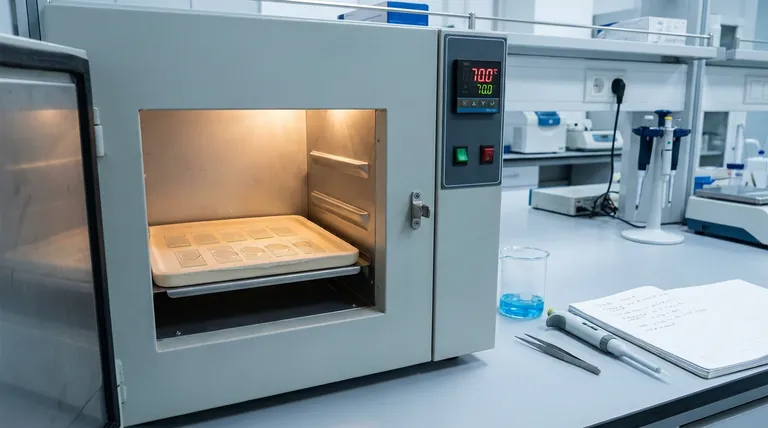
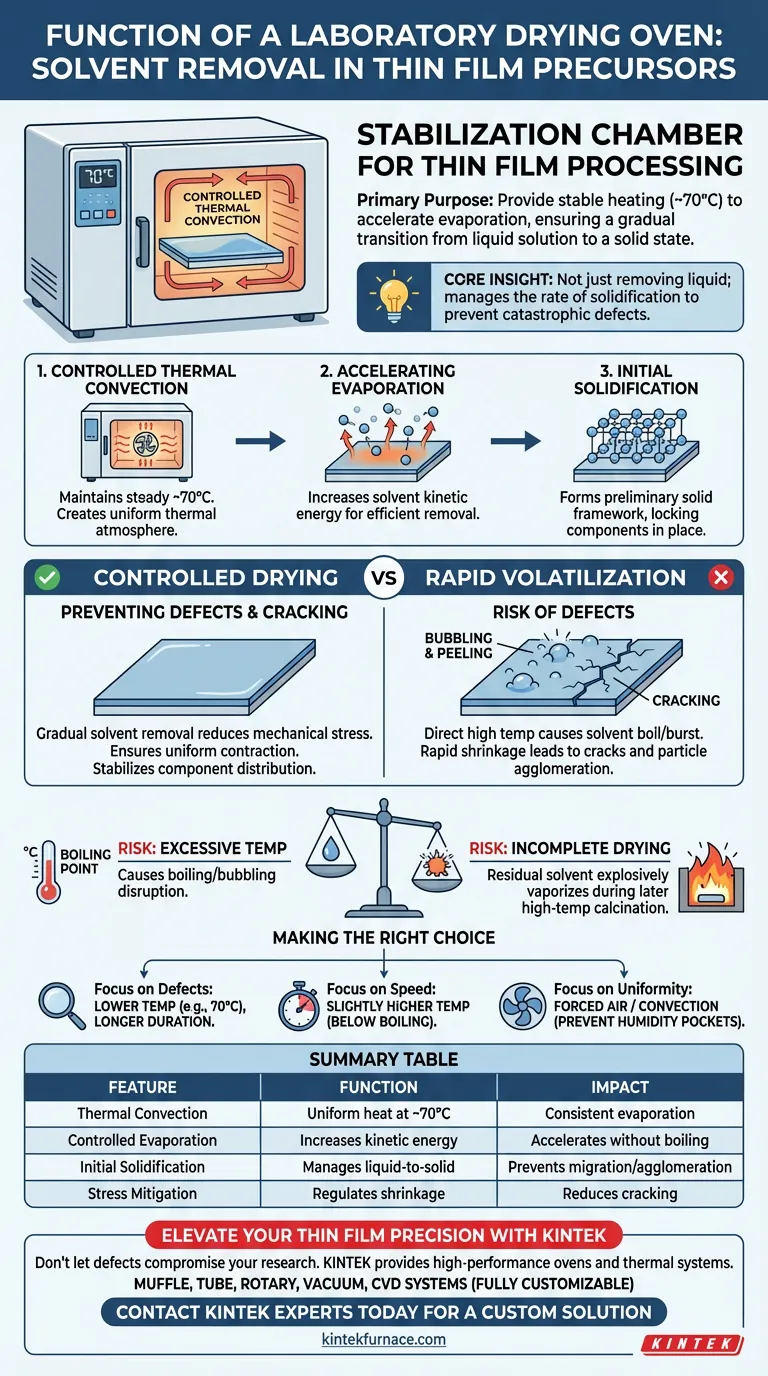
A laboratory drying oven functions as a stabilization chamber during thin film processing. Its primary purpose is to provide a stable heating environment—typically maintained around 70°C—to accelerate the evaporation of solvents from precursor solutions through controlled thermal convection. This ensures the material undergoes a gradual transition from a liquid solution to a solid state.
Core Insight: The drying oven is not merely removing liquid; it is managing the rate of solidification. By controlling the evaporation speed, the oven prevents the catastrophic structural defects, such as cracking or bubbling, that occur if a solvent-heavy precursor is exposed directly to high-temperature annealing.
The Mechanics of Solvent Removal
Controlled Thermal Convection
The oven utilizes thermal convection to maintain a steady temperature, often set near 70°C for thin film applications. This creates a uniform thermal atmosphere that surrounds the substrate.
Accelerating Evaporation
While evaporation occurs naturally at room temperature, the oven accelerates this process to a practical rate. The heat increases the kinetic energy of the solvent molecules, driving them out of the precursor solution efficiently.
Initial Solidification
As the solvent evaporates, the precursor materials begin to bond and form a preliminary solid structure. This phase establishes the physical framework of the thin film, locking the components in place before high-energy processing begins.
Why This Step Defines Film Quality
Preventing Structural Defects
The most critical function of the drying stage is preventing defects caused by rapid volatilization. If a film containing excess solvent is placed directly into a high-temperature furnace, the solvent will boil and burst, leading to bubbling or peeling.
Mitigating Cracking
Controlled drying reduces the mechanical stress within the film as it shrinks. A gradual removal of solvent ensures that the film contracts uniformly, significantly reducing the likelihood of cracks forming across the surface.
Stabilizing Component Distribution
By removing the solvent at a moderate pace, the oven prevents the migration of components within the film. This ensures that the spatial distribution of the precursor remains homogeneous, preventing particle agglomeration or segregation.
Understanding the Trade-offs
The Risk of Excessive Temperature
While heat accelerates drying, setting the oven temperature too high can be detrimental. If the temperature approaches the solvent's boiling point too quickly, it can cause the very disruption (boiling/bubbling) the process is meant to prevent.
The Danger of Incomplete Drying
Conversely, insufficient drying time or temperature leaves residual solvent trapped deep within the film. During subsequent high-temperature calcination, this trapped solvent will vaporize explosively, destroying the film's morphology.
Making the Right Choice for Your Goal
To ensure the success of your thin film deposition, consider how the drying parameters align with your specific precursor chemistry:
- If your primary focus is preventing surface defects: Prioritize a lower temperature (e.g., 70°C) with longer duration to ensure a gentle, non-disruptive evaporation rate.
- If your primary focus is processing speed: You may increase the temperature slightly, but ensure it remains well below the solvent's boiling point to avoid rapid volatilization.
- If your primary focus is uniformity: Ensure your oven utilizes forced air or established convection currents to prevent humidity pockets that cause uneven drying.
The laboratory drying oven acts as the essential gatekeeper, transforming a delicate liquid coating into a robust solid foundation ready for final thermal treatment.
Summary Table:
| Feature | Function in Solvent Removal | Impact on Thin Film Quality |
|---|---|---|
| Thermal Convection | Provides uniform heat distribution at ~70°C | Ensures consistent evaporation across the substrate |
| Controlled Evaporation | Increases kinetic energy of solvent molecules | Accelerates processing without reaching boiling points |
| Initial Solidification | Manages the transition from liquid to solid | Prevents component migration and particle agglomeration |
| Stress Mitigation | Regulates film shrinkage rates | Reduces mechanical stress to prevent surface cracking |
Elevate Your Thin Film Precision with KINTEK
Don't let structural defects like bubbling or cracking compromise your research. KINTEK provides high-performance laboratory drying ovens and specialized thermal systems designed to manage the delicate solidification of your precursors.
Backed by expert R&D and manufacturing, we offer a comprehensive range of Muffle, Tube, Rotary, Vacuum, and CVD systems, all of which are fully customizable to meet your specific thin film application needs. Ensure your materials have the robust solid foundation they deserve.
Contact KINTEK Experts Today for a Custom Solution
Visual Guide
References
- Daniel Sánchez‐Rodríguez, Jordi Farjas. Kinetic analysis of reversible solid-gas reactions in films: application to the decomposition of CaCO$$_3$$ and BaCO$$_3$$ carbonates. DOI: 10.1007/s10973-024-13318-x
This article is also based on technical information from Kintek Furnace Knowledge Base .
Related Products
- 1200℃ Muffle Oven Furnace for Laboratory
- 1800℃ High Temperature Muffle Oven Furnace for Laboratory
- High Temperature Muffle Oven Furnace for Laboratory Debinding and Pre Sintering
- 1400℃ Muffle Oven Furnace for Laboratory
- Laboratory Muffle Oven Furnace with Bottom Lifting
People Also Ask
- How does a high-temperature laboratory muffle furnace affect material properties? Transform Anodic Oxide Films Fast
- What is the primary function of a high-temperature laboratory muffle furnace in chemical synthesis? Achieve Precision.
- How is a laboratory muffle furnace used in 3D-printed PP-CF cross-linking? Achieve Thermal Stability at 150 °C
- Why is a laboratory high-temperature muffle furnace used for BaTiO3? Achieve Optimal Tetragonal Crystalline Phases
- What functions does a laboratory muffle furnace perform for AISI 1025 steel post-processing? Precision Thermal Control











