
High-pressure reaction environments act as thermodynamic enablers, allowing solvents to function effectively well beyond their standard atmospheric boiling points. By utilizing sealed vessels or high-temperature furnaces, the system maintains solvents in a liquid state even at elevated temperatures. This critical modification fundamentally alters the reaction kinetics, significantly increasing both the solubility and the reactivity of the chemical precursors involved.
By creating a pressurized system where solvents remain liquid at high temperatures, solvothermal synthesis facilitates the precise nucleation of orthorhombic beta-phase Ag₂Se. This controlled environment is the key to producing nanoparticles with defined structural integrity and specific geometric dimensions.
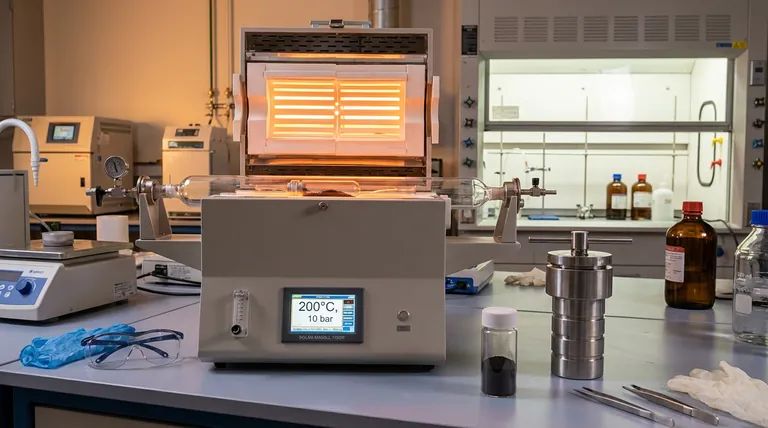
The Mechanics of Solvothermal Environments
Overcoming Atmospheric Limits
In a standard open-air reaction, a solvent cannot exceed its boiling point; it simply evaporates. High-pressure environments, created within sealed vessels, bypass this limitation.
This containment allows the solvent to absorb thermal energy far beyond its normal capacity while remaining a liquid.
Enhancing Precursor Behavior
The elevated temperature of the liquid solvent dramatically increases the solubility of the silver and selenium precursors.
Simultaneously, the high thermal energy boosts the chemical reactivity of these dissolved components. This ensures that the precursors interact efficiently, promoting a more uniform and complete reaction than would be possible at lower temperatures or pressures.
Crystallization and Morphology Control
Nucleating the Beta-Phase
The specific thermodynamic conditions generated by high pressure are required to stabilize specific crystal structures.
In the case of silver selenide, this environment directly facilitates the nucleation of Ag₂Se in the orthorhombic beta-phase. This phase formation is a direct result of the enhanced reactivity and controlled energetic landscape within the vessel.
Achieving Specific Dimensions
Beyond chemical composition, the high-pressure environment exerts strict control over the physical growth of the particles.
The conditions constrain the growth trajectory, resulting in nanoparticles with distinct morphologies. Specifically, this method yields particles with an average lateral diameter of approximately 108 nm and a thickness of approximately 50 nm.
Understanding the Trade-offs
The Cost of Control
While high-pressure environments offer superior control over phase and size, they introduce complexity to the synthesis process.
The requirement for sealed vessels or high-temperature furnaces necessitates specialized equipment that is not required for standard atmospheric precipitations. Achieving the specific dimensions of 108 nm by 50 nm requires rigorous adherence to these pressure and temperature parameters, as deviations can alter the solubility balance.
Making the Right Choice for Your Goal
If you are designing a synthesis protocol for Ag₂Se, consider your specific material requirements:
- If your primary focus is Phase Purity: Utilize high-pressure sealed vessels to ensure the successful nucleation of the orthorhombic beta-phase.
- If your primary focus is Geometric Precision: Leverage the controlled solvent conditions to achieve consistent particle dimensions around 108 nm in diameter and 50 nm in thickness.
High-pressure solvothermal synthesis is not merely a heating method, but a precision tool for engineering the specific crystal structure and morphology of silver selenide nanoparticles.
Summary Table:
| Feature | Solvothermal Environment Effect |
|---|---|
| Solvent State | Remains liquid far above atmospheric boiling point |
| Precursor Behavior | Significantly increased solubility and chemical reactivity |
| Crystal Phase | Precise nucleation of orthorhombic beta-phase Ag₂Se |
| Morphology Control | Results in lateral diameter ~108 nm and thickness ~50 nm |
| Equipment Requirement | High-temperature furnaces or sealed pressure vessels |
Elevate Your Material Synthesis with KINTEK
Precision in Ag₂Se nanoparticle synthesis requires rigorous thermal and pressure control. KINTEK provides the advanced technology necessary to achieve these exacting conditions. Backed by expert R&D and manufacturing, we offer a comprehensive range of Muffle, Tube, Rotary, Vacuum, and CVD systems, as well as other lab high-temperature furnaces—all fully customizable to meet your unique research needs.
Whether you are targeting specific geometric dimensions or phase purity, our systems provide the stability your precursors demand. Contact us today to find your custom furnace solution.
References
- Yan Liu, Wan Jiang. Fully inkjet-printed Ag2Se flexible thermoelectric devices for sustainable power generation. DOI: 10.1038/s41467-024-46183-1
This article is also based on technical information from Kintek Furnace Knowledge Base .
Related Products
- High Pressure Laboratory Vacuum Tube Furnace
- 9MPa Air Pressure Vacuum Heat Treat and Sintering Furnace
- Custom Made Versatile CVD Tube Furnace Chemical Vapor Deposition CVD Equipment Machine
- MPCVD Machine System Reactor Bell-jar Resonator for Lab and Diamond Growth
- Vacuum Hot Press Furnace Machine Heated Vacuum Press Tube Furnace
People Also Ask
- What role does a high vacuum tube furnace play in Co-Al sintering? Master High-Purity Porous Material Synthesis
- What are the different types of tube furnaces available? Find the Perfect Fit for Your Lab's Needs
- What is the role of a vacuum tube furnace during the final thermal treatment stage of Fe3O4@CSAC catalysts?
- What are the main advantages of vacuum tube furnaces in the market? Achieve Purity and Precision in Material Processing
- What parameters must be controlled when calcining freeze-dried oxide precursors in a laboratory tube furnace? A Guide



















