
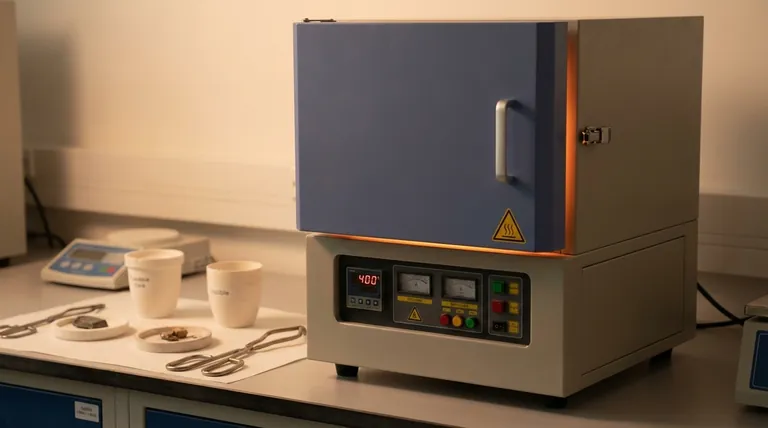
Controlled thermal treatment fundamentally alters the microstructure of manganese dioxide (delta-MnO2). By utilizing a furnace to apply stable heat, you can precisely manipulate microphysical parameters, specifically optimizing pore size and significantly increasing the specific surface area.
Core Takeaway Annealing delta-MnO2 at optimal temperatures, specifically 400°C, creates a highly porous structure with a specific surface area of approximately 63 m²/g. This physical transformation is the key driver for enhanced electrolyte wetting and faster ion migration in electrochemical applications.
Mechanisms of Structural Modification
Precision Control of Microphysical Parameters
The primary function of controlled thermal treatment is the adjustment of the material's internal architecture. Using a furnace allows for the precise regulation of the heating environment.
This stability is crucial for defining the material's specific surface area and pore dimensions. Without stable heating, these microphysical parameters can become inconsistent.
The 400°C Optimization Point
Research indicates that specific temperature benchmarks yield optimal physical properties. Annealing delta-MnO2 at 400°C is particularly effective.
At this temperature, the material is optimized to achieve a high specific surface area of approximately 63 square meters per gram. This represents a structural sweet spot for the material's surface properties.
Impact on Electrochemical Performance
Enhanced Electrolyte Wetting
The increase in specific surface area directly influences how the material interacts with liquids. A larger surface area allows for superior contact between the electrode material and the electrolyte.
The improved porous structure ensures that the electrolyte can thoroughly "wet" the surface of the manganese dioxide.
Accelerated Ion Migration
Beyond surface contact, the internal pore structure dictates how ions move through the material. The structural optimization achieved through thermal treatment reduces resistance to movement.
This acceleration of ion migration is a vital component for achieving superior overall electrochemical performance.
Understanding the Trade-offs
The Importance of Temperature Precision
While thermal treatment is beneficial, the specific temperature is the defining variable. The optimization mentioned occurs specifically around 400°C.
Deviating significantly from this temperature may result in a failure to achieve the target surface area of 63 m²/g.
Stability vs. Variability
The reference emphasizes the need for stable furnace heating. Inconsistent heating can lead to non-uniform pore sizes.
If the porous structure is uneven, the benefits regarding electrolyte wetting and ion migration will likely be compromised.
Optimizing Manganese Dioxide for Your Application
To maximize the utility of delta-MnO2, you must correlate your processing parameters with your performance goals.
- If your primary focus is maximizing active surface area: Target an annealing temperature of 400°C to achieve the benchmark of ~63 m²/g.
- If your primary focus is electrochemical efficiency: Ensure your furnace provides highly stable heating to guarantee the uniform pore structure required for rapid ion migration.
Precise thermal control is not just a processing step; it is the defining factor in unlocking the electrochemical potential of delta-MnO2.
Summary Table:
| Parameter | Influence of Thermal Treatment (at 400°C) | Impact on Performance |
|---|---|---|
| Specific Surface Area | Increases to approximately 63 m²/g | Maximizes active contact with electrolytes |
| Microstructure | Creation of a highly porous architecture | Reduces internal resistance for ion travel |
| Surface Interaction | Superior electrolyte wetting | Ensures more efficient electrochemical reactions |
| Ion Migration | Accelerated movement through pore network | Enhances overall electrochemical efficiency |
Unlock High-Performance Materials with KINTEK
Precision is the defining factor in unlocking the electrochemical potential of manganese dioxide. KINTEK provides the advanced heating solutions required to maintain the strict stability needed for optimal pore size and surface area.
Backed by expert R&D and manufacturing, we offer a comprehensive range of Muffle, Tube, Rotary, Vacuum, and CVD systems, as well as other lab high-temperature furnaces—all fully customizable to meet your unique research and production needs.
Ready to achieve superior material properties? Contact KINTEK today to find the perfect furnace for your laboratory.
References
- Shilong Li, Xiang Wu. Oxygen Vacancy-Rich δ-MnO2 Cathode Materials for Highly Stable Zinc-Ion Batteries. DOI: 10.3390/batteries10080294
This article is also based on technical information from Kintek Furnace Knowledge Base .
Related Products
- 1700℃ Controlled Inert Nitrogen Atmosphere Furnace
- 1400℃ Controlled Inert Nitrogen Atmosphere Furnace
- Molybdenum Vacuum Heat Treat Furnace
- High Temperature Muffle Oven Furnace for Laboratory Debinding and Pre Sintering
- 1200℃ Muffle Oven Furnace for Laboratory
People Also Ask
- Why is thorough binder burnout necessary before sintering advanced ceramics? Ensure Peak Density & Zero Defects
- How does real-time dilatometric analysis in a controlled-atmosphere furnace optimize PZT ceramic sintering?
- How does oxygen partial pressure control affect ceramic sintering? Master Defect Chemistry
- How do controlled-atmosphere furnaces support polymer pyrolysis? Master SiC & Si3N4 Ceramic Conversion
- Why is controlled-atmosphere heating required for functional ceramics and sensors? Master Defect Engineering



















