
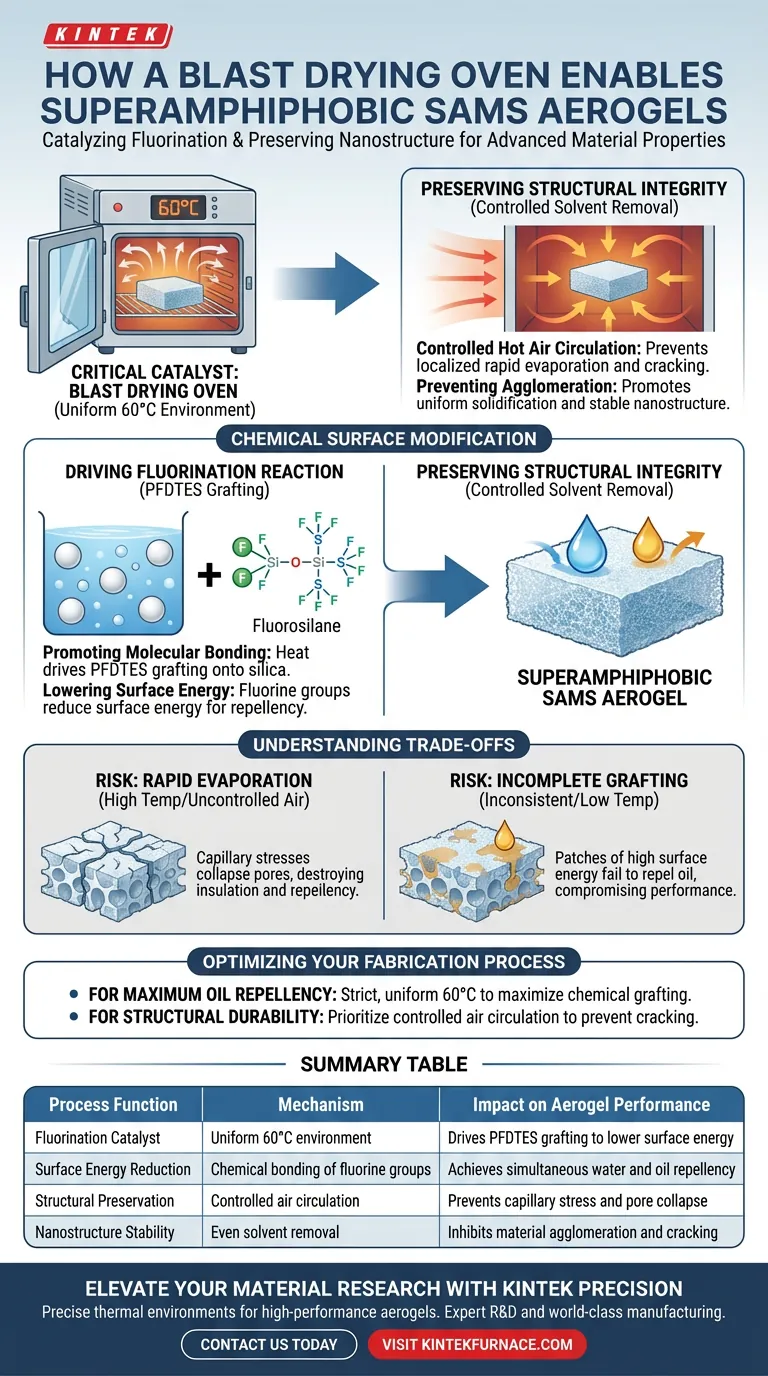
The blast drying oven acts as the critical catalyst for chemical surface modification. It facilitates superamphiphobicity by maintaining a uniform 60 °C environment that drives the grafting of fluorosilane (PFDTES) molecules onto silica nanoparticles, drastically lowering the material's surface energy.
The core function of the oven is to provide a stable thermal environment that ensures fluorination agents chemically bond to the aerogel structure uniformly, transforming the material into one that actively repels both water and low-surface-tension oils.
Driving the Fluorination Reaction
Promoting Molecular Bonding
The primary role of the blast drying oven is to facilitate the chemical reaction between the silica gel and the modification solution.
The solution typically consists of PFDTES (1H,1H,2H,2H-perfluorodecyltriethoxysilane), ammonia, and ethanol. The controlled heat ensures that the fluorosilane molecules successfully graft onto the silica nanoparticles.
Lowering Surface Energy
This grafting process is what alters the fundamental properties of the aerogel.
By chemically attaching fluorine groups to the silica, the process significantly lowers the surface energy of the material. This low surface energy is the mechanism that prevents wetting by both water (hydrophobicity) and oils (oleophobicity).
Preserving Structural Integrity
Controlled Solvent Removal
While the primary reference highlights chemical grafting, the blast drying mechanism is also essential for physical stabilization.
The oven utilizes controlled hot air circulation to remove residual solvents (like ethanol) and moisture slowly. This uniform removal prevents the rapid, localized evaporation that can cause gel cracking or compositional segregation.
Preventing Agglomeration
Uniform heating is vital for maintaining the nanostructure of the aerogel.
By drying the composite precipitates evenly, the oven promotes the solidification of nanostructures while preventing material agglomeration. This results in a stable, loose structure rather than a dense, collapsed mass.
Understanding the Trade-offs
The Risk of Rapid Evaporation
If the temperature is too high or the air circulation is uncontrolled, solvents may evaporate too quickly from the gel surface.
This can lead to capillary stresses that collapse the delicate aerogel pores, destroying the material's insulating properties and reducing the surface area available for superamphiphobicity.
Incomplete Grafting
Conversely, if the temperature is inconsistent or too low, the grafting reaction may be incomplete.
This results in a material with "patches" of high surface energy. These patches will fail to repel oil, compromising the superamphiphobic performance of the final product.
Optimizing Your Fabrication Process
To ensure the highest quality SAMS aerogels, consider the following based on your specific needs:
- If your primary focus is maximum oil repellency: Ensure the oven maintains a strict, uniform 60 °C to maximize the chemical grafting of PFDTES molecules.
- If your primary focus is structural durability: Prioritize the controlled air circulation settings to prevent cracking and agglomeration during the solvent removal phase.
The blast drying oven is not just a drying tool; it is a chemical reactor that dictates the final surface energy and structural viability of your aerogel.
Summary Table:
| Process Function | Mechanism | Impact on Aerogel Performance |
|---|---|---|
| Fluorination Catalyst | Uniform 60°C environment | Drives PFDTES grafting to lower surface energy |
| Surface Energy Reduction | Chemical bonding of fluorine groups | Achieves simultaneous water and oil repellency |
| Structural Preservation | Controlled air circulation | Prevents capillary stress and pore collapse |
| Nanostructure Stability | Even solvent removal | Inhibits material agglomeration and cracking |
Elevate Your Material Research with KINTEK Precision
Precise thermal environments are the difference between a collapsed structure and a high-performance superamphiphobic aerogel. Backed by expert R&D and world-class manufacturing, KINTEK provides high-performance blast drying ovens and lab high-temp systems designed to maintain the strict uniformity your chemical grafting processes require.
Whether you are developing advanced aerogels or specialized CVD applications, our customizable Muffle, Tube, and Vacuum furnaces are engineered to meet your unique laboratory needs.
Ready to optimize your fabrication process? Contact us today to discuss your custom furnace solution.
Visual Guide
References
- Durable and High-Efficiency Air Filtration by Superamphiphobic Silica Composite Aerogel. DOI: 10.3390/colloids9030038
This article is also based on technical information from Kintek Furnace Knowledge Base .
Related Products
- High Temperature Muffle Oven Furnace for Laboratory Debinding and Pre Sintering
- Laboratory Muffle Oven Furnace with Bottom Lifting
People Also Ask
- What thermal phenomena occur during polymer binder burnout in ceramic green bodies? Lab Furnace Guide
- What role does a high-temperature muffle furnace play in STFO synthesis? Achieve Pure Perovskite Results
- Why is controlled heat treatment in a muffle furnace necessary for calcined clay? Achieve Optimal Pozzolanic Activity
- How does a high-temperature muffle furnace facilitate the formation of LaNbxAl1−xO3+δ perovskite structures? Key Roles
- What role does a high-temperature muffle furnace play in the formation of biochar catalysts? Master Catalyst Synthesis

