
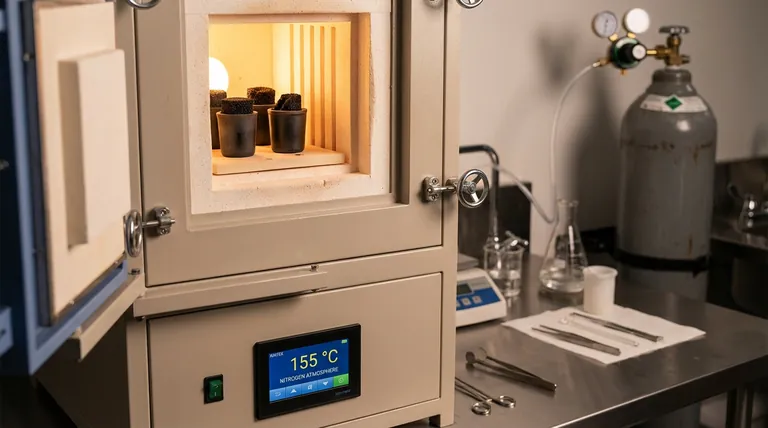
The secondary heat treatment at 155 °C acts as a critical redistribution mechanism. By causing the sublimation of a portion of the sulfur from the surface of the Sulfur-loaded Hierarchical Porous Carbon (SHPC), this process forces the sulfur to re-penetrate the Nitrogen-doped carbon nanotube (N-CNT) matrix. This creates a unified composite structure rather than a simple surface coating, directly addressing issues of conductivity and mechanical stability.
The core value of this process lies in its ability to integrate insulating sulfur into a conductive N-CNT network while simultaneously creating essential void space to absorb sulfur volume expansion during battery cycling.
The Mechanics of Sulfur Redistribution
Leveraging Controlled Sublimation
The specific temperature of 155 °C is chosen to initiate the sublimation of sulfur. This phase change allows the sulfur to migrate from the exterior of the SHPC surface.
Deep Matrix Penetration
Instead of remaining as a surface layer, the sublimated sulfur re-penetrates the N-CNT matrix. This transforms the material from two distinct layers into a cohesive, interlocked composite.
Enhancing Electrochemical Stability
Establishing a Conductive Network
Sulfur is inherently insulating, which usually hinders battery performance. By embedding the redistributed sulfur within the N-CNT matrix, the process leverages the high conductivity of the nanotubes. This ensures a robust pathway for electron flow to the active material.
Reinforcing Structural Integrity
The re-penetration process acts as a binding mechanism. It enhances the overall cohesion of the composite, preventing the electrode materials from separating or degrading during operation.
Mitigating Mechanical Failure
The Challenge of Expansion
During charge and discharge cycles, sulfur undergoes significant volume changes. Without management, this expansion can crack the electrode and lead to battery failure.
Creating Buffer Space
The secondary heat treatment does not just move sulfur; it positions it strategically. The process leaves sufficient "buffer space" within the structure to accommodate volume expansion, preserving the battery's lifespan.
Understanding the Process Constraints
Precision is Critical
This process relies on exact temperature control. Deviating significantly from 155 °C could fail to trigger sublimation or cause the loss of active sulfur material.
Balancing Loading and Space
The effectiveness of the buffer space depends on the initial sulfur loading. If the matrix is over-saturated, the heat treatment may not create enough void space to prevent mechanical stress.
Optimizing Your Battery Fabrication Strategy
To maximize the performance of your SHPC/N-CNT composites, align your processing parameters with your specific performance goals:
- If your primary focus is Long-Term Cycle Life: Prioritize the creation of buffer space during the heat treatment to ensure the electrode can withstand repeated volume expansion without cracking.
- If your primary focus is High Rate Capability: Focus on the thoroughness of the sulfur re-penetration into the N-CNT matrix to maximize the conductive contact area between the sulfur and the carbon network.
Mastering this secondary heat treatment is the key to converting high-potential raw materials into a stable, high-performance battery system.
Summary Table:
| Feature | Mechanism | Benefit |
|---|---|---|
| Sublimation at 155 °C | Redistributes sulfur from SHPC surface into N-CNT matrix | Creates a unified, cohesive composite structure |
| Conductive Network | Embeds insulating sulfur within N-CNT framework | Enhances electron flow and electrochemical stability |
| Buffer Space | Leaves strategic voids within the matrix | Absorbs sulfur volume expansion to prevent cracking |
| Structural Binding | Re-penetration increases material cohesion | Improves mechanical integrity during charge/discharge |
Revolutionize Your Battery Performance with Precision Heating
Unlock the full potential of your advanced materials with KINTEK. Our state-of-the-art laboratory high-temperature furnaces provide the exact temperature control—like the critical 155 °C required for SHPC/N-CNT redistribution—to ensure your composites achieve peak conductivity and mechanical stability.
Backed by expert R&D and manufacturing, KINTEK offers Muffle, Tube, Rotary, Vacuum, and CVD systems, all fully customizable to meet the unique demands of your energy storage research. Whether you are optimizing cycle life or high-rate capability, our systems deliver the consistency your innovations deserve.
Ready to scale your battery fabrication? Contact us today to consult with our experts and find the perfect heating solution for your lab.
References
- Arunakumari Nulu, Keun Yong Sohn. N-doped CNTs wrapped sulfur-loaded hierarchical porous carbon cathode for Li–sulfur battery studies. DOI: 10.1039/d3ra08507d
This article is also based on technical information from Kintek Furnace Knowledge Base .
Related Products
People Also Ask
- What factors determine the quality of sintered zirconia restorations? Master Material, Equipment, and Technique
- How do conventional vs rapid sintering in dental furnaces affect zirconia? Optimize Efficiency Without Sacrificing Strength
- What industries use zirconia sintering furnaces? Beyond Dental and Jewelry Applications
- What are the key components of a zirconia sintering furnace? Unlock Precision for Superior Dental Restorations
- Why is a zirconia sintering furnace considered essential for dental laboratories and clinics? Unlock Precision and Durability
