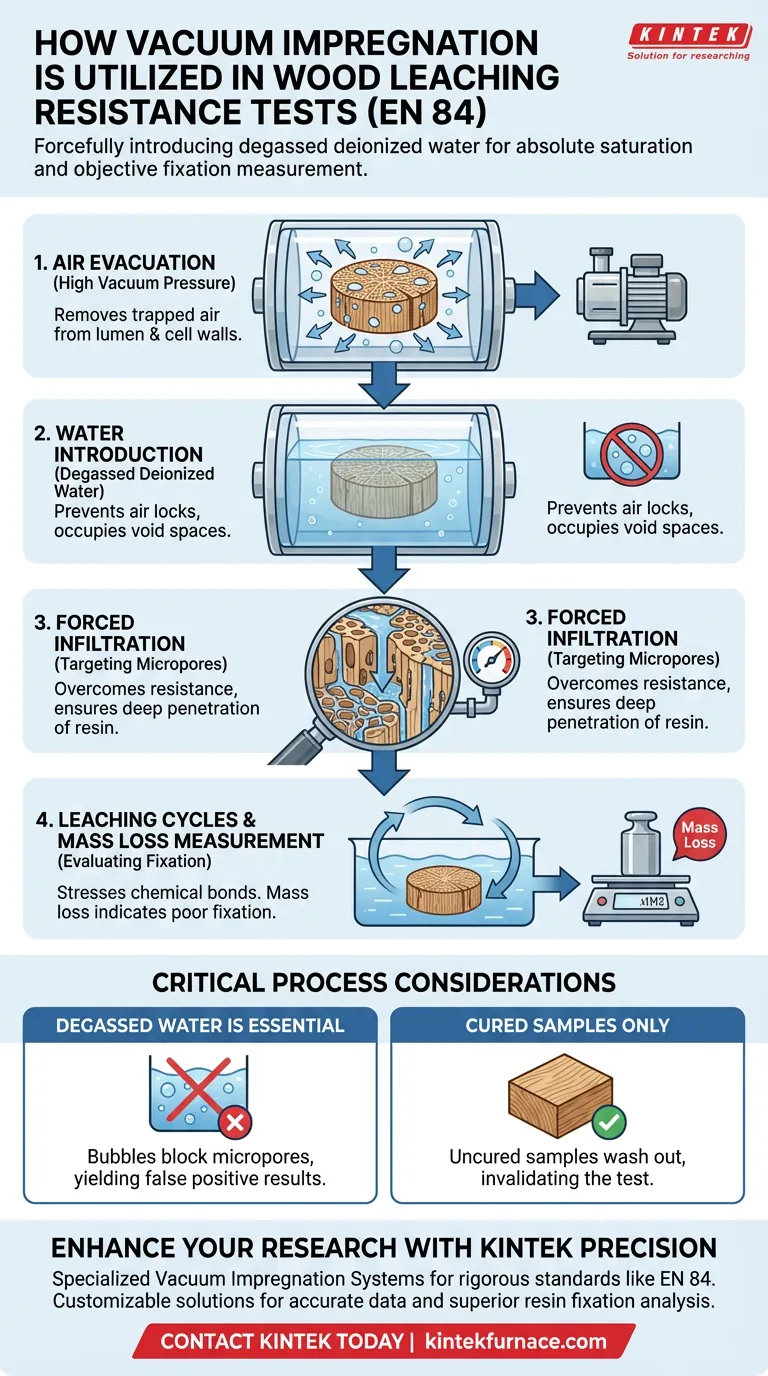
In wood leaching resistance tests, a vacuum impregnation system is utilized to forcefully introduce degassed deionized water into the cellular structure of cured, modified wood samples. This mechanical process uses high vacuum pressure to evacuate air from the wood's pores, allowing water to penetrate and completely fill the micropores, thereby simulating extreme moisture saturation.
The core objective of vacuum impregnation is to ensure absolute saturation. By eliminating air pockets, the system exposes the internal bonding of the resin to water, allowing for an accurate, objective measurement of fixation quality based on subsequent mass loss.
The Mechanics of Infiltration
Displacing Air with Water
The primary function of the vacuum system is to overcome the natural resistance of wood to rapid saturation. Wood contains air within its cellular lumen and cell walls.
The system creates a high-vacuum environment that evacuates this trapped air. Once the air is removed, degassed deionized water is introduced, occupying the void spaces previously filled by gas.
Targeting the Micropores
Standard soaking methods often fail to penetrate the smallest structures of the wood. Vacuum impregnation ensures that water reaches the micropores.
This deep penetration is essential for testing modified wood, as the modification agents (resins) often reside deep within these micro-structures.
Evaluating Resin Fixation
Simulating Extreme Conditions
The process is designed to mimic the most severe moisture conditions a wood product might encounter in its lifecycle.
By forcing water into every available pore, the test stresses the chemical and physical bonds between the wood and the modifying resin.
Measuring Bonding Strength
The ultimate metric for this test is mass loss.
Once the wood is fully impregnated, it undergoes water exchange cycles. If the resin is not properly fixed or bonded within the wood structure, the water will leach it out.
Because the vacuum ensured total contact between water and resin, any reduction in mass can be attributed to poor fixation rather than incomplete wetting.
Critical Process Considerations
The Importance of Degassed Water
The primary reference specifically highlights the use of degassed water. This is a critical variable.
If the water contains dissolved gases, bubbles can form when the vacuum is applied. These bubbles block the micropores, preventing full saturation and potentially yielding false positive results regarding the wood's leaching resistance.
Evaluating Cured Samples Only
This process is applicable specifically to cured wood samples.
Attempting to impregnate uncured samples would likely wash out the modification agent immediately, rather than testing its long-term resistance to leaching.
Ensuring Accurate Test Protocols
To effectively utilize a vacuum impregnation system for standards like EN 84, align your approach with your specific testing goals:
- If your primary focus is Resin Formulation: Analyze the mass loss data strictly after the water exchange cycles to determine the chemical bonding efficiency of your specific resin.
- If your primary focus is Test Validity: Verify that the water used is fully deionized and degassed to prevent air locks from protecting the resin from water contact.
Complete saturation is the only way to distinguish between a waterproof coating and a truly leach-resistant modification.
Summary Table:
| Process Step | Mechanism | Objective in EN 84 Testing |
|---|---|---|
| Air Evacuation | High vacuum pressure | Removes trapped air from cellular lumen and cell walls. |
| Water Introduction | Degassed deionized water | Prevents air locks and fills micropores completely. |
| Forced Infiltration | Pressure differential | Overcomes natural resistance to simulate extreme saturation. |
| Leaching Cycles | Periodic water exchange | Stresses chemical bonds to measure resin fixation via mass loss. |
Enhance Your Research with KINTEK Precision
Ensure your wood modification and leaching resistance tests meet the most rigorous standards like EN 84. Backed by expert R&D and manufacturing, KINTEK offers specialized Vacuum Impregnation Systems, Muffle, Tube, and Vacuum furnaces—all fully customizable to your unique laboratory needs.
Our advanced systems provide the precise control required to eliminate variables like dissolved gases and incomplete saturation, allowing you to focus on accurate data and superior resin fixation analysis.
Ready to elevate your lab's testing capabilities? Contact KINTEK today to discuss your custom solution.
Visual Guide
References
- Johannes Karthäuser, Holger Militz. Utilizing pyrolysis cleavage products from softwood kraft lignin as a substitute for phenol in phenol-formaldehyde resins for modifying different wood species. DOI: 10.1007/s00107-024-02056-4
This article is also based on technical information from Kintek Furnace Knowledge Base .
Related Products
- Vacuum Induction Melting Furnace
- Vacuum Hot Press Furnace Machine for Lamination and Heating
- Vacuum Heat Treat Sintering Furnace with Pressure for Vacuum Sintering
- 304 316 Stainless Steel High Vacuum Ball Stop Valve for Vacuum Systems
- Stainless Steel KF ISO Vacuum Flange Blind Plate for High Vacuum Systems
People Also Ask
- What are the core functions of the High Vacuum Induction Melting (VIM) furnace? Optimize DD5 Superalloy Purification
- Why is a Vacuum Induction Melting furnace (VIM) used for Cu-Zn-Al-Sn alloys? Achieve Precision Composition Control
- What are the technical advantages of using a Vacuum Induction Melting furnace in the development of advanced packaging steel?
- What are the advantages of using a VIM furnace to control residual oxygen pressure? Achieve Superior Metal Uniformity
- What is the role of VIM and directional solidification in aero-engine blade substrates? Engineering Extreme Durability