
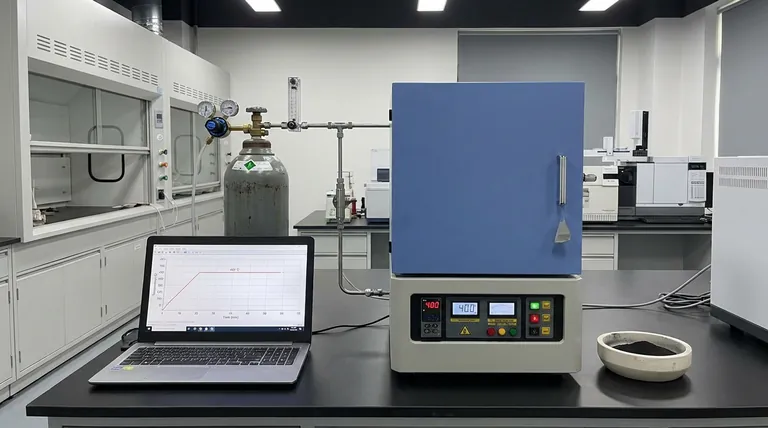
High-temperature pretreatment is the essential purification step required to validate any carbon monoxide (CO) oxidation experiment. By subjecting the catalyst to 400 °C in a nitrogen stream for 60 minutes, you effectively strip the surface of pre-adsorbed water vapor, carbon dioxide, and other volatile impurities. This process unblocks the active sites, ensuring that the CO probe molecules interact directly with the catalyst material rather than surface contaminants.
The core objective is standardization. Pretreatment does not change the catalyst; it reveals its true nature by removing environmental interference, ensuring that the data you collect reflects the intrinsic performance of the material.
The Science of Surface Decontamination
To understand why this step is non-negotiable, one must look at the microscopic state of a catalyst before testing.
Removing Molecular Barriers
Catalysts stored in ambient conditions act like sponges for atmospheric gases.
Water vapor and carbon dioxide naturally adsorb onto the surface of the material. These molecules create a physical barrier, effectively "poisoning" the surface before the experiment even begins.
Heating the material to 400 °C provides the thermal energy necessary to break the bonds holding these impurities to the surface.
The Role of the Nitrogen Stream
Heat alone is often insufficient to fully clear the surface.
The nitrogen stream acts as a chemically inert sweep gas. As the thermal energy desorbs the volatile impurities, the flowing nitrogen physically carries them away from the sample.
This prevents re-adsorption, ensuring the environment within the reactor remains pristine.
Targeting the FeOx Active Sites
The primary reference specifically highlights the importance of this process for FeOx (iron oxide) active sites.
For CO oxidation to occur, the CO molecule must chemically interact with these specific iron oxide sites.
If these sites are occupied by residual water or $CO_2$, the CO probe molecules cannot bond. This leads to false negatives or artificially low activity readings that do not represent the catalyst's actual potential.
Ensuring Data Integrity
Beyond simple cleaning, this process is about scientific rigor.
Guarantees of Accuracy
Data collected from a "dirty" catalyst is scientifically useless.
Without the removal of volatile impurities, any measured reaction rate is a result of undefined variables (the level of contamination) rather than fixed variables (the catalyst structure).
Pretreatment eliminates these variables, ensuring the data is accurate to the material itself.
Comparability Across Studies
Scientific validity relies on the ability to compare results.
Standardizing the pretreatment to 400 °C for 60 minutes creates a uniform baseline.
This allows researchers to confidently compare the performance of different catalysts, knowing that environmental history is not skewing the results.
Understanding the Trade-offs
While pretreatment is necessary, the parameters must be managed carefully to avoid unintended consequences.
The Risk of Thermal Sintering
While 400 °C is the standard for cleaning, excessive temperatures or prolonged exposure beyond the 60-minute mark could alter the catalyst structure.
Overheating can cause sintering, where active particles agglomerate and reduce the total surface area.
Inert vs. Reactive Environments
It is critical that this step occurs in nitrogen (or another inert gas).
Attempting this pretreatment in air or a reactive gas mixture could oxidize or reduce the catalyst surface prematurely.
This would fundamentally change the chemical state of the FeOx sites before the actual experiment begins, invalidating the test.
Making the Right Choice for Your Experiment
To ensure your CO oxidation data is publishable and reliable, apply the following principles to your protocol.
- If your primary focus is Data Accuracy: Strictly adhere to the 60-minute duration to ensure complete desorption of all water and $CO_2$ molecules.
- If your primary focus is Reproducibility: Automate the temperature ramp and gas flow to ensure every sample experiences the exact same thermal history at 400 °C.
- If your primary focus is Material Stability: Verify that your specific catalyst morphology is stable at the standard 400 °C pretreatment temperature to prevent structural degradation.
By rigorously clearing the stage of impurities, you ensure that the interaction between CO and the active sites is the only story your data tells.
Summary Table:
| Parameter | Standard Requirement | Purpose/Benefit |
|---|---|---|
| Temperature | 400 °C | Provides thermal energy to break impurity bonds |
| Atmosphere | Nitrogen ($N_2$) Stream | Inert sweep gas to prevent re-adsorption & oxidation |
| Duration | 60 Minutes | Ensures complete desorption of $H_2O$ and $CO_2$ |
| Target Sites | $FeOx$ Active Sites | Unblocks sites for direct CO molecule interaction |
| Key Risk | Thermal Sintering | Avoided by maintaining specific time/temp limits |
Elevate Your Research with KINTEK’s Precision Thermal Solutions
Inaccurate catalyst data starts with improper pretreatment. At KINTEK, we understand that scientific breakthroughs depend on precision. Our high-performance Muffle, Tube, and Vacuum furnaces are designed to provide the stable, uniform thermal environments required for critical 400°C pretreatment protocols.
Why choose KINTEK for your laboratory?
- Expert Engineering: Backed by world-class R&D, our systems ensure consistent heating and precise gas flow control.
- Customizable Systems: From CVD to Rotary systems, we tailor our high-temp furnaces to your specific material requirements.
- Reliable Data: Remove environmental variables and prevent thermal sintering with our advanced temperature ramp automation.
Don't let surface contaminants compromise your CO oxidation experiments. Contact KINTEK today to find the perfect thermal system for your lab and achieve the reproducibility your research deserves.
References
- Guobo Li, Honggen Peng. Unraveling FeOx Nanoparticles Confined on Fibrous Mesoporous Silica Catalyst Construction and CO Catalytic Oxidation Performance. DOI: 10.3390/catal14010063
This article is also based on technical information from Kintek Furnace Knowledge Base .
Related Products
- High Temperature Muffle Oven Furnace for Laboratory Debinding and Pre Sintering
- 1400℃ High Temperature Laboratory Tube Furnace with Alumina Tube
- 1700℃ High Temperature Laboratory Tube Furnace with Alumina Tube
- 2200 ℃ Tungsten Vacuum Heat Treat and Sintering Furnace
- 2200 ℃ Graphite Vacuum Heat Treat Furnace
People Also Ask
- What thermal phenomena occur during polymer binder burnout in ceramic green bodies? Lab Furnace Guide
- Why is controlled heat treatment in a muffle furnace necessary for calcined clay? Achieve Optimal Pozzolanic Activity
- What role does a high-temperature muffle furnace play in STFO synthesis? Achieve Pure Perovskite Results
- How does a high-temperature muffle furnace facilitate the formation of LaNbxAl1−xO3+δ perovskite structures? Key Roles
- What role does a high-temperature muffle furnace play in the multi-stage synthesis of Li0.5MnFe1.5O4? Key to Pure Spinel



















