
Reliable microstructure analysis begins with rigorous sample preparation. An electric blast drying oven is required to dehydrate Cement-based Recycled Powder (CRP) samples, typically by maintaining a temperature of 40°C for 24 hours. This specific pretreatment removes physically adsorbed water and free water, which ensures that subsequent testing measures the material's actual mineral composition rather than artifacts caused by moisture.
By eliminating free moisture before analysis, the drying process prevents data distortion in X-ray Diffraction (XRD) and Thermogravimetric Analysis (TG), ensuring the results accurately reflect the material's intrinsic mineralogy.
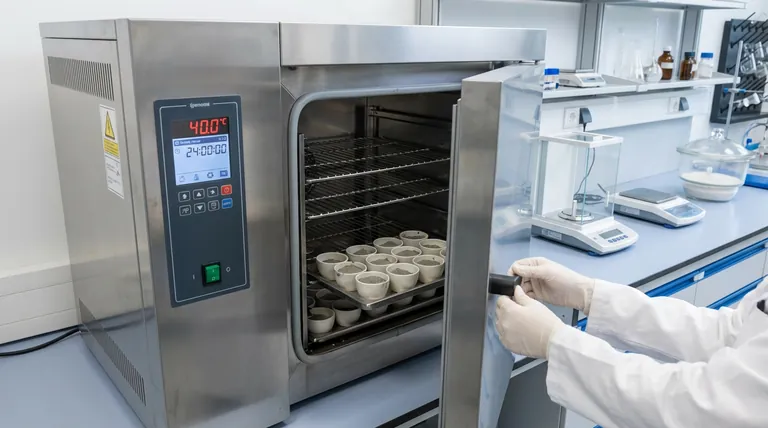
The Critical Role of Dehydration
Removing Non-Structural Water
The primary function of the electric blast drying oven is to target "free water."
This includes moisture that is physically adsorbed onto the surface or trapped within the pores of the CRP.
Removing this water is essential because it is not part of the chemical structure you are trying to analyze.
Defining the Baseline
Without drying, it is impossible to establish a reliable baseline for your material.
If samples contain varying amounts of ambient moisture, comparing results between different batches becomes statistically invalid.
Standardizing the moisture content via oven drying ensures consistency across all test samples.
Impact on Analytical Instruments
Stabilizing Thermogravimetric Analysis (TG)
In Thermogravimetry (TG), the instrument measures weight loss as the sample is heated.
If the sample is not pre-dried, the evaporation of free water will dominate the initial stages of the test.
This interference can mask the subtle weight changes associated with the actual decomposition of mineral phases.
Clarifying X-Ray Diffraction (XRD) Data
XRD relies on the diffraction of X-rays by the crystal structure of the material to identify minerals.
Excess moisture can cause significant background noise and scattering in the signal.
By drying the sample, you minimize this interference, resulting in sharper peaks and clearer identification of the mineral composition.
Understanding the Trade-offs
The Risk of Overheating
While drying is necessary, the specific temperature of 40°C is critical.
A common pitfall is setting the oven temperature too high in an attempt to speed up the process.
Excessive heat can cause the dehydration of chemically bound water within the cement hydrates, effectively destroying the microstructure you intend to study.
The Balance of Time and Efficiency
The 24-hour duration is a calculated trade-off.
It provides enough time for gentle, thorough dehydration without subjecting the sample to thermal shock.
Rushing this process often leads to incomplete drying, which reintroduces the very errors the oven is meant to prevent.
Ensuring Data Fidelity in Your Experiments
To obtain valid microstructure data, you must distinguish between removing environmental moisture and altering the sample's chemistry.
- If your primary focus is TGA accuracy: Ensure the sample is dried at 40°C to prevent free water evaporation from obscuring the initial weight loss curve.
- If your primary focus is XRD clarity: Adhere strictly to the 24-hour drying period to minimize background signal interference and sharpen mineral peaks.
Proper dehydration is not just a cleaning step; it is the calibration standard that validates your entire analysis.
Summary Table:
| Factor | Requirement | Purpose in CRP Analysis |
|---|---|---|
| Temperature | 40°C | Removes free/adsorbed water without dehydrating cement hydrates |
| Duration | 24 Hours | Ensures uniform dehydration and prevents thermal shock |
| TG Impact | Pre-drying | Prevents free water evaporation from masking mineral weight loss |
| XRD Impact | Moisture Removal | Reduces background noise and sharpens diffraction peaks |
| Goal | Standardization | Establishes a consistent baseline for valid statistical comparison |
Elevate Your Microstructure Analysis Precision
Don’t let residual moisture compromise your data integrity. At KINTEK, we understand that reliable results start with superior sample preparation. Backed by expert R&D and manufacturing, we offer high-precision Electric Blast Drying Ovens, along with specialized Muffle, Tube, Vacuum, and CVD systems designed for the rigorous demands of material science.
Whether you are analyzing Cement-based Recycled Powder (CRP) or advanced mineral compositions, our laboratory furnaces are fully customizable to meet your unique temperature and duration requirements. Ensure the fidelity of your XRD and TGA experiments today.
Contact KINTEK for a Professional Consultation
References
- Jianglin Li, Jianhe Xie. Effect of the Pretreatment on the Properties of Cement-Based Recycled Powder. DOI: 10.3390/coatings14010107
This article is also based on technical information from Kintek Furnace Knowledge Base .
Related Products
People Also Ask
- What thermal phenomena occur during polymer binder burnout in ceramic green bodies? Lab Furnace Guide
- Why is controlled heat treatment in a muffle furnace necessary for calcined clay? Achieve Optimal Pozzolanic Activity
- What role does a high-temperature muffle furnace play in STFO synthesis? Achieve Pure Perovskite Results
- How does a high-temperature muffle furnace facilitate the formation of LaNbxAl1−xO3+δ perovskite structures? Key Roles
- What role does a high-temperature muffle furnace play in the multi-stage synthesis of Li0.5MnFe1.5O4? Key to Pure Spinel
