
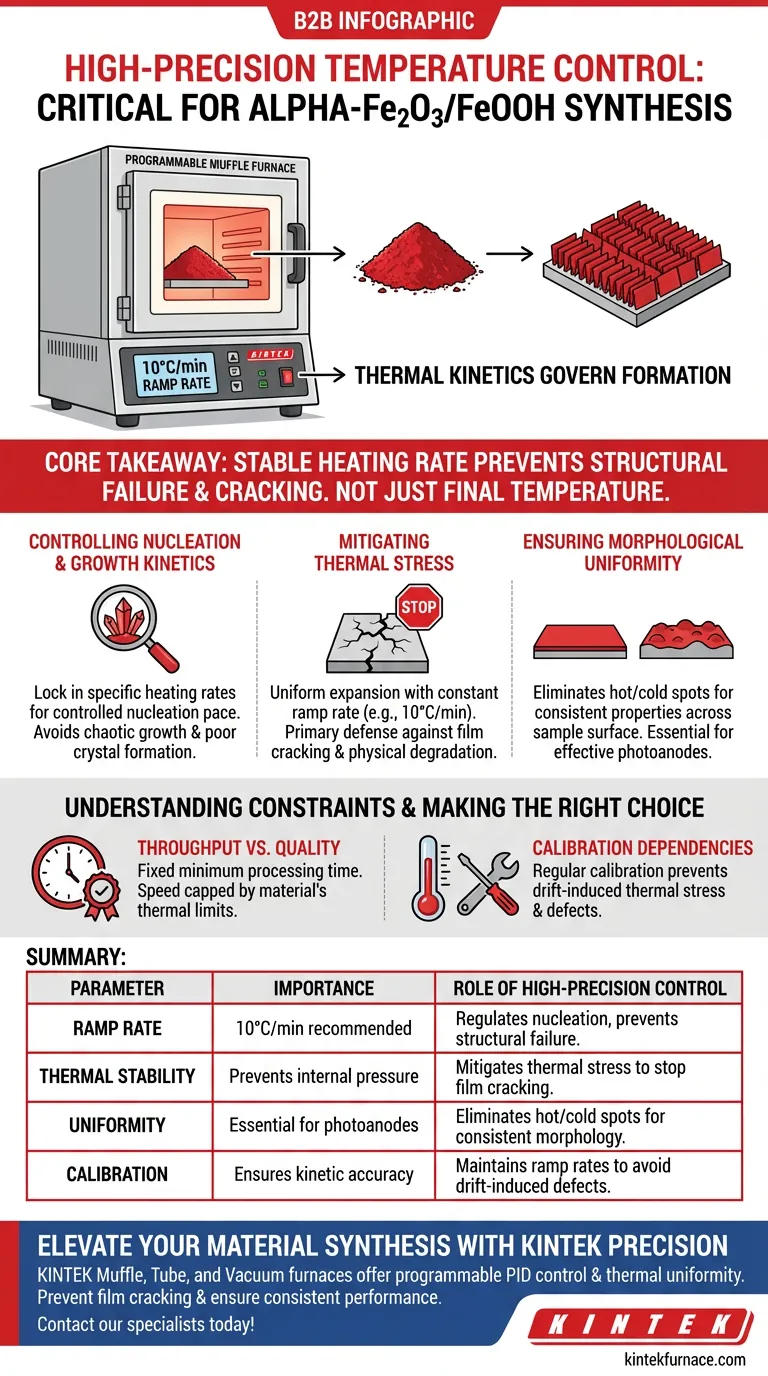
High-precision temperature control is mandatory for synthesizing alpha-Fe2O3/FeOOH because the formation of these nanosheets is strictly governed by thermal kinetics. Specifically, you must use a programmable furnace to maintain a stable ramp rate, such as 10 degrees Celsius per minute, up to 450 degrees Celsius to prevent structural failure.
Core Takeaway The physical integrity of alpha-Fe2O3/FeOOH samples is dictated by the stability of the heating rate, not just the final temperature. Without precise program control to regulate nucleation and mitigate thermal stress, the material will suffer from film cracking and morphological inconsistencies, rendering the photoanode ineffective.
The Critical Role of Thermal Stability
The transformation of precursors into alpha-Fe2O3/FeOOH is a delicate process where the heating history determines the material's final architecture.
Controlling Nucleation and Growth Kinetics
The transition from raw material to structured nanosheets relies on specific reaction kinetics.
A high-precision furnace allows you to lock in a specific heating rate, ensuring that nucleation occurs at a controlled pace.
If the temperature fluctuates or rises too quickly, the growth mechanism becomes chaotic, leading to poor crystal formation.
Mitigating Thermal Stress
Materials expand as they heat, and rapid or uneven heating creates internal pressure.
A constant, programmed ramp rate (e.g., 10°C/min) allows the material to expand uniformly.
This stability is the primary defense against film cracking, which physically degrades the sample and interrupts the continuity required for electronic applications.
Ensuring Morphological Uniformity
For a photoanode to function correctly, the material properties must be consistent across the entire sample surface.
Precision heating eliminates "hot spots" or "cold spots" that result in uneven growth.
This creates a uniformly distributed material, which is essential for consistent electrochemical performance.
Understanding the Constraints
While high-precision equipment is necessary for quality, it imposes specific operational constraints that must be managed.
Throughput vs. Quality
Strict adherence to a ramp rate (such as 10°C/min) dictates a fixed minimum processing time.
You cannot accelerate the manufacturing process by simply increasing the heating power without risking morphological non-uniformity.
Production speed is effectively capped by the physical limits of the material's ability to withstand thermal stress.
Equipment Calibration Dependencies
The definition of "high precision" relies entirely on the calibration of the furnace's thermocouples and controller.
A furnace that drifts even slightly from the programmed ramp rate can reintroduce the thermal stress you are trying to avoid.
Regular calibration is as critical as the hardware itself to maintain the required kinetic control.
Making the Right Choice for Your Goal
To ensure successful synthesis, align your equipment capabilities with your specific material requirements.
- If your primary focus is Structural Integrity: Prioritize a furnace with programmable PID control to strictly enforce the 10°C/min ramp rate, as this is the primary variable preventing film cracking.
- If your primary focus is Electrochemical Performance: Ensure the furnace provides exceptional thermal uniformity within the chamber to guarantee the nanosheets are distributed evenly across the photoanode surface.
Mastering the ramp rate is the difference between a high-performance photoanode and a cracked, unusable sample.
Summary Table:
| Parameter | Importance in Synthesis | Role of High-Precision Control |
|---|---|---|
| Ramp Rate | 10°C/min recommended | Regulates nucleation and prevents structural failure. |
| Thermal Stability | Prevents internal pressure | Mitigates thermal stress to stop film cracking. |
| Uniformity | Essential for photoanodes | Eliminates hot/cold spots for consistent sample morphology. |
| Calibration | Ensures kinetic accuracy | Maintains programmed ramp rates to avoid drift-induced defects. |
Elevate Your Material Synthesis with KINTEK Precision
Don’t let thermal stress compromise your alpha-Fe2O3/FeOOH research. KINTEK provides high-precision Muffle, Tube, and Vacuum furnaces specifically designed to meet the rigorous thermal kinetics of advanced material synthesis. Backed by expert R&D and manufacturing, our systems offer the programmable PID control and thermal uniformity required to prevent film cracking and ensure consistent photoanode performance.
Ready to achieve superior morphological uniformity? Contact our laboratory specialists today to discuss our customizable high-temperature solutions for your unique lab needs.
Visual Guide
References
- Wenyao Zhang, Changqing Zhu. Deposition of FeOOH Layer on Ultrathin Hematite Nanoflakes to Promote Photoelectrochemical Water Splitting. DOI: 10.3390/mi15030387
This article is also based on technical information from Kintek Furnace Knowledge Base .
Related Products
- 1700℃ Controlled Inert Nitrogen Atmosphere Furnace
- 1400℃ Controlled Inert Nitrogen Atmosphere Furnace
- 2200 ℃ Graphite Vacuum Heat Treat Furnace
- 2200 ℃ Tungsten Vacuum Heat Treat and Sintering Furnace
- 1200℃ Muffle Oven Furnace for Laboratory
People Also Ask
- Why is thorough binder burnout necessary before sintering advanced ceramics? Ensure Peak Density & Zero Defects
- How do controlled-atmosphere furnaces support polymer pyrolysis? Master SiC & Si3N4 Ceramic Conversion
- How does oxygen partial pressure control affect ceramic sintering? Master Defect Chemistry
- How does real-time dilatometric analysis in a controlled-atmosphere furnace optimize PZT ceramic sintering?
- Why is controlled-atmosphere heating required for functional ceramics and sensors? Master Defect Engineering



















