
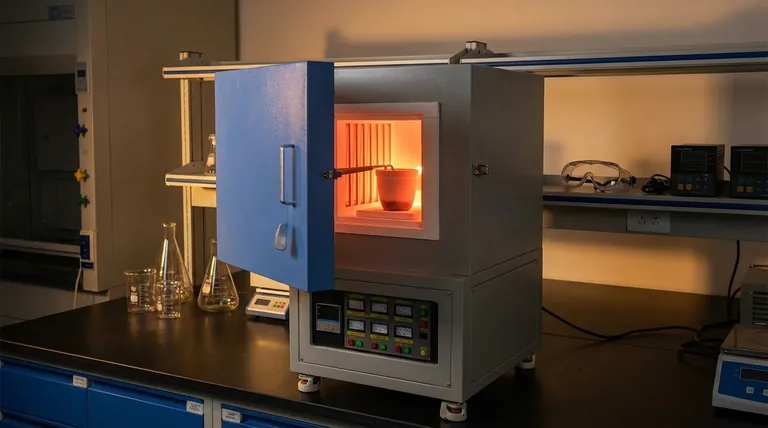
The primary function of an industrial-grade electric furnace in the preparation of phosphate glass (PBG) is to provide a rigorously controlled thermal environment that drives specific chemical and physical transitions. It does not merely melt the material; it executes a multi-stage heating profile designed to purify the raw batch and ensure total chemical homogeneity through convection.
The electric furnace acts as a precision reactor. Its role extends beyond liquefaction to include the critical removal of volatile impurities and the mechanical mixing of components via thermal currents, ensuring the final glass is uniform and defect-free.
The Two-Stage Thermal Processing Strategy
To understand the furnace's function, you must look at the specific temperature profile it executes. The process is distinct from simple heating; it is a staged operation.
Stage 1: Volatile Removal and Purification
The furnace typically targets an initial plateau of 500 °C.
At this specific temperature, the focus is not yet on melting the silica or phosphate network, but on purification.
The heat forces the release of volatile byproducts, specifically ammonia and water, from the raw materials. This "outgassing" phase is vital to prevent bubbles or structural weaknesses in the final glass.
Stage 2: High-Temperature Melting
Once volatiles are removed, the furnace ramps the temperature up to 1000 °C.
The material is held at this peak temperature for a specific duration, typically 60 minutes.
This sustained heat ensures the complete transition of the raw batch from solid to liquid, breaking down the crystalline structures of the ingredients.
Achieving Homogeneity via Convection
The furnace's function encompasses mixing as well as heating.
By maintaining high temperatures, the furnace facilitates thermal convection within the crucible.
These natural currents within the molten fluid physically mix the chemical components, ensuring the additives are distributed evenly throughout the glass matrix.
Critical Process Constraints
While the furnace is a robust tool, the quality of the output depends on adhering to the specific limitations of the process.
The Necessity of the Dwell Time
One cannot simply reach 1000 °C and immediately cool the glass.
The 60-minute hold time is a non-negotiable constraint required to allow thermal convection to do its work.
Shortening this window results in a "cordy" or streaky glass where the chemical composition varies from one millimeter to the next.
Temperature Staging Risks
The ramp rate between 500 °C and 1000 °C must be managed carefully.
If the furnace moves past the 500 °C stage before ammonia and water are fully evacuated, these gases become trapped in the viscous melt.
This leads to permanent inclusions and bubbles that ruin the optical and structural integrity of the PBG.
Making the Right Choice for Your Goal
When configuring your furnace protocols for phosphate glass, your priorities dictate your process control.
- If your primary focus is Optical Clarity: Prioritize the duration and stability of the 500 °C stage to ensure absolute removal of water and ammonia before melting begins.
- If your primary focus is Structural Uniformity: Ensure you strictly adhere to the 60-minute hold at 1000 °C to maximize the effects of thermal convection mixing.
Success in PBG preparation relies on treating the furnace not just as a heater, but as an instrument for precise chemical management.
Summary Table:
| Process Phase | Temperature | Duration | Primary Function |
|---|---|---|---|
| Purification | 500 °C | Until Outgassed | Removal of ammonia and water volatiles |
| Melting | 1000 °C | Transition | Complete liquefaction of the raw batch |
| Homogenization | 1000 °C | 60 Minutes | Mixing via thermal convection currents |
Elevate Your Material Processing with KINTEK
Precise thermal control is the difference between defective glass and a high-performance phosphate matrix. KINTEK provides the advanced heating technology required for rigorous PBG manufacturing.
Backed by expert R&D and manufacturing, KINTEK offers a comprehensive range of Muffle, Tube, Rotary, Vacuum, and CVD systems. Our lab high-temp furnaces are fully customizable to meet your unique dwell time and temperature staging needs.
Ready to optimize your glass melting protocols? Contact us today to find your custom furnace solution!
References
- Ragab Mahani, Ahlam M. Fathi. Electrical, optical, and electrochemical performances of phosphate-glasses-doped with ZnO and CuO and their composite with polyaniline. DOI: 10.1038/s41598-023-51065-5
This article is also based on technical information from Kintek Furnace Knowledge Base .
Related Products
- Vacuum Induction Melting Furnace
- Spark Plasma Sintering SPS Furnace
- Electric Rotary Kiln Pyrolysis Furnace Plant Machine Small Rotary Kiln Calciner
- Electric Rotary Kiln Continuous Working Small Rotary Furnace Kiln for Pyrolysis Plant Heating
- 2200 ℃ Graphite Vacuum Heat Treat Furnace
People Also Ask
- What are the core functions of the High Vacuum Induction Melting (VIM) furnace? Optimize DD5 Superalloy Purification
- Why is a Vacuum Induction Melting furnace (VIM) used for Cu-Zn-Al-Sn alloys? Achieve Precision Composition Control
- What are the advantages of using a VIM furnace to control residual oxygen pressure? Achieve Superior Metal Uniformity
- What are the technical advantages of using a Vacuum Induction Melting furnace in the development of advanced packaging steel?
- What is the role of VIM and directional solidification in aero-engine blade substrates? Engineering Extreme Durability








