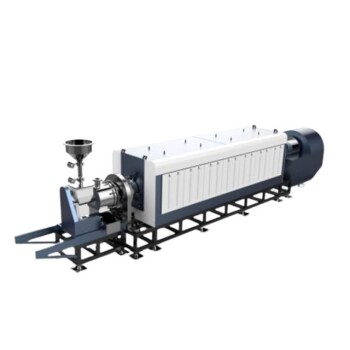
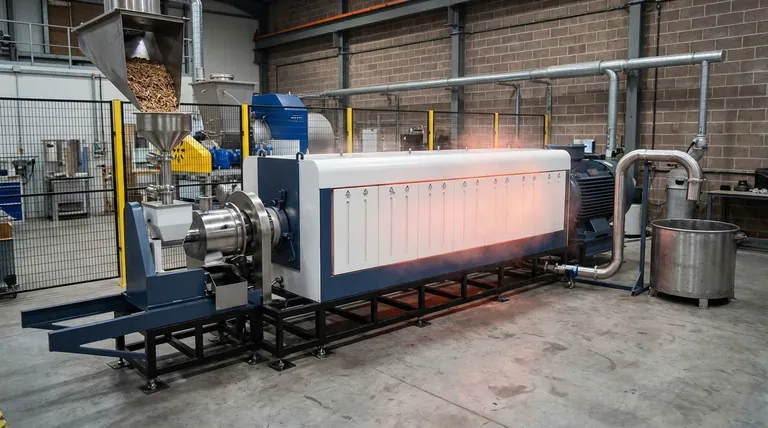
An electric heating industrial furnace serves as the precision reactor responsible for driving the thermochemical decomposition of biomass. Unlike open burning, this equipment creates a strictly controlled, oxygen-free environment that allows raw material—such as spruce or birch wood chips—to be converted into high-quality primary biochar rather than ash.
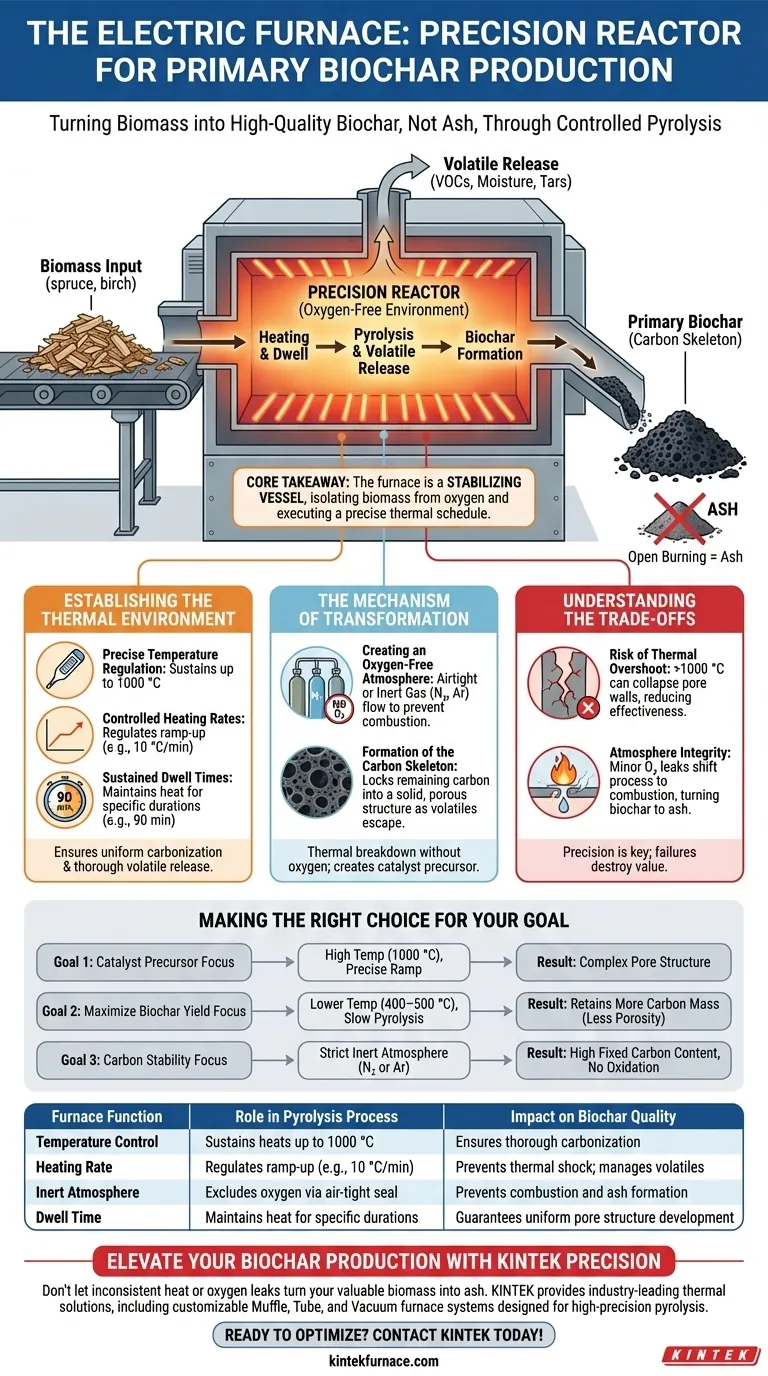
Core Takeaway The furnace functions not just as a heat source, but as a stabilizing vessel that isolates biomass from oxygen while executing a precise thermal schedule. By maintaining specific heating rates and dwell times (e.g., 1000 °C for 90 minutes), it ensures the thorough release of volatiles to leave behind a stable, porous carbonaceous skeleton.
Establishing the Thermal Environment
Precise Temperature Regulation
The primary role of the furnace is to reach and sustain high temperatures with exacting stability. For primary biochar production, the furnace must often maintain temperatures as high as 1000 °C.
Controlled Heating Rates
Success depends on how the target temperature is reached, not just the final heat level. The furnace regulates the ramp-up speed, such as a rate of 10 °C/min. This controlled acceleration prevents thermal shock and manages the predictable release of volatile components.
Sustained Dwell Times
Once the target temperature is achieved, the furnace maintains it for a set duration, typically around 90 minutes for specific wood chips. This "holding time" ensures the thermal energy penetrates the biomass completely, guaranteeing uniform carbonization throughout the material.
The Mechanism of Transformation
Creating an Oxygen-Free Atmosphere
The furnace is designed to be air-tight or to facilitate the flow of inert gases like nitrogen or argon. By excluding oxygen, the furnace prevents the biomass from combusting (burning away). Instead, it forces the material to undergo pyrolysis, where chemical bonds break down thermally rather than oxidatively.
Volatile Component Release
Under these high-temperature conditions, the furnace drives out non-carbon elements. It facilitates the removal of volatile organic compounds, moisture, and tars from the biomass matrix.
Formation of the Carbon Skeleton
As volatiles escape, the furnace locks the remaining carbon into a solid structure. This process results in a "carbonaceous catalyst precursor"—a material with a specific, preliminary pore structure that serves as the physical foundation for any future activation or filtration applications.
Understanding the Trade-offs
The Risk of Thermal Overshoot
While high temperatures (1000 °C) create a highly developed carbon structure, excessive heat or uncontrolled spikes can collapse the pore walls. This destroys the surface area intended for catalytic or adsorption activities, rendering the biochar less effective.
Atmosphere Integrity
The most common failure point is a breach in the furnace's sealed environment. Even a minor leak of oxygen during the high-heat phase will instantly shift the process from pyrolysis to combustion, turning valuable biochar into useless ash and significantly reducing yield.
Making the Right Choice for Your Goal
To select the correct furnace parameters for your specific biomass application, consider your end-goal requirements:
- If your primary focus is creating a catalyst precursor: Prioritize a furnace capable of higher temperatures (1000 °C) and precise ramp rates to develop a complex pore structure.
- If your primary focus is maximizing biochar yield: Utilize lower temperature settings (400–500 °C) to facilitate slow pyrolysis, which retains more carbon mass but develops less porosity.
- If your primary focus is carbon stability: Ensure the furnace can maintain a strict inert atmosphere (nitrogen or argon) to prevent oxidation and ensure the fixed carbon content is high.
Ultimately, the electric heating furnace acts as the gatekeeper of quality, determining whether your biomass becomes a high-value industrial material or simple waste ash.
Summary Table:
| Furnace Function | Role in Pyrolysis Process | Impact on Biochar Quality |
|---|---|---|
| Temperature Control | Sustains heats up to 1000 °C | Ensures thorough carbonization |
| Heating Rate | Regulates ramp-up (e.g., 10 °C/min) | Prevents thermal shock; manages volatiles |
| Inert Atmosphere | Excludes oxygen via air-tight seal | Prevents combustion and ash formation |
| Dwell Time | Maintains heat for specific durations | Guarantees uniform pore structure development |
Elevate Your Biochar Production with KINTEK Precision
Don't let inconsistent heat or oxygen leaks turn your valuable biomass into ash. KINTEK provides industry-leading thermal solutions, including customizable Muffle, Tube, and Vacuum furnace systems specifically designed for high-precision pyrolysis.
Backed by expert R&D and manufacturing, our systems offer the exact temperature regulation and atmosphere control needed to develop stable, porous carbon skeletons for any research or industrial application.
Ready to optimize your carbonization process? Contact KINTEK today to discuss your unique needs!
Visual Guide
References
- Roger Khalil, Øyvind Skreiberg. Catalytic Methane Decomposition for the Simultaneous Production of Hydrogen and Low-Reactivity Biocarbon for the Metallurgic Industry. DOI: 10.3390/en18030558
This article is also based on technical information from Kintek Furnace Knowledge Base .
Related Products
- Electric Rotary Kiln Small Rotary Furnace Biomass Pyrolysis Plant Rotating Furnace
- Electric Rotary Kiln Continuous Working Small Rotary Furnace Kiln for Pyrolysis Plant Heating
- Electric Rotary Kiln Pyrolysis Furnace Plant Machine Small Rotary Kiln Calciner
- Electric Rotary Kiln Small Rotary Furnace for Activated Carbon Regeneration
- Spark Plasma Sintering SPS Furnace
People Also Ask
- What are the key components of a rotary kiln electric furnace? Unlock Efficient Thermal Processing
- What are the main applications of a rotary kiln electric furnace? Achieve Uniform Heat Treatment for Powders
- What is the significance of the refractory lining in a rotary kiln electric furnace? Unlock Efficiency and Longevity
- What is the benefit of adjustable speed control in rotary kilns? Optimize Efficiency and Quality
- What are the two main types of rotary kilns based on heating method? Choose the Right One for Your Process