
A stable thermal environment is the critical factor governing the final quality of metal oxide thin films. In a Muffle Furnace, precise temperature control ensures that the chemical decomposition of the precursor solution and its subsequent crystallization occur uniformly across the entire substrate. This uniformity is the prerequisite for establishing consistent film thickness and a homogeneous morphology.
Uniform heating is essential for preventing structural defects in materials like ZnO or TiO2. By strictly regulating the thermal profile, you minimize carrier recombination and maximize optical performance, which is vital for efficient solar energy applications.
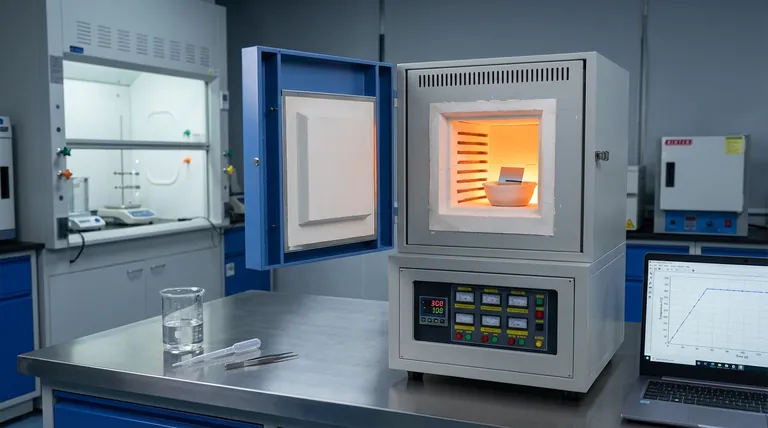
The Mechanics of Crystallization
Uniform Chemical Decomposition
The process begins with the breakdown of the precursor solution. A stable thermal environment ensures that this chemical decomposition happens at an identical rate across the entire surface area.
Without this stability, localized temperature variations cause uneven reaction rates. This leads to chemical inconsistencies that persist into the final layer.
Consistent Film Morphology
Following decomposition, the material begins to crystallize. Uniformity is essential here to achieve a consistent film morphology and thickness.
If the temperature fluctuates, crystal growth becomes erratic. Stable heat promotes a smooth, continuous structure rather than a rough or uneven surface.
Impact on Device Performance
Preventing Structural Defects
For metal oxides intended for electronic use, the internal structure is just as important as the surface. Precise temperature regulation prevents the formation of structural defects within the crystal lattice.
These defects are detrimental because they interrupt the orderly arrangement of atoms. In a semiconductor, these interruptions can severely degrade performance.
Optimizing for Solar Energy
In applications involving Zinc Oxide (ZnO) or Titanium Dioxide (TiO2), defects act as traps for charge carriers. This leads to carrier recombination, where energy is lost rather than converted.
By maintaining a stable environment, you reduce these recombination centers. This directly improves the optical performance and efficiency of solar energy devices.
Understanding the Trade-offs
Precision vs. Processing Speed
Achieving absolute thermal stability often requires a slower, more measured approach to heating. The trade-off is typically between throughput and quality.
Thermal Gradients
Rapid heating or cooling can introduce thermal gradients within the Muffle Furnace. While the average temperature may be correct, the disparity between the center and the edges of the substrate can lead to mechanical stress or cracking in the film.
Making the Right Choice for Your Goal
To maximize the utility of your Muffle Furnace for thin film fabrication, align your thermal strategy with your end application:
- If your primary focus is high-efficiency photovoltaics: Prioritize strict temperature regulation to eliminate lattice defects and minimize carrier recombination.
- If your primary focus is structural uniformity: Ensure the furnace maintains a consistent holding temperature to guarantee even film thickness across the substrate.
Mastering the thermal environment is the single most effective step to transition from a raw precursor to a high-performance electronic component.
Summary Table:
| Factor | Impact on Thin Film | Result of Instability |
|---|---|---|
| Chemical Decomposition | Uniform precursor breakdown | Chemical inconsistencies and uneven layers |
| Film Morphology | Consistent thickness and smooth structure | Erratic crystal growth and surface roughness |
| Lattice Structure | Minimized structural defects | Increased carrier recombination and energy loss |
| Optical Performance | Optimized solar energy efficiency | Degraded semiconductor and device performance |
Elevate Your Material Research with KINTEK
Achieving the perfect crystalline structure requires more than just heat—it requires absolute thermal stability. Backed by expert R&D and world-class manufacturing, KINTEK offers high-precision Muffle, Tube, Rotary, Vacuum, and CVD systems designed to eliminate thermal gradients and prevent structural defects. Whether you are optimizing ZnO for photovoltaics or developing advanced semiconductors, our lab high-temp furnaces are fully customizable to meet your unique research needs.
Ready to achieve superior film uniformity and maximize device efficiency? Contact KINTEK today for a customized solution!
Visual Guide

References
- Seyyedeh Sedigheh Azad, Iraj Mohammadpoor‐Baltork. Stability enhancement of perovskite solar cells using multifunctional inorganic materials with UV protective, self cleaning, and high wear resistance properties. DOI: 10.1038/s41598-024-57133-8
This article is also based on technical information from Kintek Furnace Knowledge Base .
Related Products
- 1400℃ Muffle Oven Furnace for Laboratory
- 1700℃ High Temperature Muffle Oven Furnace for Laboratory
- 1800℃ High Temperature Muffle Oven Furnace for Laboratory
- 1200℃ Muffle Oven Furnace for Laboratory
- High Temperature Muffle Oven Furnace for Laboratory Debinding and Pre Sintering
People Also Ask
- What is the primary function of a high-temperature laboratory muffle furnace in chemical synthesis? Achieve Precision.
- How does a high-temperature laboratory muffle furnace affect material properties? Transform Anodic Oxide Films Fast
- What is the role of a laboratory high-temperature muffle furnace in H13 steel treatment? Optimize Tool Performance
- How is a laboratory high-temperature muffle furnace utilized to achieve the specific crystalline structure of LaFeO3 catalysts?
- How does a muffle furnace facilitate Ag/ATP catalyst preparation? Optimize Calcination for Superior Performance



















