
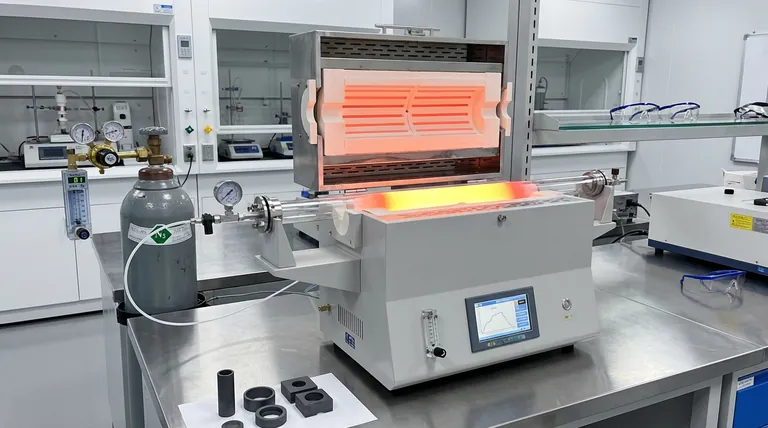
A high-temperature laboratory furnace facilitates Pressureless Sintering (PLS) by creating a precise thermal and chemical environment that drives densification without the need for external mechanical force.
Specifically, the furnace enables liquid-phase sintering by maintaining a nitrogen-rich atmosphere at approximately 0.1 MPa and reaching temperatures up to 1770°C, which triggers the essential phase transformation and grain growth required for high-performance silicon nitride.
The Core Mechanism
The furnace functions not just as a heater, but as a reactor that balances extreme thermal energy with chemical stability. Its primary role is to sustain a stable isothermal environment under nitrogen protection, allowing sintering additives to form a liquid phase that rearranges particles and transforms the material's microstructure from alpha to beta-silicon nitride.
Creating the Conditions for Liquid-Phase Sintering
The fundamental challenge in sintering silicon nitride is that it does not melt; it decomposes. The furnace overcomes this by strictly controlling two variables: temperature and atmosphere.
Precise Thermal Energy Delivery
The furnace provides the high thermal energy required to activate sintering additives (such as yttria or alumina).
By controlling heating rates (e.g., 10°C/min) and stabilizing at temperatures around 1770°C, the furnace allows these additives to melt and form a liquid phase.
This liquid phase wets the silicon nitride particles, acting as a medium for atomic transport.
Suppression of Thermal Decomposition
At these extreme temperatures, silicon nitride is thermodynamically unstable and prone to decomposing into silicon and nitrogen gas.
The furnace mitigates this by maintaining a specific nitrogen pressure of 0.1 MPa.
This positive pressure creates a chemical equilibrium that inhibits decomposition, ensuring the material remains stoichiometric rather than degrading into its constituent elements.
Driving Microstructural Transformation
Once the thermal and atmospheric conditions are set, the furnace facilitates the physical evolution of the ceramic.
Promoting Grain Rearrangement
As the liquid phase forms, capillary forces generated within the furnace's heat zone pull the solid particles closer together.
This leads to significant grain rearrangement, which is the primary driver for densification in a pressureless environment.
This process allows the material to reach high relative densities (often exceeding 97%) without the assistance of mechanical rams or dies.
The Alpha-to-Beta Phase Transformation
The sustained high temperature facilitates a critical "dissolution-precipitation" process.
Unstable alpha-silicon nitride dissolves into the liquid phase and precipitates out as stable beta-silicon nitride.
This transformation is vital because beta-silicon nitride forms an interlaced columnar crystal structure, which gives the final ceramic its high strength and toughness.
Understanding the Trade-offs
While pressureless sintering in a high-temperature furnace is effective, it is important to recognize its limitations compared to other methods like Hot Pressing or Gas Pressure Sintering.
Higher Temperature Requirements
Because PLS relies solely on thermal energy and capillary forces (rather than mechanical pressure) to remove pores, it typically requires higher sintering temperatures.
Hot press furnaces, by contrast, can achieve full density at temperatures 100-200°C lower due to the assistance of mechanical force.
Sensitivity to Atmosphere
The process is highly sensitive to the furnace's ability to maintain a pure nitrogen environment.
Any failure in the inert gas protection system that allows residual oxygen to enter will cause the silicon nitride to oxidize into silica.
This oxidation degrades the chemical stability and mechanical properties of the final component, making precise atmospheric control a non-negotiable feature of the furnace.
Making the Right Choice for Your Goal
Selecting the right furnace parameters depends heavily on your specific manufacturing objectives.
- If your primary focus is complex geometry: Rely on the furnace's pressureless sintering capabilities (0.1 MPa Nitrogen), as this allows you to sinter net-shape parts without the geometric restrictions of a mechanical die.
- If your primary focus is microstructural integrity: Ensure the furnace can maintain a stable isothermal hold (e.g., 120 minutes) at 1770°C to allow sufficient time for the complete alpha-to-beta phase transformation.
- If your primary focus is material purity: Verify the furnace has a robust vacuum or inert gas exchange system to eliminate oxygen before the heating cycle begins, preventing surface oxidation.
Success in pressureless sintering is defined by the furnace's ability to balance high heat with chemical preservation.
Summary Table:
| Feature | Pressureless Sintering (PLS) Requirement | Benefit for Silicon Nitride |
|---|---|---|
| Temperature | Up to 1770°C | Activates sintering additives to form liquid phase |
| Atmosphere | 0.1 MPa Nitrogen | Suppresses thermal decomposition and oxidation |
| Heating Rate | ~10°C/min | Ensures uniform thermal distribution and grain growth |
| Phase Control | Stable Isothermal Hold | Facilitates Alpha-to-Beta microstructural transformation |
| Densification | Capillary Forces | Reaches >97% density without mechanical pressure |
Elevate Your Advanced Ceramics Research with KINTEK
Precision is the difference between a high-performance ceramic and a failed experiment. Backed by expert R&D and world-class manufacturing, KINTEK provides specialized high-temperature furnace solutions—including Muffle, Tube, Rotary, Vacuum, and CVD systems—engineered to handle the rigorous demands of silicon nitride sintering.
Our customizable furnaces ensure stable nitrogen atmospheres and precise thermal profiles, allowing you to achieve superior densification and perfect alpha-to-beta phase transformation every time.
Ready to optimize your material properties? Contact our technical experts today to find the perfect furnace for your laboratory’s unique needs.
References
- You Zhou, Manabu Fukushima. Effects of packing powder on densification and properties of pressureless sintered silicon nitride ceramics. DOI: 10.1111/ijac.70001
This article is also based on technical information from Kintek Furnace Knowledge Base .
Related Products
- 1400℃ High Temperature Laboratory Tube Furnace with Alumina Tube
- 1700℃ High Temperature Laboratory Tube Furnace with Alumina Tube
- 1800℃ High Temperature Muffle Oven Furnace for Laboratory
- 1700℃ High Temperature Muffle Oven Furnace for Laboratory
- 1200℃ Muffle Oven Furnace for Laboratory
People Also Ask
- How does zone-melting in tube furnaces synthesize bismuth micro-wires? Master Single-Crystal Thermoelectric Growth
- How do high-temperature laboratory tube furnaces ensure environmental stability? Precision Thermal Reduction Tips
- How are high-temp tube furnaces used to measure diffusion coefficients per Fick's law? Master Precision Annealing
- How are high-temperature laboratory tube furnaces applied in long-term vacuum homogenization heat treatments for intermetallic samples?
- How are high-temperature tube furnaces applied in testing ceramic-supported alloy membranes? Insights



















