
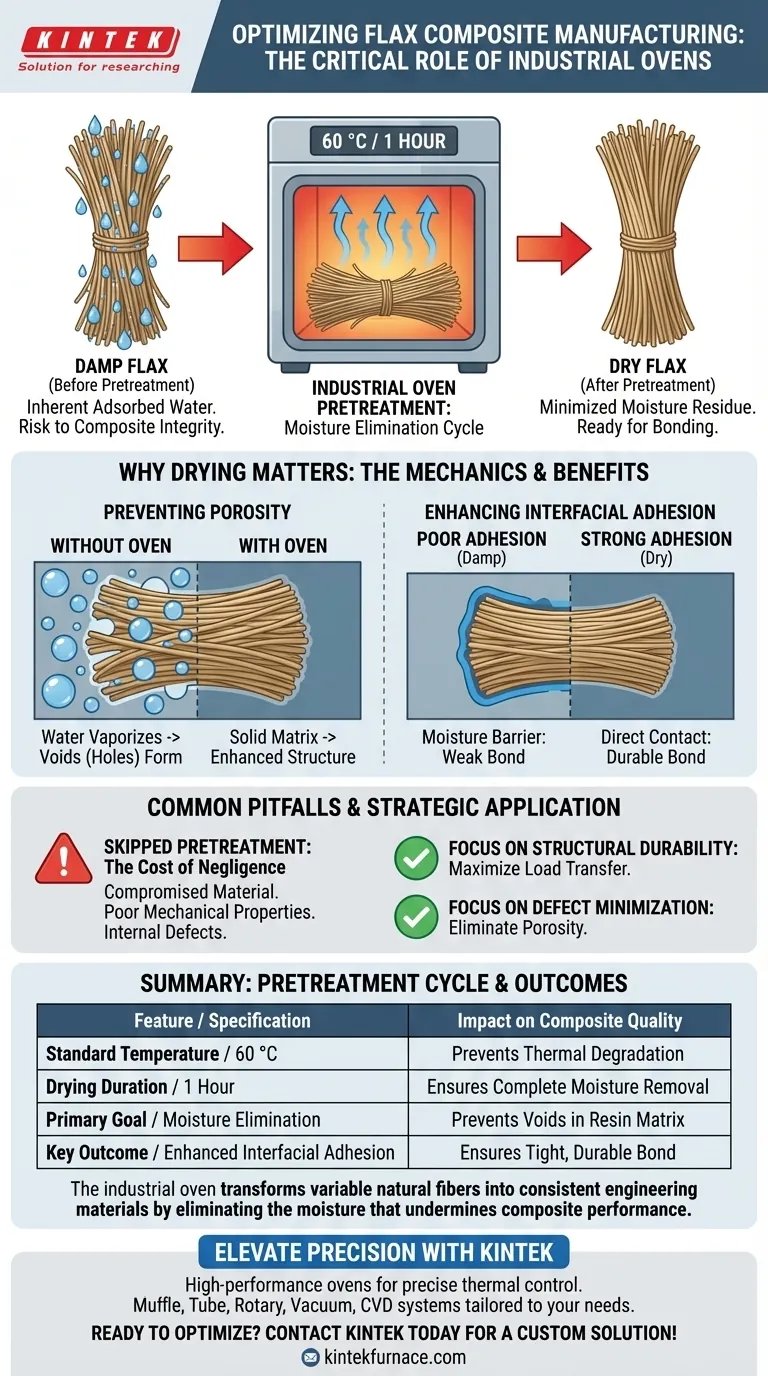
The primary function of an industrial oven in the pretreatment of natural flax fibers is to eliminate moisture content prior to composite processing. This critical drying step, typically executed at 60 °C for one hour, removes adsorbed water from the fibers to ensure the structural integrity of the final material.
Core Takeaway Natural fibers are inherently prone to holding moisture, which is detrimental to composite manufacturing. The industrial oven acts as a necessary safeguard, preventing trapped water from creating structural voids and ensuring the resin bonds securely to the fiber.
The Mechanics of Moisture Removal
To understand the necessity of this equipment, you must look at the physical properties of natural flax. Unlike synthetic fibers, natural fibers actively adsorb water from their environment.
Removing Adsorbed Water
The industrial oven targets adsorbed water—moisture that has adhered to the surface or permeated the structure of the flax.
If this water remains during the manufacturing stage, it becomes a contaminant. The oven ensures that moisture residue is minimized before the fiber ever touches the resin.
The Standard Pretreatment Cycle
According to standard manufacturing protocols, the effective baseline for this process is 60 °C for one hour.
This specific duration and temperature balance the need to thoroughly dry the material without thermally degrading the natural fibers themselves.
Why Dry Fibers Matter for Structural Integrity
The deep need for an industrial oven is not just about "drying"; it is about preventing catastrophic failure modes within the composite material.
Preventing Porosity
The most immediate risk of processing damp fibers is the formation of pores within the resin matrix.
If water is present during the curing process, it often vaporizes or occupies space that should be filled by the resin. This results in voids (holes) inside the material, which significantly weaken the composite.
Enhancing Interfacial Adhesion
For a composite to be strong, the load must transfer effectively from the resin (the matrix) to the fiber (the reinforcement).
Moisture creates a barrier that prevents the resin from wetting the fiber surface. By drying the flax, the oven enhances interfacial adhesion, ensuring a tight, durable bond between the fiber and the resin.
Common Pitfalls to Avoid
While the process seems straightforward, understanding the risks of negligence is vital.
The Cost of Skipped Pretreatment
Attempting to bypass the drying phase to save production time is a fundamental error.
Without the oven treatment, moisture residue is all but guaranteed to compromise the material. The trade-off for saving one hour of oven time is often a finished product with poor mechanical properties and internal defects.
Making the Right Choice for Your Goal
Using an industrial oven for flax pretreatment is a quality control necessity. Here is how to apply this to your manufacturing process:
- If your primary focus is Structural Durability: Adhere strictly to the drying cycle to maximize interfacial adhesion and load transfer capabilities.
- If your primary focus is Defect Minimization: Use the oven to eliminate moisture residue, which is the leading cause of porosity and void formation in the resin matrix.
The industrial oven transforms variable natural fibers into consistent engineering materials by eliminating the moisture that undermines composite performance.
Summary Table:
| Feature | Pretreatment Specification | Impact on Composite Quality |
|---|---|---|
| Standard Temperature | 60 °C | Prevents thermal degradation of natural fibers |
| Drying Duration | 1 Hour | Ensures complete removal of adsorbed water |
| Primary Goal | Moisture Elimination | Prevents voids and pores in the resin matrix |
| Key Outcome | Enhanced Interfacial Adhesion | Ensures a tight, durable bond between fiber and resin |
Elevate Your Composite Manufacturing Precision with KINTEK
Don't let moisture compromise the structural integrity of your natural fiber composites. KINTEK provides high-performance industrial ovens and lab high-temp furnaces designed to deliver the precise thermal control needed for critical pretreatment cycles.
Backed by expert R&D and manufacturing, we offer customizable Muffle, Tube, Rotary, Vacuum, and CVD systems tailored to your unique research or production needs. Ensure consistent material quality and eliminate defects by partnering with the experts in thermal processing.
Ready to optimize your drying process? Contact KINTEK today for a custom solution!
Visual Guide
References
- Veena Phunpeng, Wipada Boransan. Recycled PET Sandwich Cores, Waste-Derived Carbon Additive, and Cure-Rate Control: FTIR/SEM Study of Flexural Performance in Flax Fiber-Reinforced Composites. DOI: 10.3390/fib13100142
This article is also based on technical information from Kintek Furnace Knowledge Base .
Related Products
People Also Ask
- What thermal phenomena occur during polymer binder burnout in ceramic green bodies? Lab Furnace Guide
- Why is controlled heat treatment in a muffle furnace necessary for calcined clay? Achieve Optimal Pozzolanic Activity
- What role does a high-temperature muffle furnace play in STFO synthesis? Achieve Pure Perovskite Results
- How does a high-temperature muffle furnace facilitate the formation of LaNbxAl1−xO3+δ perovskite structures? Key Roles
- What role does a high-temperature muffle furnace play in the formation of biochar catalysts? Master Catalyst Synthesis
