
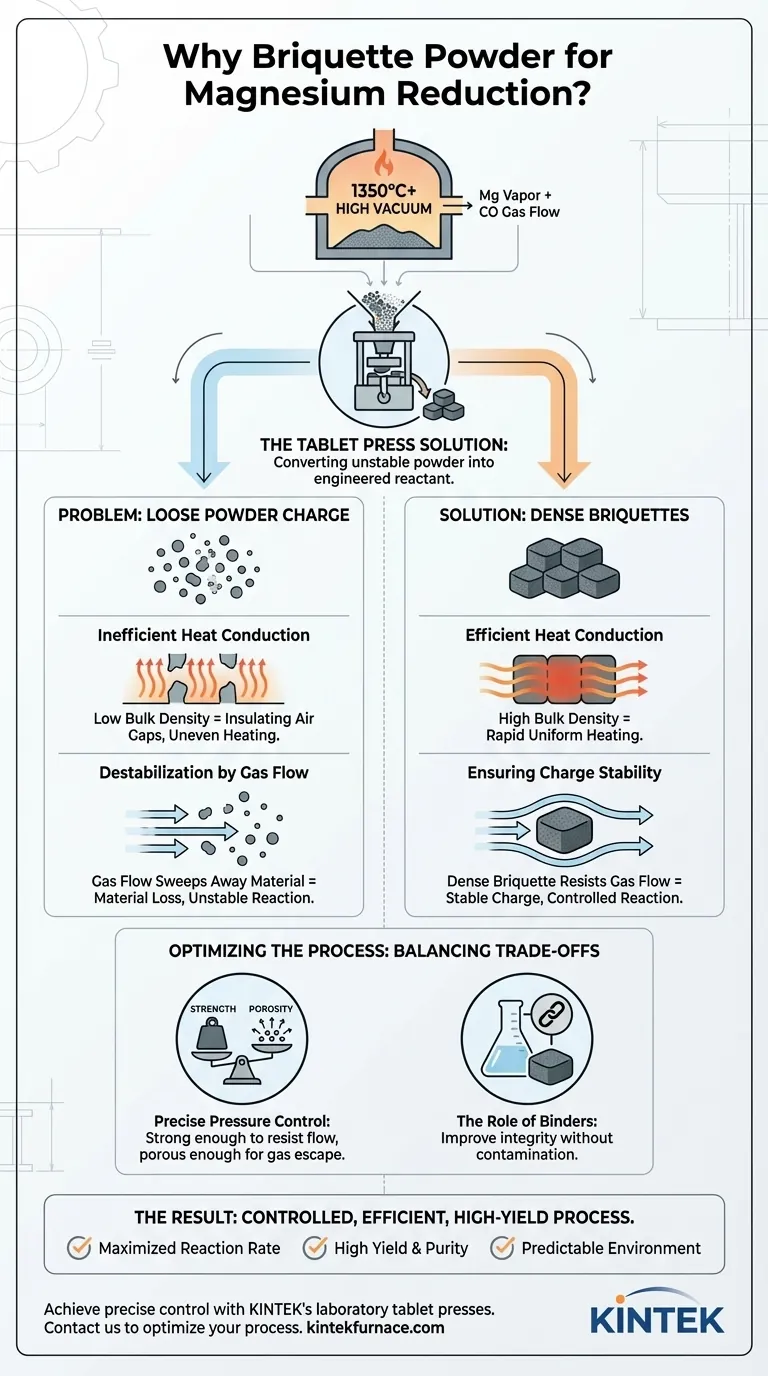
The primary purpose of using a laboratory tablet press is to compact the mixed raw material powder into dense briquettes. This is done for two critical reasons: it dramatically improves heat conduction throughout the furnace charge and, crucially, it prevents the fine powder from being blown away by the intense gas flow generated during the high-temperature vacuum process.
The core challenge in vacuum carbothermic reduction is managing a fine powder in a high-temperature, low-pressure environment. Briquetting transforms this unstable powder into a dense, stable charge, ensuring the reaction is both efficient and controllable.
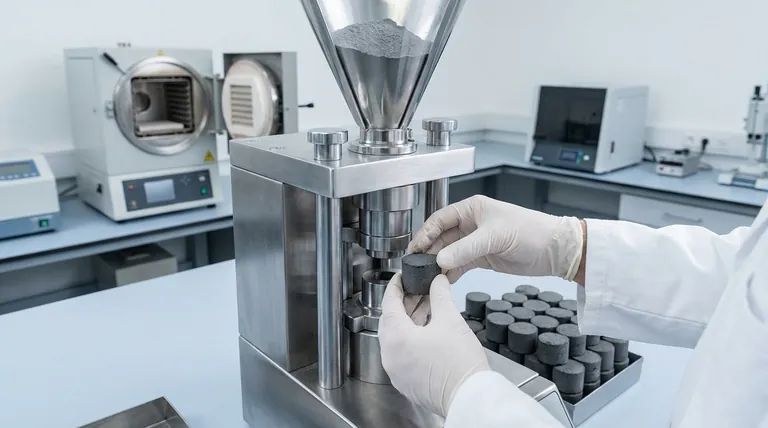
The Problem with a Loose Powder Charge
To understand the need for briquetting, we must first examine the hostile environment inside a vacuum furnace during this process. The furnace creates extreme conditions—temperatures over 1350°C and a high vacuum—that are necessary for the reaction but problematic for a powdered charge.
Destabilization from Gas Flow
The carbothermic reduction of magnesium oxide produces two gaseous products: magnesium vapor and carbon monoxide.
Under high vacuum, these gases expand rapidly and create a powerful stream moving through the furnace. A lightweight, loose powder charge would be easily swept away by this flow, leading to material loss and an unstable reaction.
Inefficient Heat Conduction
A loose powder has a very low bulk density, meaning it contains a significant amount of empty space between particles.
This trapped space acts as an insulator, severely hindering the transfer of heat from the furnace walls to the core of the charge. This results in uneven heating, incomplete reactions, and overall process inefficiency.
How Briquetting Solves the Core Problems
The use of a laboratory tablet press is a targeted engineering solution to overcome the inherent instability and inefficiency of a powdered charge.
Increasing Bulk Density for Better Heating
Compacting the powder into a solid briquette eliminates most of the insulating air gaps between particles.
This creates a dense, solid mass with excellent particle-to-particle contact, allowing heat to conduct rapidly and uniformly throughout the material. The entire charge reaches the required reaction temperature more quickly and evenly.
Ensuring Charge Stability
The resulting briquettes are dense and heavy enough to resist the force of the escaping magnesium and carbon monoxide vapor stream.
This physical stability ensures the charge remains in place, allowing the reaction to proceed smoothly and predictably without material being lost from the reaction zone.
Understanding the Trade-offs
While essential, the briquetting process itself requires careful control. The goal is not simply to create the densest briquette possible, as this can introduce other problems.
Balancing Strength and Porosity
A briquette must be strong enough to handle loading and resist gas flow, but it also needs sufficient porosity.
If the briquette is too dense and non-porous, it can trap the gaseous products, slowing down their escape and hindering the overall reaction rate. The tablet press allows for precise pressure control to achieve this optimal balance.
The Role of Binders
In some cases, a binder may be mixed with the powder to improve the strength and integrity of the final briquette.
However, the choice of binder is critical. It must not introduce contaminants into the final product and must be able to withstand the extreme temperatures and vacuum without interfering with the primary chemical reaction.
Making the Right Choice for Your Process
Properly preparing your furnace charge is not a preliminary step; it is fundamental to the success of the entire reduction process.
- If your primary focus is maximizing reaction rate and efficiency: Briquetting is non-negotiable, as it provides the rapid and uniform heat transfer essential for driving the reaction to completion.
- If your primary focus is achieving high yield and product purity: Briquetting ensures the charge remains stable, preventing material loss and allowing for a controlled, steady reaction environment.
Ultimately, briquetting with a laboratory press converts a simple powder mixture into a structured, engineered reactant, creating the physical conditions necessary for a successful vacuum carbothermic reduction.
Summary Table:
| Challenge with Loose Powder | How Briquetting Solves It |
|---|---|
| Powder blown away by gas flow | Creates dense, stable briquettes |
| Poor heat conduction (insulating air gaps) | Enables rapid, uniform heating |
| Unstable, unpredictable reaction | Provides a controlled reaction environment |
Achieve precise control over your vacuum reduction process with KINTEK's laboratory tablet presses. Our robust and customizable presses are engineered to help you create the ideal briquette density and porosity for maximum reaction efficiency and yield. Backed by expert R&D and manufacturing, KINTEK offers a full range of lab equipment, including Muffle, Tube, Rotary, and Vacuum Furnaces, all tailored to your unique needs. Contact us today to discuss how we can optimize your material preparation and reaction processes.
Contact our experts to optimize your process
Visual Guide
Related Products
- High Temperature Muffle Oven Furnace for Laboratory Debinding and Pre Sintering
- Vacuum Hot Press Furnace Machine for Lamination and Heating
- Vacuum Hot Press Furnace Machine Heated Vacuum Press
- Vacuum Hot Press Furnace Machine Heated Vacuum Press Tube Furnace
- High Pressure Laboratory Vacuum Tube Furnace
People Also Ask
- What thermal phenomena occur during polymer binder burnout in ceramic green bodies? Lab Furnace Guide
- Why is controlled heat treatment in a muffle furnace necessary for calcined clay? Achieve Optimal Pozzolanic Activity
- What role does a high-temperature muffle furnace play in STFO synthesis? Achieve Pure Perovskite Results
- How does a high-temperature muffle furnace facilitate the formation of LaNbxAl1−xO3+δ perovskite structures? Key Roles
- What role does a high-temperature muffle furnace play in the multi-stage synthesis of Li0.5MnFe1.5O4? Key to Pure Spinel



















