
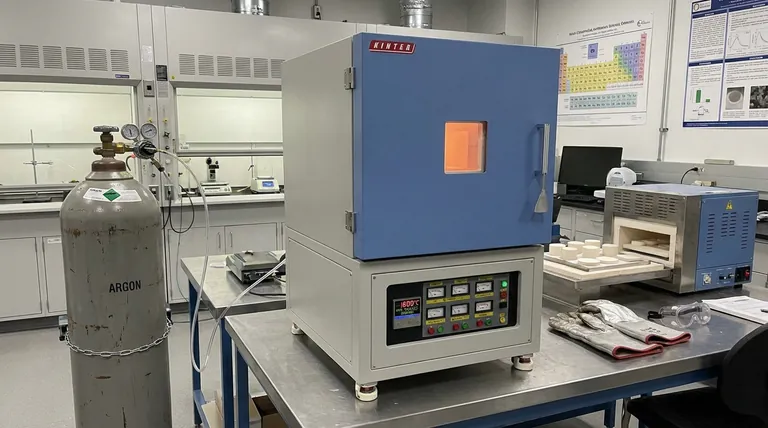
The high-power graphite resistance furnace serves as the catalyst for critical phase transformation. It provides the stable, argon-shielded 1800°C environment necessary to convert amorphous silicon oxycarbide (SiOC) into crystalline $\beta$-SiC. Beyond heat generation, this equipment establishes the microstructural foundation required for successful composite manufacturing.
The furnace performs a dual critical function: it thermally drives the crystallization of the ceramic matrix while simultaneously engineering the material's porosity to maximize the efficiency of subsequent liquid silicon impregnation.
Driving Phase Transformation
Reaching the Critical Thermal Threshold
The primary role of the furnace is to achieve and maintain an extreme temperature of 1800°C. This is not merely about heating; it is about reaching the specific activation energy required for material evolution.
At this temperature, the material undergoes a fundamental transition. The amorphous SiOC precursor is forced into a structured, crystalline $\beta$-SiC phase.
Modifying the Carbon Matrix
The thermal impact extends beyond the silicon components. The 1800°C environment also promotes the partial recrystallization of the carbon matrix.
This simultaneous restructuring of both the silicon and carbon phases ensures the material achieves the necessary thermal and mechanical properties.
Atmospheric Protection
These transformations must occur without material degradation. The furnace utilizes an argon atmosphere to protect the ceramics during treatment.
This prevents oxidation or unwanted chemical reactions that would otherwise compromise the purity of the SiC ceramic at such extreme temperatures.
Optimizing for Subsequent Processing
Controlling the Pressure Environment
A unique feature of the high-power graphite resistance furnace is its ability to maintain a micro-pressure environment.
This controlled pressure is not a byproduct; it is an active process parameter that influences the physical structure of the ceramic.
Enhancing Impregnation Efficiency
The specific combination of high heat and micro-pressure increases the material's micro-porosity.
This increased porosity is a strategic advantage. It opens the material structure, significantly improving the efficiency of the next manufacturing step: liquid silicon impregnation. Without this furnace-induced porosity, the silicon would fail to penetrate the matrix effectively.
Operational Criticalities
The Necessity of Precision
The process relies on precise environmental control. Failing to maintain the 1800°C threshold will result in incomplete crystallization, leaving the material in an unstable amorphous state.
Balancing Structure and Porosity
There is a direct correlation between the furnace environment and the material's final utility.
If the micro-pressure is not maintained correctly, the resulting micro-porosity may be insufficient. This directly leads to poor impregnation performance, compromising the final density and strength of the composite.
Making the Right Choice for Your Goal
To maximize the utility of High-Temperature Treatment (HTP), consider which outcome dictates your process parameters:
- If your primary focus is Phase Purity: Ensure the furnace can consistently hold 1800°C to guarantee the complete transition of SiOC to $\beta$-SiC and carbon recrystallization.
- If your primary focus is Manufacturing Efficiency: Prioritize the stability of the micro-pressure environment to maximize micro-porosity for easier liquid silicon impregnation.
The furnace is not just a heat source; it is the tool that determines the viability of the final SiC composite.
Summary Table:
| Process Parameter | Role in HTP Treatment | Impact on SiC Material |
|---|---|---|
| Temperature (1800°C) | Drives Phase Transformation | Converts amorphous SiOC to crystalline $\beta$-SiC |
| Argon Atmosphere | Provides Oxidation Protection | Prevents degradation and ensures high material purity |
| Micro-pressure | Structural Engineering | Increases micro-porosity for silicon impregnation |
| Graphite Heating | Thermal Stability | Promotes partial recrystallization of the carbon matrix |
Elevate Your SiC Composite Production with KINTEK
Precision at 1800°C is the difference between a failed batch and a high-performance ceramic. KINTEK provides the cutting-edge thermal solutions required for advanced High-Temperature Treatment (HTP). Backed by expert R&D and manufacturing, we offer high-power Muffle, Tube, Rotary, Vacuum, and CVD systems, all customizable for your unique crystallization and impregnation needs.
Whether you are aiming for superior phase purity or optimized micro-porosity, our specialized lab furnaces ensure consistent results for demanding industrial applications. Contact KINTEK today to discuss your custom furnace requirements and let our experts help you optimize your material transformation process.
References
- Marco Pelanconi, Alberto Ortona. High‐strength Si–SiC lattices prepared by powder bed fusion, infiltration‐pyrolysis, and reactive silicon infiltration. DOI: 10.1111/jace.19750
This article is also based on technical information from Kintek Furnace Knowledge Base .
Related Products
- 2200 ℃ Graphite Vacuum Heat Treat Furnace
- 1400℃ Muffle Oven Furnace for Laboratory
- 2200 ℃ Tungsten Vacuum Heat Treat and Sintering Furnace
- 1700℃ High Temperature Laboratory Tube Furnace with Alumina Tube
- 1400℃ High Temperature Laboratory Tube Furnace with Alumina Tube
People Also Ask
- Why are vacuum heat treating furnaces essential for aerospace? Ensure Superior Material Integrity for High-Stakes Applications
- What is the primary application of vacuum heat treating furnaces in aerospace? Enhance Component Performance with Precision
- How does a vacuum heat treating furnace improve the condition of metal alloys? Achieve Superior Metal Performance
- What is the process of vacuum heat treating? Achieve Superior Metallurgical Properties
- How does vacuum heat treating work in terms of temperature and time control? Master Precise Material Transformations



















