
High-temperature calcination is the key to controlling chemical kinetics. Producing dead-burned magnesium oxide in furnaces at 1600°C forces the material to develop a dense and complete crystal structure. This physical transformation significantly lowers the material's chemical reactivity, which is the defining requirement for its use in modification slurries.
By processing magnesium oxide at 1600°C, the crystals achieve a stable, low-reactivity state. This slows the acid-base reaction within the cement, preventing thermal damage to recycled aggregates and ensuring a durable reinforcement coating.
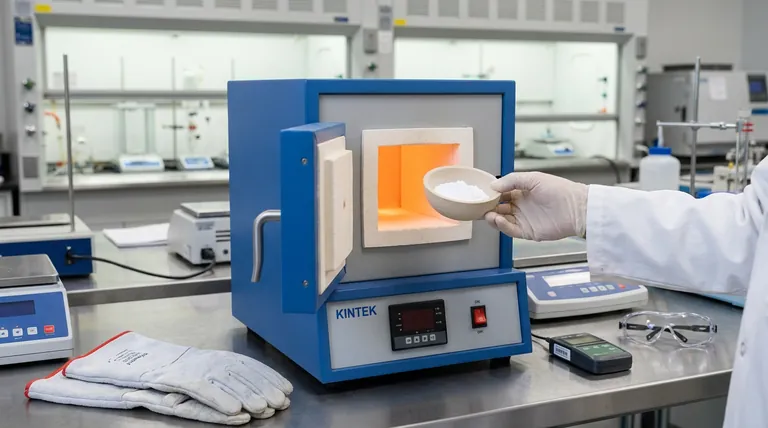
The Physics of Crystal Modification
Achieving Crystal Density
At 1600°C, magnesium oxide undergoes a fundamental structural change. The high thermal energy drives the crystals to coalesce into a highly dense formation.
Reducing Surface Area Availability
This "dead-burned" state results in a complete crystal structure with fewer defects. This dramatically reduces the surface area available for immediate chemical interaction, rendering the material much less reactive than light-burned or medium-burned alternatives.
Controlling the Acid-Base Reaction
Moderating Reaction Rates
In magnesium potassium phosphate cement (MKPC), the magnesium oxide reacts with potassium dihydrogen phosphate. If the magnesium oxide is too reactive, this acid-base reaction occurs violently and instantly.
Extending Operational Time
The low reactivity of the 1600°C dead-burned oxide acts as a natural retarder. It slows the reaction rate down, extending the window of time in which the slurry remains workable and chemically stable.
Protecting the Aggregate Microstructure
Mitigating Exothermic Heat
Rapid acid-base reactions generate significant exothermic heat. By slowing the reaction speed, the 1600°C magnesium oxide prevents sudden temperature spikes that can thermally shock the mixture.
Preserving Recycled Aggregates
Excessive heat can degrade the microstructure of recycled aggregates used in the slurry. By controlling the heat release, the dead-burned oxide prevents this damage, ensuring the aggregates remain sound.
Ensuring Coating Stability
The ultimate goal of the modification slurry is to form a reinforcement coating. Because the reaction is controlled and heat is managed, the resulting coating is more uniform, stable, and effective.
Understanding the Trade-offs
The Risk of Under-Burning
If the furnace temperature drops below 1600°C, the magnesium oxide will not fully densify. This leaves the material too reactive, leading to "flash setting" where the cement hardens too quickly to be used effectively.
Thermal Damage Potential
Using magnesium oxide that has not been dead-burned at sufficient temperatures results in uncontrolled heat generation. This excess heat compromises the bond between the coating and the aggregate, defeating the purpose of the modification.
Making the Right Choice for Your Project
To ensure the integrity of your magnesium potassium phosphate cement, select your raw materials based on the specific performance requirements of your slurry.
- If your primary focus is Workability: Ensure the magnesium oxide is certified as dead-burned at 1600°C to guarantee sufficient operational time before setting.
- If your primary focus is Microstructural Integrity: Prioritize high-temperature calcined oxides to minimize reaction heat and prevent thermal degradation of your recycled aggregates.
Success in MKPC modification relies not just on the ingredients, but on the thermal history of the magnesium oxide itself.
Summary Table:
| Feature | Light-Burned MgO (<1100°C) | Dead-Burned MgO (1600°C) |
|---|---|---|
| Crystal Structure | Porous & Incomplete | Dense & Complete |
| Chemical Reactivity | High / Instantaneous | Low / Controlled |
| Reaction Rate | Flash Setting | Stable & Workable |
| Heat Generation | High Exothermic Spike | Low & Gradual |
| Effect on Aggregates | Thermal Shock Risk | Structural Integrity Preserved |
Elevate Your Material Research with KINTEK Precision
Achieving the exact 1600°C thermal history for dead-burned magnesium oxide requires uncompromising temperature control. KINTEK provides industry-leading Muffle, Tube, and Vacuum furnaces designed for high-temp material synthesis. Backed by expert R&D and precision manufacturing, our systems are fully customizable to meet the rigorous demands of cement modification and advanced material science.
Ready to optimize your calcination process? Contact KINTEK today to discover how our high-temperature solutions can enhance your lab's output.
References
- Siyao Wang, Yuan Gao. Surface treatment with nano-silica and magnesium potassium phosphate cement co-action for enhancing recycled aggregate concrete. DOI: 10.1515/ntrev-2023-0192
This article is also based on technical information from Kintek Furnace Knowledge Base .
Related Products
- Laboratory Muffle Oven Furnace with Bottom Lifting
- Molybdenum Vacuum Heat Treat Furnace
- 1700℃ High Temperature Muffle Oven Furnace for Laboratory
- High Temperature Muffle Oven Furnace for Laboratory Debinding and Pre Sintering
- Magnesium Extraction and Purification Condensing Tube Furnace
People Also Ask
- Why is a high-temperature laboratory muffle furnace essential for the alkali fusion process in zeolite synthesis?
- Why is a high-temperature muffle furnace required for FeOx-MOx/TiO2? Engineering High-Performance Nanocomposites
- What is the importance of the calcination process? Master High-Purity Calcium Phosphate Nanopowder Production
- What function does a muffle furnace perform in Ba0.75Ca0.25TiO3 calcination? Ensure Phase Purity & Synthesis
- What are the primary functions of a high-temperature laboratory muffle furnace in the preparation of biosorbent materials?



















