
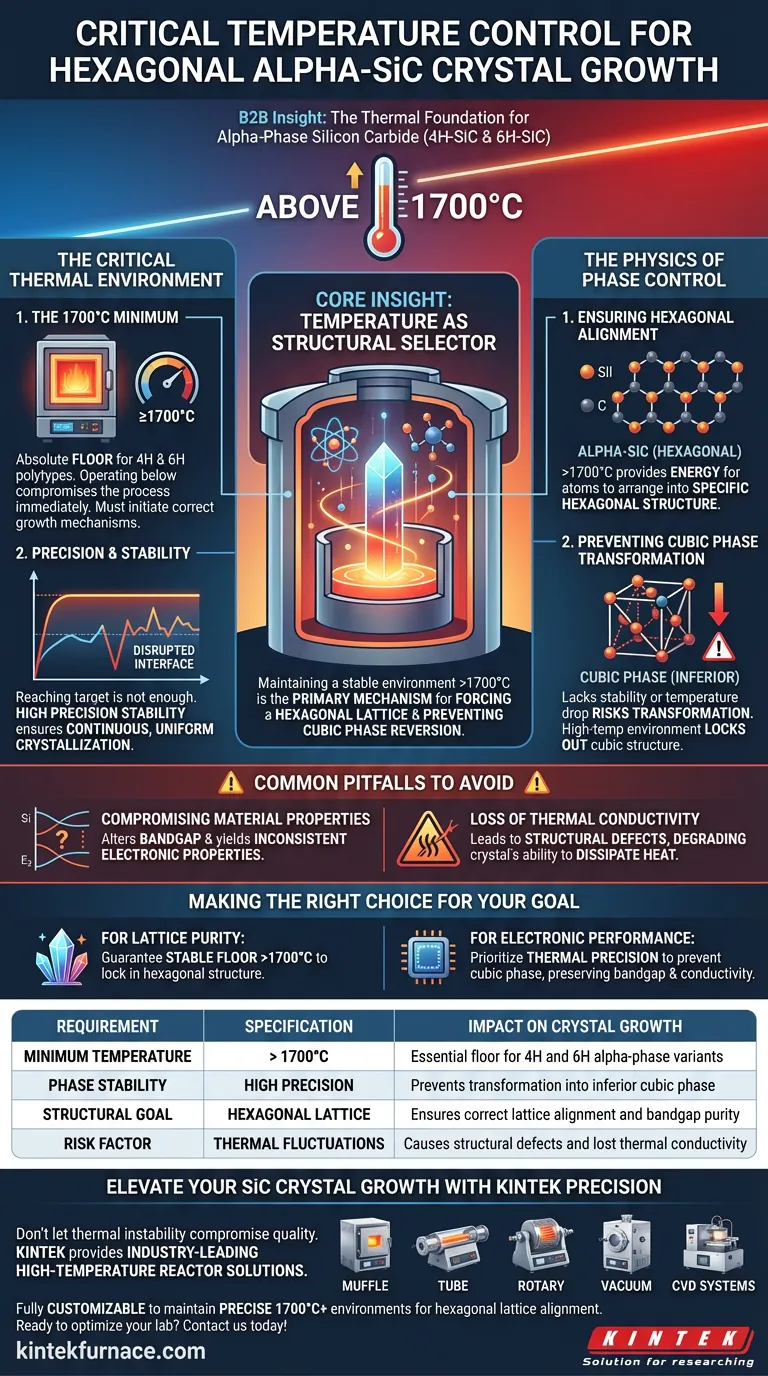
To successfully grow hexagonal alpha-Silicon Carbide (alpha-SiC) crystals, your high-temperature reactor must maintain a precise and stable environment above 1700 degrees Celsius. This thermal threshold is non-negotiable for producing alpha-phase variants, such as 4H-SiC and 6H-SiC.
Core Insight: Temperature in SiC growth is not merely a catalyst; it is a structural selector. Maintaining a stable environment above 1700°C is the primary mechanism for forcing the material into a hexagonal lattice and preventing it from reverting to an inferior cubic phase.
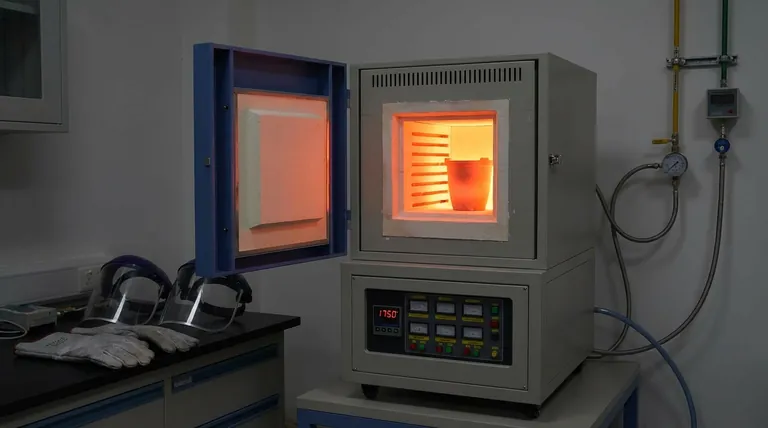
The Critical Thermal Environment
The 1700°C Minimum
For alpha-phase Silicon Carbide, specifically the 4H and 6H polytypes, 1700°C serves as the absolute floor for viable crystal growth.
Operating below this temperature compromises the process immediately. The reactor must be capable of reaching and sustaining temperatures exceeding this figure to initiate the correct growth mechanisms.
Precision and Stability
Reaching the target temperature is not enough; the reactor must maintain it with high precision.
Fluctuations in the thermal environment can disrupt the growth interface. Stability is essential to ensure continuous, uniform crystallization throughout the production cycle.
The Physics of Phase Control
Ensuring Hexagonal Alignment
The primary reason for this high thermal requirement is lattice alignment.
At temperatures above 1700°C, the silicon and carbon atoms possess the energy required to arrange themselves into the specific hexagonal structure that defines alpha-SiC.
Preventing Cubic Phase Transformation
If the temperature drops or lacks stability, the crystal structure is at risk of transforming into the cubic phase.
This phase change is a failure mode for alpha-SiC growth. The high-temperature environment effectively locks out the cubic structure, forcing the crystal to maintain its hexagonal identity.
Common Pitfalls to Avoid
Compromising Material Properties
Failing to maintain the required temperature profile has direct downstream effects on the material's performance.
Specifically, the transformation into the cubic phase alters the bandgap of the material. A reactor that cannot hold >1700°C yields a material with inconsistent electronic properties.
Loss of Thermal Conductivity
Beyond the bandgap, thermal stability is critical for preserving thermal conductivity characteristics.
Inconsistent heating leads to structural defects or mixed phases, which degrade the crystal's ability to dissipate heat—one of the primary advantages of using SiC in the first place.
Making the Right Choice for Your Goal
To ensure your reactor setup meets the necessary criteria for high-quality SiC production, prioritize your system specifications based on the following:
- If your primary focus is Lattice Purity: Ensure your control systems can guarantee a stable floor above 1700°C to lock in the hexagonal structure.
- If your primary focus is Electronic Performance: Prioritize thermal precision to prevent cubic phase transformation, thereby preserving the specific bandgap and thermal conductivity required for your application.
Mastering the thermal environment is the single most critical factor in defining the physical and electronic identity of your Silicon Carbide crystals.
Summary Table:
| Requirement | Specification | Impact on Crystal Growth |
|---|---|---|
| Minimum Temperature | > 1700°C | Essential floor for 4H and 6H alpha-phase variants |
| Phase Stability | High Precision | Prevents transformation into inferior cubic phase |
| Structural Goal | Hexagonal Lattice | Ensures correct lattice alignment and bandgap purity |
| Risk Factor | Thermal Fluctuations | Causes structural defects and lost thermal conductivity |
Elevate Your SiC Crystal Growth with KINTEK Precision
Don't let thermal instability compromise your semiconductor quality. KINTEK provides industry-leading high-temperature reactor solutions specifically engineered for the rigorous demands of alpha-Silicon Carbide production.
Backed by expert R&D and manufacturing, we offer Muffle, Tube, Rotary, Vacuum, and CVD systems—all fully customizable to maintain the precise 1700°C+ environments your hexagonal lattice alignment requires. Whether you are prioritizing lattice purity or electronic performance, our systems ensure the stability needed to lock out cubic phase transformations.
Ready to optimize your lab's high-temp capabilities? Contact us today to discuss your custom furnace needs!
Visual Guide
References
- Qingyuan Yu. Comparative Analysis of Sic and Gan: Third-Generation Semiconductor Materials. DOI: 10.54097/2q3qyj85
This article is also based on technical information from Kintek Furnace Knowledge Base .
Related Products
- 1400℃ Muffle Oven Furnace for Laboratory
- MPCVD Machine System Reactor Bell-jar Resonator for Lab and Diamond Growth
- 1400℃ High Temperature Laboratory Tube Furnace with Alumina Tube
- Cylindrical Resonator MPCVD Machine System for Lab Diamond Growth
- 1700℃ High Temperature Laboratory Tube Furnace with Alumina Tube
People Also Ask
- How does a high-temperature laboratory muffle furnace affect material properties? Transform Anodic Oxide Films Fast
- What is the primary function of a high-temperature laboratory muffle furnace in chemical synthesis? Achieve Precision.
- What role does a muffle furnace play in refractory bricks? Enhance Performance and Durability Testing
- How does a laboratory high-temperature muffle furnace facilitate the homogenization of borosilicate glass samples? Expert Insights
- How does a muffle furnace facilitate Ag/ATP catalyst preparation? Optimize Calcination for Superior Performance















