Knowledge What role does an RTA system play in processing SiN thin films? Unlock High-Performance Quantum & Optical Materials
Author avatar

Tech Team · Kintek Furnace

Updated 1 day ago

What role does an RTA system play in processing SiN thin films? Unlock High-Performance Quantum & Optical Materials


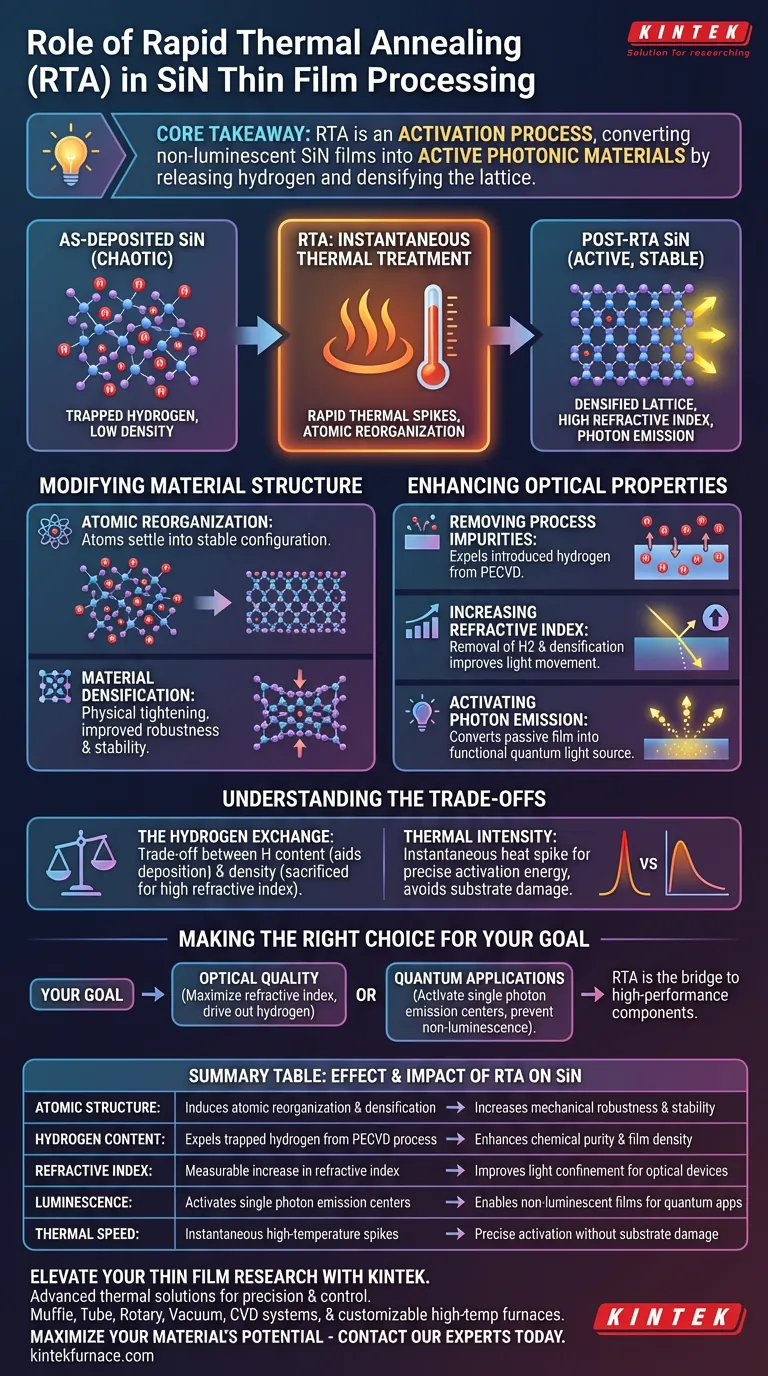
A Rapid Thermal Annealing (RTA) system serves as a decisive post-processing tool that applies high-temperature, instantaneous thermal treatment to Silicon Nitride (SiN) thin films. Its primary function is to transform the "as-deposited" material by driving atomic reorganization and altering the film's chemical composition immediately after deposition.

Core Takeaway: RTA is not merely a hardening step; it is an activation process that converts non-luminescent SiN films into active photonic materials. By releasing trapped hydrogen and densifying the lattice, it stabilizes the film for single photon emission.

What role does an RTA system play in processing SiN thin films? Unlock High-Performance Quantum & Optical Materials

Modifying the Material Structure

Atomic Reorganization

The deposition process often leaves the material in a chaotic or metastable state. RTA uses rapid thermal spikes to induce atomic reorganization, allowing the atoms to settle into a more thermodynamically stable configuration.

Material Densification

As the atomic structure aligns, the film undergoes significant densification. This physical tightening of the lattice is crucial for improving the mechanical robustness and environmental stability of the thin film.

Enhancing Optical Properties

Removing Process Impurities

Films created via Plasma Enhanced Chemical Vapor Deposition (PECVD) inherently contain hydrogen. RTA is essential for breaking the weak bonds of this introduced hydrogen and expelling it from the material.

Increasing Refractive Index

The removal of hydrogen and the subsequent densification directly impact how light moves through the material. This process results in a measurable increase in the refractive index, a key metric for high-performance optical devices.

Activating Photon Emission

For quantum applications, the "as-deposited" film is often non-luminescent. The thermal shock provided by the RTA system activates single photon emission centers, converting the passive film into a functional source of quantum light.

Understanding the Trade-offs

The Hydrogen Exchange

There is a direct trade-off between hydrogen content and film density. While hydrogen aids the initial chemical deposition (PECVD), it must be sacrificed via RTA to achieve the high density and refractive index required for advanced optics.

Thermal Intensity

Unlike gradual furnace annealing, RTA relies on instantaneous heat application. This intensity is required to achieve the specific activation energy for photon centers, but it requires precise control to avoid damaging the underlying substrate.

Making the Right Choice for Your Goal

To maximize the utility of your Silicon Nitride films, consider your specific application requirements:

  • If your primary focus is Optical Quality: Utilize RTA to drive out hydrogen and maximize the refractive index for superior light confinement.
  • If your primary focus is Quantum Applications: You must employ RTA to activate the specific defects required for stable single photon emission, as untreated films will remain non-luminescent.

The RTA process is the bridge between a raw deposited coating and a functional, high-performance optical component.

Summary Table:

Feature Effect of RTA on SiN Thin Films Impact on Performance
Atomic Structure Induces atomic reorganization and densification Increases mechanical robustness and stability
Hydrogen Content Expels trapped hydrogen from PECVD process Enhances chemical purity and film density
Refractive Index Measurable increase in refractive index Improves light confinement for optical devices
Luminescence Activates single photon emission centers Enables non-luminescent films for quantum apps
Thermal Speed Instantaneous high-temperature spikes Precise activation without substrate damage

Elevate Your Thin Film Research with KINTEK

Ready to transform your SiN thin films into high-performance photonic components? KINTEK’s advanced thermal solutions provide the precision and control necessary for critical material activation. Backed by expert R&D and manufacturing, we offer Muffle, Tube, Rotary, Vacuum, and CVD systems, along with customizable high-temperature lab furnaces designed to meet your unique processing requirements.

Maximize your material's potential—contact our experts today to find the perfect RTA or furnace system for your laboratory.

Visual Guide
What role does an RTA system play in processing SiN thin films? Unlock High-Performance Quantum & Optical Materials Visual Guide

References

  1. Zachariah O. Martin, Vladimir M. Shalaev. Single-photon emitters in PECVD-grown silicon nitride films: from material growth to photophysical properties. DOI: 10.1515/nanoph-2024-0506

This article is also based on technical information from Kintek Furnace Knowledge Base .

Related Products

People Also Ask

Related Products

Laboratory Quartz Tube Furnace RTP Heating Tubular Furnace

Laboratory Quartz Tube Furnace RTP Heating Tubular Furnace

KINTEK's RTP Rapid Heating Tube Furnace delivers precise temperature control, rapid heating up to 100°C/sec, and versatile atmosphere options for advanced lab applications.

Slide PECVD Tube Furnace with Liquid Gasifier PECVD Machine

Slide PECVD Tube Furnace with Liquid Gasifier PECVD Machine

KINTEK Slide PECVD Tube Furnace: Precision thin film deposition with RF plasma, rapid thermal cycling, and customizable gas control. Ideal for semiconductors and solar cells.

Inclined Rotary Plasma Enhanced Chemical Deposition PECVD Tube Furnace Machine

Inclined Rotary Plasma Enhanced Chemical Deposition PECVD Tube Furnace Machine

Advanced PECVD Tube Furnace for precise thin film deposition. Uniform heating, RF plasma source, customizable gas control. Ideal for semiconductor research.

Vacuum Heat Treat Sintering Furnace Molybdenum Wire Vacuum Sintering Furnace

Vacuum Heat Treat Sintering Furnace Molybdenum Wire Vacuum Sintering Furnace

KINTEK's Vacuum Molybdenum Wire Sintering Furnace excels in high-temperature, high-vacuum processes for sintering, annealing, and material research. Achieve precise 1700°C heating with uniform results. Custom solutions available.

Controlled Inert Nitrogen Hydrogen Atmosphere Furnace

Controlled Inert Nitrogen Hydrogen Atmosphere Furnace

Discover KINTEK's Hydrogen Atmosphere Furnace for precise sintering & annealing in controlled environments. Up to 1600°C, safety features, customizable.

Custom Made Versatile CVD Tube Furnace Chemical Vapor Deposition CVD Equipment Machine

Custom Made Versatile CVD Tube Furnace Chemical Vapor Deposition CVD Equipment Machine

KINTEK's CVD Tube Furnace offers precision temperature control up to 1600°C, ideal for thin film deposition. Customizable for research and industrial needs.

Spark Plasma Sintering SPS Furnace

Spark Plasma Sintering SPS Furnace

Discover KINTEK's advanced Spark Plasma Sintering (SPS) Furnace for rapid, precise material processing. Customizable solutions for research and production.

1700℃ High Temperature Laboratory Tube Furnace with Quartz or Alumina Tube

1700℃ High Temperature Laboratory Tube Furnace with Quartz or Alumina Tube

KINTEK's Tube Furnace with Alumina Tube: Precision heating up to 1700°C for material synthesis, CVD, and sintering. Compact, customizable, and vacuum-ready. Explore now!

Vertical Laboratory Quartz Tube Furnace Tubular Furnace

Vertical Laboratory Quartz Tube Furnace Tubular Furnace

Precision KINTEK Vertical Tube Furnace: 1800℃ heating, PID control, customizable for labs. Ideal for CVD, crystal growth & materials testing.

1400℃ High Temperature Laboratory Tube Furnace with Quartz and Alumina Tube

1400℃ High Temperature Laboratory Tube Furnace with Quartz and Alumina Tube

KINTEK's Tube Furnace with Alumina Tube: Precision high-temperature processing up to 2000°C for labs. Ideal for material synthesis, CVD, and sintering. Customizable options available.

Mesh Belt Controlled Atmosphere Furnace Inert Nitrogen Atmosphere Furnace

Mesh Belt Controlled Atmosphere Furnace Inert Nitrogen Atmosphere Furnace

KINTEK Mesh Belt Furnace: High-performance controlled atmosphere furnace for sintering, hardening & heat treatment. Customizable, energy-efficient, precise temperature control. Get a quote now!

1400℃ Controlled Inert Nitrogen Atmosphere Furnace

1400℃ Controlled Inert Nitrogen Atmosphere Furnace

KT-14A Controlled Atmosphere Furnace for labs & industry. 1400°C max temp, vacuum sealing, inert gas control. Customizable solutions available.

High Temperature Muffle Oven Furnace for Laboratory Debinding and Pre Sintering

High Temperature Muffle Oven Furnace for Laboratory Debinding and Pre Sintering

KT-MD Debinding & Pre-Sintering Furnace for ceramics - precise temperature control, energy-efficient design, customizable sizes. Boost your lab efficiency today!

RF PECVD System Radio Frequency Plasma Enhanced Chemical Vapor Deposition

RF PECVD System Radio Frequency Plasma Enhanced Chemical Vapor Deposition

KINTEK RF PECVD System: Precision thin-film deposition for semiconductors, optics & MEMS. Automated, low-temperature process with superior film quality. Custom solutions available.

1200℃ Controlled Inert Nitrogen Atmosphere Furnace

1200℃ Controlled Inert Nitrogen Atmosphere Furnace

KINTEK 1200℃ Controlled Atmosphere Furnace: Precision heating with gas control for labs. Ideal for sintering, annealing, and material research. Customizable sizes available.

Laboratory Muffle Oven Furnace with Bottom Lifting

Laboratory Muffle Oven Furnace with Bottom Lifting

Boost lab efficiency with KT-BL Bottom Lifting Furnace: precise 1600℃ control, superior uniformity, and enhanced productivity for material science and R&D.

1700℃ Controlled Inert Nitrogen Atmosphere Furnace

1700℃ Controlled Inert Nitrogen Atmosphere Furnace

KT-17A Controlled Atmosphere Furnace: Precise 1700°C heating with vacuum & gas control. Ideal for sintering, research & material processing. Explore now!

Multi Heating Zones CVD Tube Furnace Machine for Chemical Vapor Deposition Equipment

Multi Heating Zones CVD Tube Furnace Machine for Chemical Vapor Deposition Equipment

KINTEK's Multi-Zone CVD Tube Furnaces offer precision temperature control for advanced thin film deposition. Ideal for research and production, customizable for your lab needs.

Vacuum Heat Treat Furnace with Ceramic Fiber Liner

Vacuum Heat Treat Furnace with Ceramic Fiber Liner

KINTEK's Vacuum Furnace with Ceramic Fiber Lining offers precise high-temperature processing up to 1700°C, ensuring uniform heat distribution and energy efficiency. Ideal for labs and production.

Split Chamber CVD Tube Furnace with Vacuum Station CVD Machine

Split Chamber CVD Tube Furnace with Vacuum Station CVD Machine

Split Chamber CVD Tube Furnace with Vacuum Station - High precision 1200°C lab furnace for advanced materials research. Customizable solutions available.


Leave Your Message