
Conducting a blank control experiment is the only way to distinguish actual oxide growth from environmental artifacts. In high-temperature furnace environments, factors such as gas density changes and mechanical drift create false weight readings that mimic or mask real chemical changes. Running a blank cycle—an experiment without a sample—allows you to quantify and subtract these errors, ensuring that your data reflects only the true oxidation kinetics of your material.
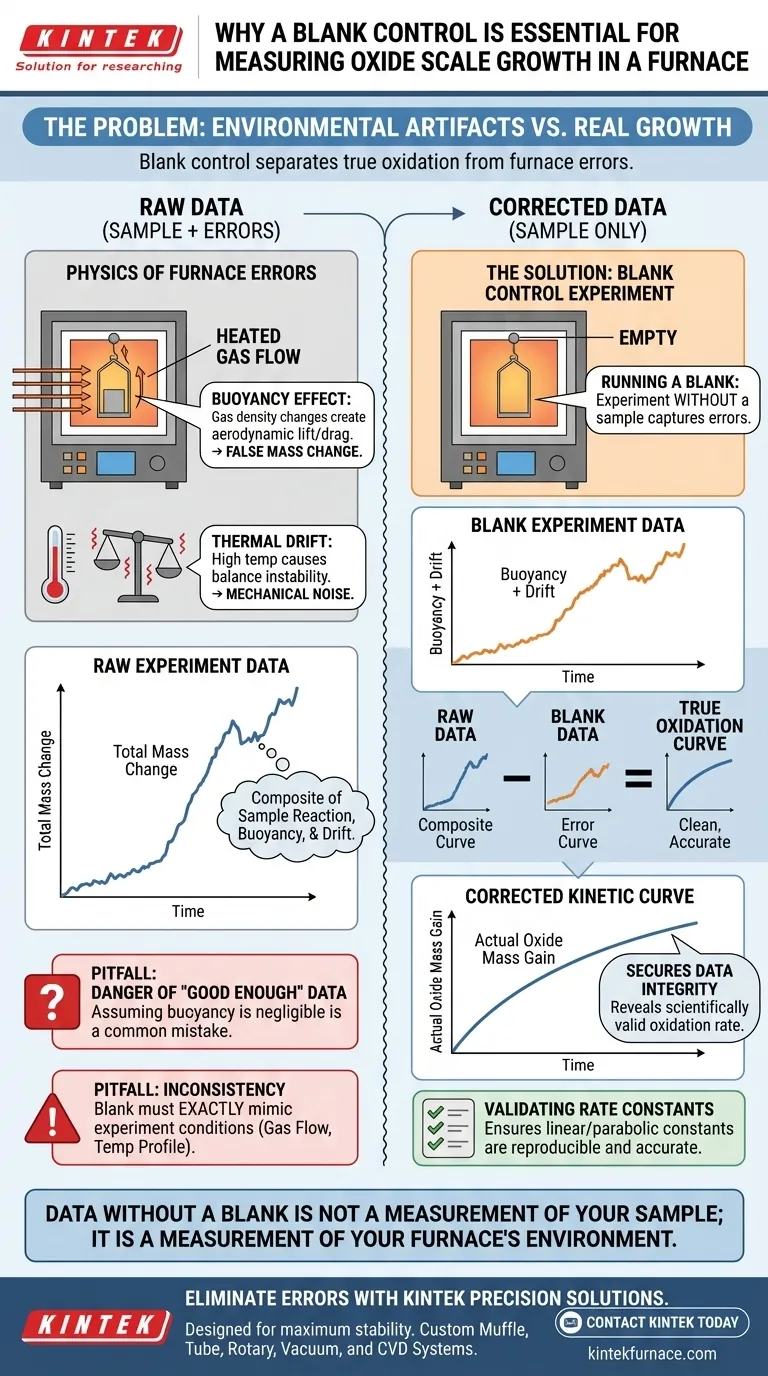
The blank control acts as a critical baseline, filtering out the buoyancy effects of heated gas flow and the thermal drift of the balance to reveal the scientifically valid oxidation rate of the sample.
The Physics of Furnace Measurement Errors
To understand why a blank is necessary, you must first understand the invisible forces acting on your measurement system inside the furnace.
The Buoyancy Effect
When gases are heated, their density changes significantly. As gas flows through the furnace, these density variations create aerodynamic forces—lift or drag—on the sample holder.
This is known as the buoyancy effect. It registers as a mass change on the balance even though no chemical reaction has occurred. Without a blank control, you might mistakenly interpret this lift as a loss or gain in sample mass.
Systemic Temperature Drift
Thermogravimetric balances are highly sensitive instruments. As the furnace temperature ramps up, the balance mechanism itself experiences thermal drift.
This inherent instability in the balance system adds noise to your raw data. A blank experiment captures this specific mechanical behavior so it can be mathematically removed later.
Securing Data Integrity
The ultimate goal of measuring oxide scales is to derive accurate kinetic models. The blank control is the mathematical key to this accuracy.
Retrieving True Oxidation Curves
Raw data from a furnace is a composite of three things: the sample reaction, the buoyancy effect, and the system drift.
By subtracting the blank values (buoyancy + drift) from the raw data, you isolate the true oxidation kinetic curve. This corrected curve represents the actual mass gain of the oxide scale alone.
Validating Rate Constants
Researchers rely on linear and parabolic rate constants to predict how a material will behave over time.
If you calculate these constants using raw data, they will be skewed by the environmental artifacts mentioned above. Correcting with a blank ensures these constants are scientifically valid and reproducible.
Common Pitfalls in Methodology
While the concept of a blank control is simple, failing to execute it correctly can compromise your results.
The Danger of "Good Enough" Data
It is a common mistake to assume that buoyancy effects are negligible in heavy samples. In reality, even small buoyancy errors can significantly distort the slope of a kinetic curve, leading to incorrect conclusions about the oxidation mechanism.
Consistency is Critical
The blank experiment must mimic the actual experiment exactly. You must use the exact same gas flow rates and temperature profiles as your sample run. If the conditions differ, the subtraction will be inaccurate, introducing new errors rather than removing old ones.
Making the Right Choice for Your Goal
To ensure your oxide growth measurements are defensible, apply the following approach to your experimental design.
- If your primary focus is high-precision kinetics: Run a fresh blank control for every distinct temperature profile to account for specific buoyancy behaviors.
- If your primary focus is determining rate constants: Ensure you subtract the blank data from the raw data before calculating any linear or parabolic constants to avoid mathematical distortion.
Data without a blank control is not a measurement of your sample; it is a measurement of your furnace's environment.
Summary Table:
| Factor | Impact on Measurement | How Blank Control Corrects It |
|---|---|---|
| Buoyancy Effect | Gas density changes create false mass gain/loss. | Quantifies aerodynamic lift for mathematical subtraction. |
| Thermal Drift | Temperature fluctuations cause balance instability. | Captures mechanical noise to isolate real chemical changes. |
| Data Accuracy | Raw data includes environmental artifacts. | Filters out systemic errors to reveal true oxidation curves. |
| Rate Constants | Skewed linear/parabolic results. | Validates constants by basing them on corrected kinetic data. |
Eliminate Measurement Errors with KINTEK Precision Solutions
Don't let buoyancy and thermal drift compromise your research integrity. KINTEK provides industry-leading thermal processing equipment designed for maximum stability and scientific precision.
Backed by expert R&D and manufacturing, KINTEK offers Muffle, Tube, Rotary, Vacuum, and CVD systems, along with specialized lab high-temp furnaces—all fully customizable to meet your unique experimental needs. Whether you are measuring oxide growth or developing new materials, our systems provide the controlled environment necessary for defensible data.
Ready to upgrade your lab's performance? Contact KINTEK today to discuss your custom furnace requirements!
Visual Guide
References
- M.S. Archana, S. Ningshen. Initial Stage Oxidation of 304HCu Stainless Steel in Oxygen Environment. DOI: 10.1007/s12666-024-03478-7
This article is also based on technical information from Kintek Furnace Knowledge Base .
Related Products
- High Temperature Muffle Oven Furnace for Laboratory Debinding and Pre Sintering
- 1200℃ Controlled Inert Nitrogen Atmosphere Furnace
- Mesh Belt Controlled Atmosphere Furnace Inert Nitrogen Atmosphere Furnace
- High Pressure Laboratory Vacuum Tube Furnace
- 1200℃ Muffle Oven Furnace for Laboratory
People Also Ask
- What thermal phenomena occur during polymer binder burnout in ceramic green bodies? Lab Furnace Guide
- Why is controlled heat treatment in a muffle furnace necessary for calcined clay? Achieve Optimal Pozzolanic Activity
- What role does a high-temperature muffle furnace play in STFO synthesis? Achieve Pure Perovskite Results
- How does a high-temperature muffle furnace facilitate the formation of LaNbxAl1−xO3+δ perovskite structures? Key Roles
- What role does a high-temperature muffle furnace play in the multi-stage synthesis of Li0.5MnFe1.5O4? Key to Pure Spinel



















