
The adoption of a nitrate salt bath furnace offers a decisive upgrade in both process safety and metallurgical quality over traditional lead baths. Specifically, nitrate salt provides superior thermal conductivity for rapid cooling, utilizes natural buoyancy to prevent wire deformation, and eliminates the severe toxicity and fire hazards associated with lead processing.
Core Insight Shifting to nitrate salt is not merely an environmental compliance decision; it is a process optimization strategy. It solves the critical engineering challenge of balancing rapid, uniform cooling (for sorbitic structure) with the physical protection of the wire and the safety of the workforce.
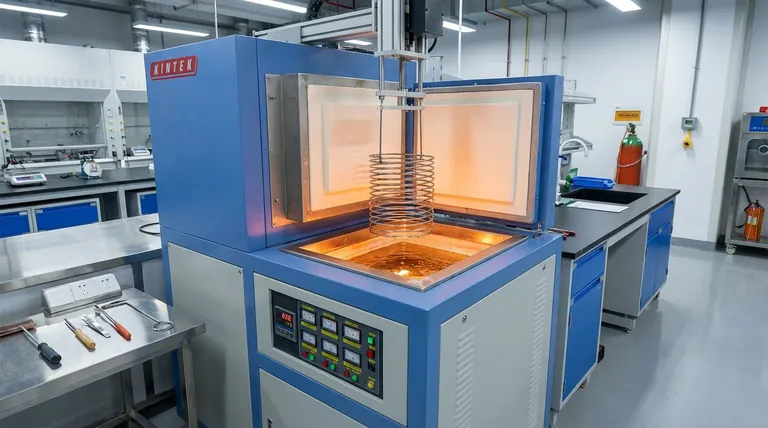
Optimizing Thermal Performance
The primary goal of isothermal quenching is to achieve a specific metallurgical structure. Nitrate salt baths offer distinct physical advantages that directly influence the quality of the sorbitic steel wire.
High Thermal Conductivity
Molten nitrate salt exhibits excellent thermal conductivity. This property is essential for rapidly lowering the temperature of the steel wire to the precise phase transformation point.
Efficient Latent Heat Export
During the phase transformation, steel releases significant latent heat. Nitrate salt effectively absorbs and exports this latent heat, preventing localized overheating that could alter the steel's microstructure.
Superior Thermal Stability
The reference emphasizes the thermal stability of nitrate salt. This ensures that the bath maintains a consistent temperature profile, which is critical for uniform quenching results across the entire length of the wire.
Enhancing Product Integrity
Beyond thermal management, the physical interaction between the quenching medium and the wire affects the final physical dimensions of the product.
Minimizing Wire Deformation
At high temperatures, steel wire is soft and prone to bending or stretching. The natural buoyancy provided by the nitrate salt bath supports the wire, significantly reducing the risk of mechanical deformation during the treatment.
Improving Operational Safety
The most immediate operational difference between nitrate salt and lead lies in the safety profile for both the facility and its personnel.
Eliminating Toxic Contaminants
Traditional lead baths generate hazardous lead dust and smoke. Nitrate salt baths create a safer environment for human health, eliminating heavy metal toxicity risks for operators and reducing the facility's ecological footprint.
Reducing Fire Hazards
Unlike some quenching oils or unstable mixtures, nitrate salt is non-flammable. This inherent chemical stability drastically reduces the risk of industrial fires during the heat treatment process.
Understanding the Operational Trade-offs
While the advantages of nitrate salt are clear, it is important to contextualize the shift away from lead.
The Cost of Legacy Systems
Sticking with traditional lead baths requires accepting a high environmental liability. The trade-off for using the established lead method is the constant management of toxic byproducts and the implementation of expensive containment systems for lead dust and smoke.
Chemical Stability vs. Reactivity
Nitrate salts offer chemical stability, but this implies a controlled environment. While lead is chemically simple, its toxicity is the limiting factor; nitrate salts solve the toxicity issue but require their own specific operational parameters to maintain that stability.
Making the Right Choice for Your Goal
The decision to utilize a nitrate salt bath serves different priorities depending on your operational focus.
- If your primary focus is Metallurgical Precision: Nitrate salt provides the high thermal conductivity and latent heat removal necessary for consistent sorbitic phase transformation.
- If your primary focus is Product Quality: The natural buoyancy of the salt bath minimizes physical deformation, ensuring the wire retains its intended geometry.
- If your primary focus is EHS (Environment, Health, and Safety): Nitrate salt eliminates lead toxicity and fire risks, ensuring compliance with modern safety standards and protecting your workforce.
Switching to nitrate salt transforms the quenching process from a hazardous necessity into a clean, precise, and stable manufacturing step.
Summary Table:
| Feature | Nitrate Salt Bath | Traditional Lead Bath |
|---|---|---|
| Thermal Performance | High conductivity & latent heat export | Moderate conductivity |
| Safety Profile | Non-toxic; Non-flammable | Highly toxic dust & smoke; Fire risk |
| Product Integrity | Natural buoyancy prevents deformation | Higher risk of wire stretching/bending |
| Workplace Health | Safe environment for operators | Severe heavy metal toxicity exposure |
| Thermal Stability | Excellent across entire bath length | Variable stability during transformation |
Revolutionize Your Heat Treatment Process with KINTEK
Transitioning from legacy lead baths to modern nitrate salt bath furnaces is more than an upgrade—it is a commitment to precision, safety, and superior metallurgical results.
Backed by expert R&D and manufacturing, KINTEK offers a comprehensive range of lab high-temp furnaces, including Muffle, Tube, Rotary, Vacuum, and CVD systems, all customizable to your specific industrial needs. Whether you are optimizing for metallurgical precision or modern EHS standards, our systems deliver the thermal stability your research and production demand.
Ready to enhance your lab's efficiency and safety? Contact KINTEK today for a customized consultation
References
- Jun Li, Jieyu Zhang. A Novel Design of a Molten Salt Bath Structure and Its Quenching Effect on Wire Transformation from Austenite to Sorbite. DOI: 10.3390/met14040483
This article is also based on technical information from Kintek Furnace Knowledge Base .
Related Products
- 1700℃ Controlled Inert Nitrogen Atmosphere Furnace
- 1200℃ Controlled Inert Nitrogen Atmosphere Furnace
- Controlled Inert Nitrogen Hydrogen Atmosphere Furnace
- Mesh Belt Controlled Atmosphere Furnace Inert Nitrogen Atmosphere Furnace
- Magnesium Extraction and Purification Condensing Tube Furnace
People Also Ask
- How does real-time dilatometric analysis in a controlled-atmosphere furnace optimize PZT ceramic sintering?
- How do controlled-atmosphere furnaces support polymer pyrolysis? Master SiC & Si3N4 Ceramic Conversion
- Why is thorough binder burnout necessary before sintering advanced ceramics? Ensure Peak Density & Zero Defects
- How does oxygen partial pressure control affect ceramic sintering? Master Defect Chemistry
- Why is controlled-atmosphere heating required for functional ceramics and sensors? Master Defect Engineering





